Who gets GPT-5.6 first matters more than its benchmark score
Sol, Terra, and Luna have appeared, but access is still selective. The preview shows developers how frontier models are being tiered, priced, and controlled.
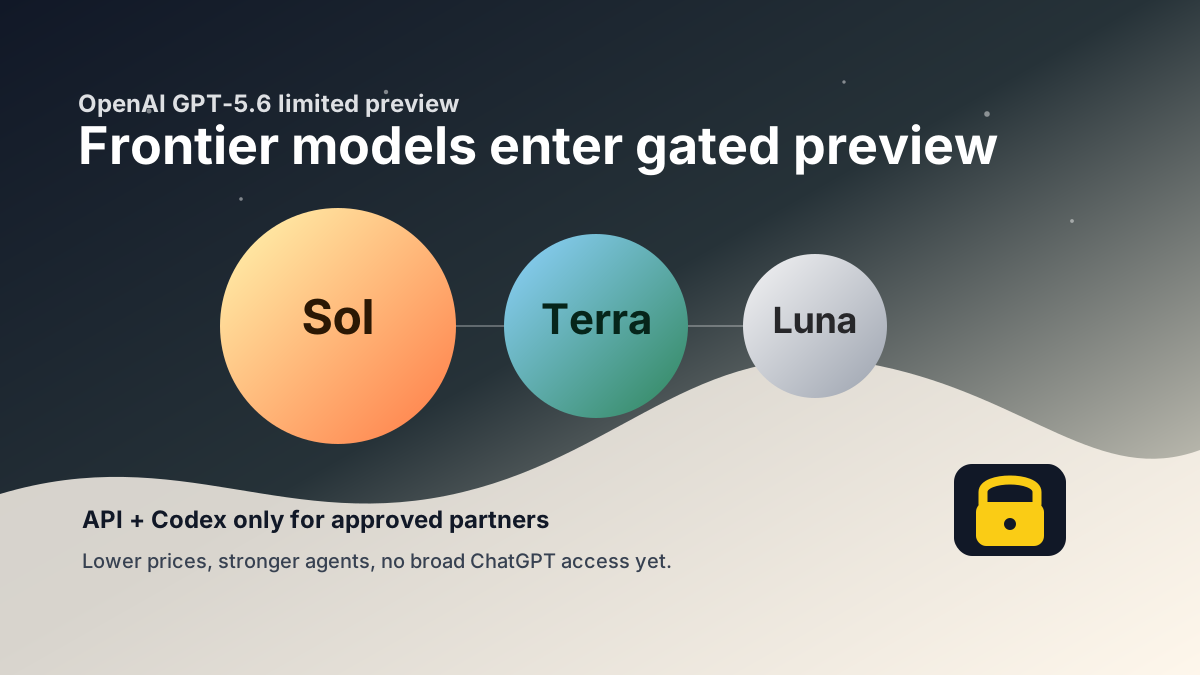
OpenAI announced the GPT-5.6 family on June 26, 2026, but this was not a normal release to every user. The company calls it a limited preview. Sol is the flagship model, Terra is positioned for everyday work, and Luna is the fast, lower-cost tier. Initial access is restricted to selected API and Codex customers.
The prices and access that are confirmed
Official list prices per million tokens are $5 input and $30 output for Sol, $2.50 and $15 for Terra, and $1 and $6 for Luna. GPT-5.6 also introduces explicit cache breakpoints. Cache writes cost 1.25 times the uncached input rate, while cache reads retain a 90% discount.
Those figures describe unit prices, not the cost of finishing a task. An agent may call the model, tools, and validators several times. A cheaper model that needs more retries can still cost more per completed job.
As of July 14, 2026, developers should not assume that every organization can call GPT-5.6. Check actual account access and rate limits before planning a migration, and keep a fallback to an older model or another provider.
Choose by task risk, not model name
- Test Sol on a small traffic slice for complex code changes, long research workflows, or high-risk analysis.
- Compare Terra with your current default on task success rate and total task cost, not only token price.
- Try Luna first for verifiable work such as classification, extraction, and formatting.
OpenAI's software-engineering, biology, and cybersecurity results are vendor evaluations. They do not establish performance on your data or workflow. A migration test should compare success rate, P95 latency, cost per completed task, and recovery after failure on a fixed set of your own tasks.
What to prepare before access expands
The practical signal from this preview is model tiering. Keep model IDs, timeouts, budgets, and fallbacks in configuration rather than business logic. Record the model used for every request. Make the product able to handle safety refusals, longer reasoning, and temporary access limits.
If you do not have preview access, there is no reason to rewrite the application around GPT-5.6 today. Build the evaluation and routing layer first, then place the new models into the same test harness when access arrives.
Sources
Related

OpenAI's GPT-Live is not just a more natural voice. It separates continuous conversation from background reasoning, which is the more consequential change for voice products and agents.

ChatGPT Work can connect apps and files, break down large tasks, and keep working for hours. Its real significance is that AI assistants now need the same permissions, boundaries, and acceptance criteria as coworkers.