Open source is not free: a 2026 TCO guide to self-hosting vs API LLMs in production
The pitch is seductive: self-host an open-source LLM and stop paying per-token API fees. The reality is that a minimal self-hosted deployment can cost $125K–$190K per year, and production-scale deployments can reach millions. Here is a source-checked 2026 guide to the true cost of ownership for open-source vs commercial LLMs: the hidden costs of self-hosting (GPU, ops, inference optimization, downtime), the break-even volume where self-hosting wins, and why most teams should start with API and move to self-hosting only when the math genuinely justifies it.
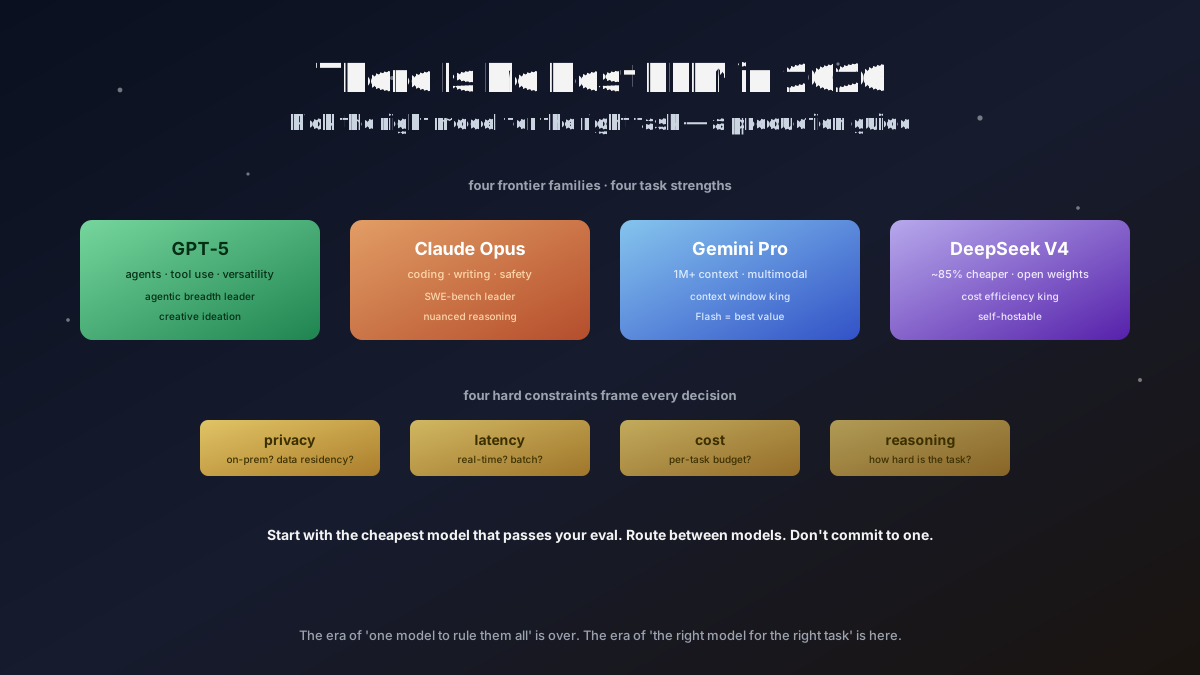
This is the second piece in the LLM model selection cluster, following There is no best LLM in 2026. That piece framed model selection as a portfolio decision across four constraints. This piece deep-dives into the constraint that creates the most confusion: cost — specifically, the false economy of treating 'open source' as 'free.'
My read, after going through the TCO literature, is blunt: the single most expensive mistake teams make in LLM model selection is assuming that self-hosting an open-source model is free because there are no per-token API fees. There are always per-token costs; in self-hosting, they are just hidden inside GPU leases, ops salaries, inference infrastructure, and the downtime you eat when your self-hosted model goes down at 3am and nobody is on call. The teams that get this decision right are the ones who ran the full TCO math — not just the API bill — and chose self-hosting only when their volume justified the fixed cost.
The hidden costs of self-hosting
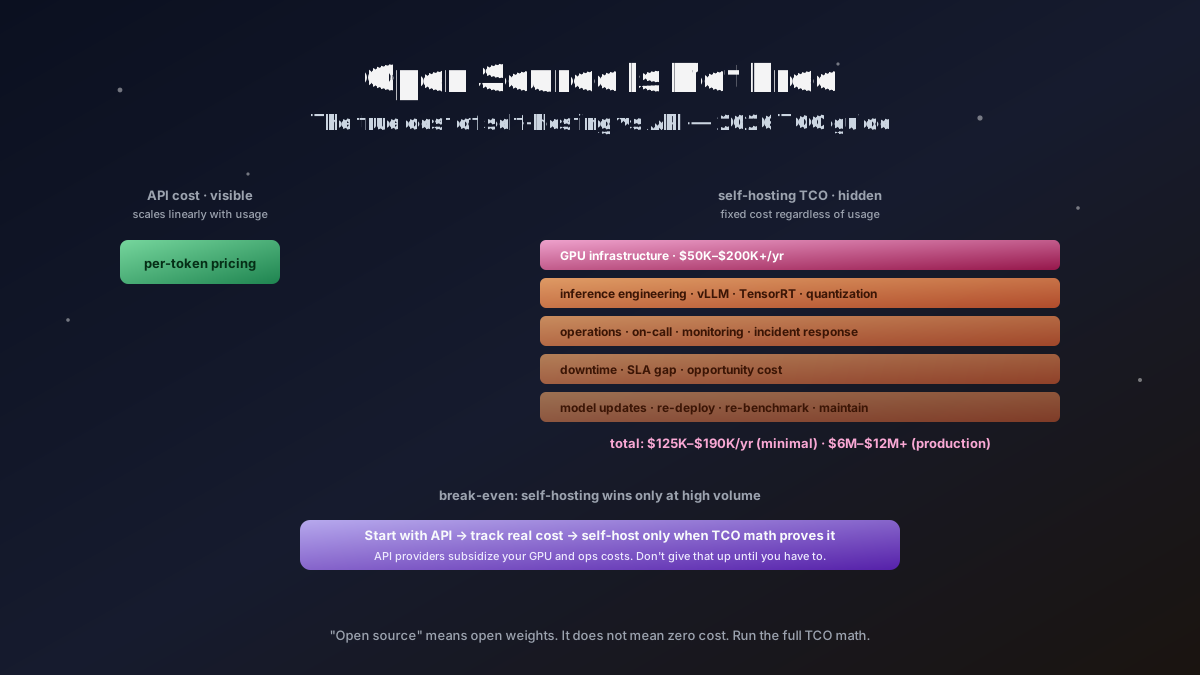
The "costly open-source LLM lie" framing from the practitioner literature is worth taking seriously. A minimal internal self-hosted deployment is estimated at $125K–$190K per year, and production-scale deployments can reach $6M–$12M+. Where does that money go?
-
GPU infrastructure. Frontier-class open models (Llama 4, DeepSeek V4) need serious hardware — multiple H100s or equivalent. Whether you lease cloud GPUs or buy your own, this is the dominant cost line. GPU pricing is volatile and supply-constrained.
-
Inference optimization. Raw model weights are not enough. You need an inference engine (vLLM, TensorRT-LLM, TGI), quantization, batching, and potentially model parallelism across multiple GPUs. This is specialized engineering work that does not come free with the model weights.
-
Operations and reliability. Who keeps the inference server running? Who handles failures, scaling, updates, and security patches? A self-hosted LLM is a production service, and production services need on-call, monitoring, and incident response. This is the cost most teams forget to budget.
-
Downtime and opportunity cost. When your self-hosted model goes down, your product goes down (or falls back to a more expensive API). Commercial API providers offer SLAs; your self-hosted deployment offers whatever your ops team can deliver.
-
Model updates and maintenance. Open-source models get updated. Each update may require re-deployment, re-quantization, re-benchmarking, and potentially re-tuning of your inference pipeline. This is ongoing work, not a one-time setup cost.
When self-hosting actually wins
Self-hosting is not always wrong — it wins when the volume is high enough that the fixed cost of infrastructure is cheaper than the variable cost of API calls. The break-even depends on your usage pattern:
-
High-volume, predictable workloads. If you process millions of tokens per day with predictable patterns, the per-token cost of self-hosting (amortized GPU + ops) can fall below API pricing. This is where the TCO math genuinely favors self-hosting.
-
Data privacy requirements. If regulatory or contractual constraints prohibit sending data to a third-party API, self-hosting is not a cost decision — it is a compliance decision. The TCO is whatever it costs to be compliant.
-
Latency requirements that cloud APIs cannot meet. If you need sub-50ms inference latency for a real-time feature, a locally deployed model may be the only option that meets your SLA.
-
Customization and fine-tuning. If you need deep fine-tuning or custom architectures that API providers do not support, self-hosting gives you control that APIs cannot match.
The honest framing: self-hosting wins at scale, under constraints, or with customization needs. For most teams at most volumes, the API is cheaper once you account for the full TCO — because the API provider is amortizing the GPU and ops costs across thousands of customers, and you are not.
The decision framework I would use
- Start with the API. Use commercial APIs (or free-tier open models via API) until you have real production volume data. Do not self-host on speculation.
- Track your real per-task cost. Use per-task cost observability to know exactly what you spend on API calls today.
- Calculate the self-hosting TCO honestly. Include GPU, inference engineering, ops, downtime risk, and model maintenance. Do not just compare GPU cost to API cost.
- Find the break-even volume. At what token volume does the self-hosting TCO fall below the API cost? If your current volume is well below that, stay on the API.
- Re-evaluate when volume grows or constraints change. The break-even shifts as your volume grows, as GPU prices change, and as new open-source models arrive. Revisit the math quarterly.
The sharp edges
- "Open source" does not mean "no vendor lock-in." If you build deeply around Llama's inference quirks or DeepSeek's tool-calling shape, switching to a different open model is not free. Build a routing abstraction regardless of whether you use open or commercial models.
- Capability gaps are real. The best open-source models in 2026 are close to but not at parity with the best commercial models on the hardest tasks. If your evaluation shows a meaningful quality gap, the cost savings of self-hosting may not be worth the quality loss.
- Security cuts both ways. Self-hosting eliminates the risk of your data going to a third party — but it introduces the risk of you running an unpatched, vulnerable inference server. Security is not automatic with self-hosting; it is a different set of responsibilities.
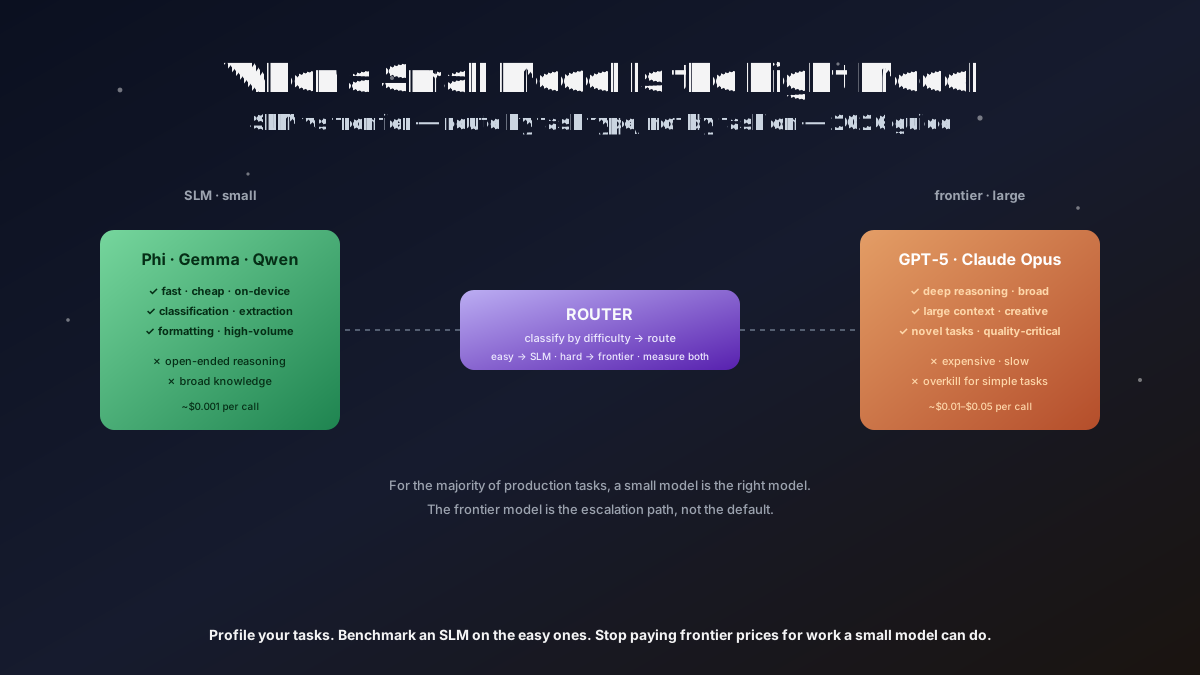
- The hybrid pattern is increasingly common. Many production teams run commercial APIs for low-volume, high-difficulty tasks and self-hosted open models for high-volume, lower-difficulty tasks — routing between them based on task type and cost. This captures the best of both without committing to one.
My take
The 2026 story is that the open-source vs commercial decision is a TCO question, not an ideology question. The teams that get it right do not choose sides; they run the math, start with the API, and move to self-hosting when their volume justifies the fixed cost. Open source is powerful — but it is not free, and treating it as free is how you end up with a $200K GPU bill you did not budget for, an inference server nobody knows how to debug, and a product that is down more than it is up.
If you take one thing from this piece: start with the API, track your real cost, and self-host only when the TCO math proves it is cheaper at your volume. The API provider is subsidizing your GPU and ops costs; do not give up that subsidy until you have to.
This is the second piece in the LLM model selection cluster. Start with There is no best LLM in 2026 for the portfolio framework, then this piece for the open-vs-commercial TCO dimension, then When a small model is the right model for the sizing dimension. For how to track the per-task cost that drives this decision, see the per-task cost observability guide. For a maintained provider reference, see our AI pricing data page.
Sources
- SitePoint: Open-source vs commercial LLMs — the complete guide (2026)
- Medium (Devansh): The costly open-source LLM lie
- Taskade: 9 best open-source AI LLMs in 2026, ranked for real work
- WhatLLM: Best open source LLM 2026 ranking + Ollama guide
- Let's Data Science: Open source LLMs 2026 — Llama 3.3 vs Llama 4 comparison
- BentoML: Navigating the world of open-source LLMs
- LushBinary: Best open-source LLMs April 2026
- Our cluster: There is no best LLM in 2026
- Our pricing cluster: per-task cost observability
- Our pricing cluster: API routing and fallback
- Our pricing cluster: 2026 LLM API price war
- Our eval cluster: Pass@1 is not quality
Related
The question 'which LLM is best?' is the wrong question in 2026. There is no best model — there is the best model for your specific task, at your specific scale, under your specific constraints. Here is a source-checked guide to production LLM model selection: the four frontier families (GPT, Claude, Gemini, DeepSeek), which task each wins, the four hard constraints that frame every decision (privacy, latency, cost, reasoning depth), and why the dominant 2026 pattern is model routing — using multiple models in parallel, not picking one winner.
2026 data shows small language models now match or beat frontier LLMs on specific tasks — at a fraction of the cost and latency. Yet most teams default to the biggest model available, paying for capability they do not use. Here is a source-checked guide to the small-vs-frontier decision: what an SLM actually is (Phi, Gemma, Qwen), when it wins (classification, extraction, formatting, high-volume tasks), when it loses (open-ended reasoning, broad knowledge), and why the 2026 pattern is routing between both rather than choosing one.