When a small model is the right model: a 2026 guide to SLMs vs frontier LLMs in production
2026 data shows small language models now match or beat frontier LLMs on specific tasks — at a fraction of the cost and latency. Yet most teams default to the biggest model available, paying for capability they do not use. Here is a source-checked guide to the small-vs-frontier decision: what an SLM actually is (Phi, Gemma, Qwen), when it wins (classification, extraction, formatting, high-volume tasks), when it loses (open-ended reasoning, broad knowledge), and why the 2026 pattern is routing between both rather than choosing one.
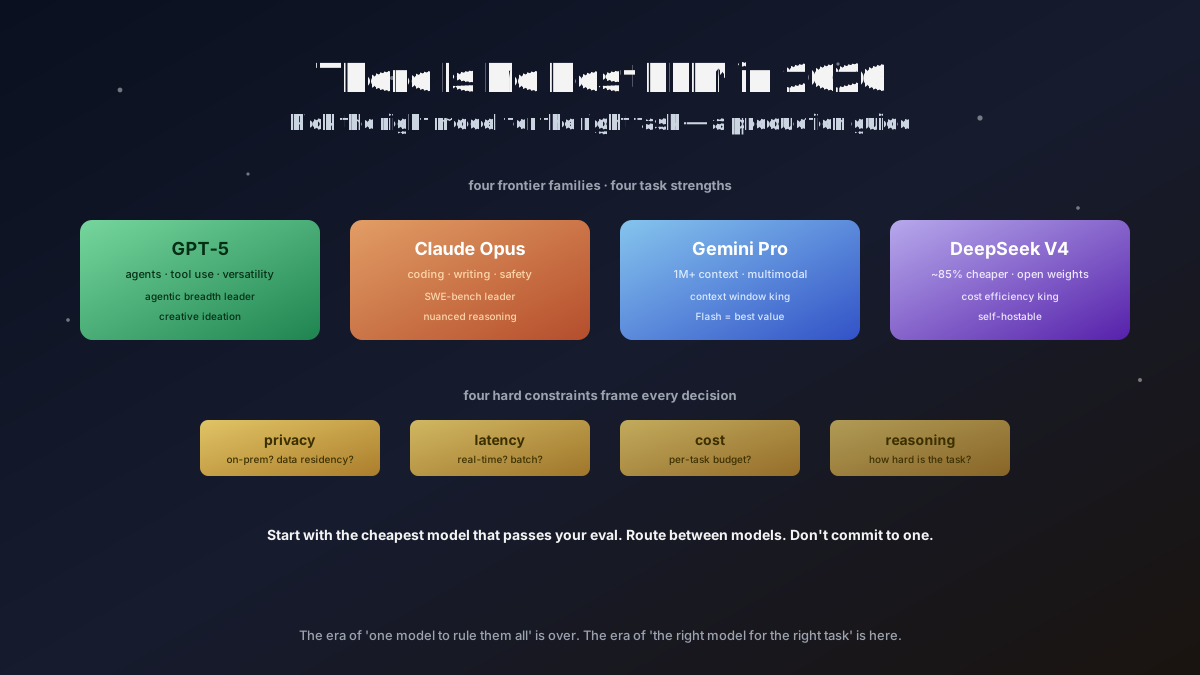
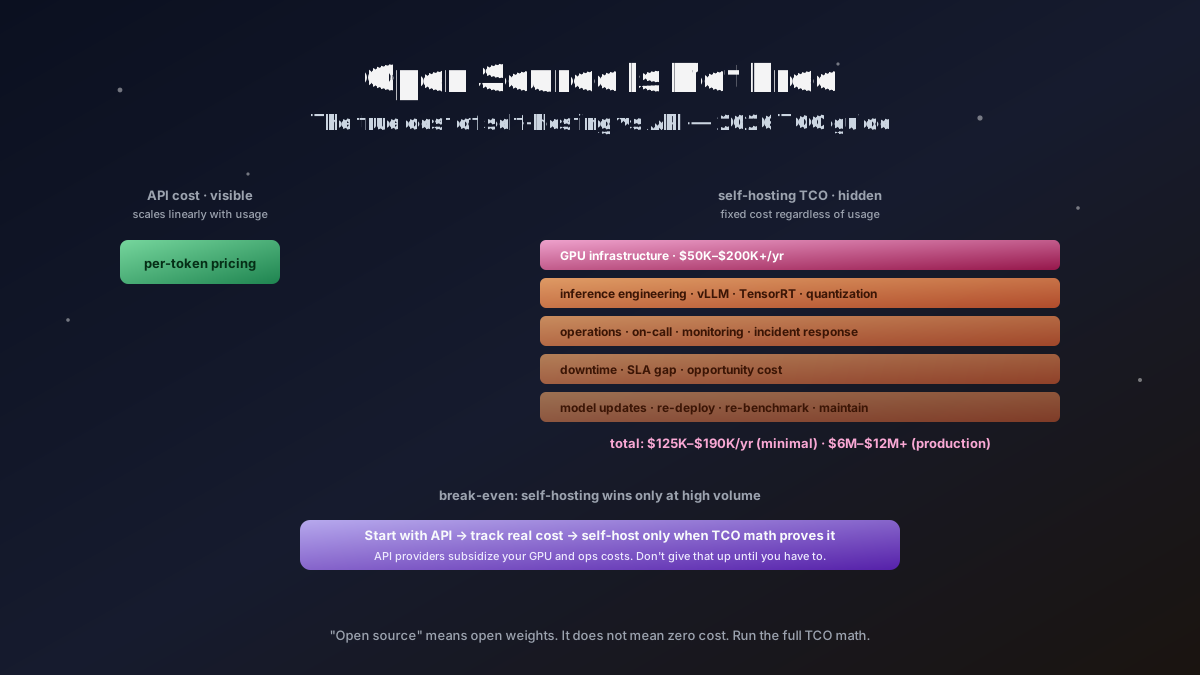
This is the third piece in the LLM model selection cluster, completing a portfolio → TCO → small-vs-frontier loop. There is no best LLM in 2026 framed selection as a portfolio. Open source is not free showed the TCO math of self-hosting. This piece tackles the dimension that creates the most wasted spend: using a frontier model for a task a small model handles just as well, at a fraction of the cost.
My read, after going through the 2026 literature, is blunt: 2026 is the year the 'bigger is always better' default died. Forbes reports new data showing small language models now outperform frontier AI on cost, speed, and accuracy for task-specific workloads. The implication for production is direct: if you are routing a classification, extraction, or formatting task to GPT-5 or Claude Opus, you are likely overpaying by 5-10x for capability you do not need — and adding latency you do not want.
What is an SLM?
A small language model (SLM) is a model with fewer parameters — typically under 10 billion — designed for efficiency rather than maximum capability. The 2026 SLM landscape includes models like Phi-4, Gemma, Qwen small variants, and distilled versions of larger models. They are not toys; they are production-grade tools that excel at well-defined, narrow tasks where the full reasoning power of a frontier model is unnecessary.
The key distinction from frontier models: SLMs trade breadth for efficiency. A frontier model can reason about open-ended problems, draw on broad knowledge, and handle tasks it has never seen before. An SLM is optimized for specific task types — classification, extraction, summarization, formatting, simple Q&A — where the task is well-defined and the model's narrower training is sufficient.
When an SLM wins
Drawing on the Forbes 2026 data and the CogitX decision framework:
-
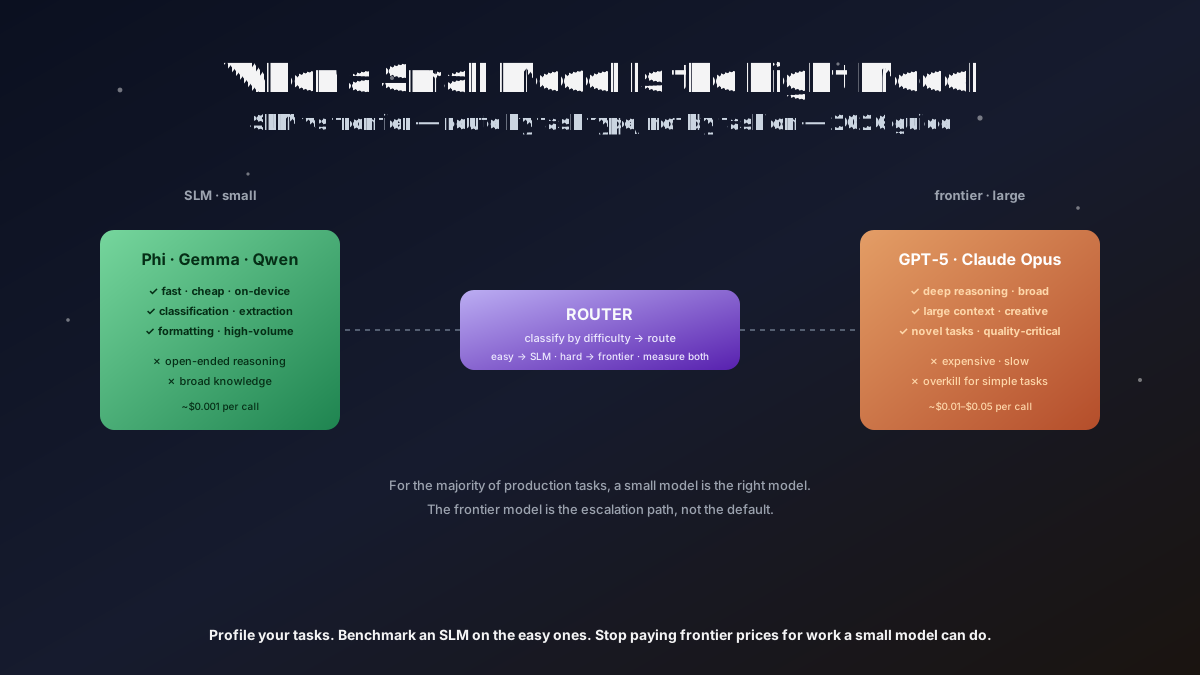
High-volume, well-defined tasks. Classification, sentiment analysis, entity extraction, formatting, routing decisions. These are tasks where the input→output mapping is clear, and the model does not need broad reasoning. An SLM handles these at a fraction of the cost and latency of a frontier model.
-
Cost-sensitive production at scale. If you process millions of requests per day, the per-request cost difference between a frontier model ($0.01-$0.05 per call) and an SLM ($0.001 or less) compounds into real money. This is the per-task cost observability discipline applied to model sizing.
-
Latency-critical features. SLMs are faster — often dramatically faster. For real-time user-facing features where 200ms vs 2s is the difference between a good and a bad experience, the SLM's speed advantage is not a nice-to-have; it is the feature.
-
On-device or edge deployment. SLMs can run locally — on a phone, a laptop, an edge server — which eliminates network latency, data residency concerns, and API dependency entirely.
-
Narrow domain specialization. A fine-tuned SLM on your specific domain can outperform a general-purpose frontier model on domain-specific tasks, because the fine-tuning concentrates capability where you need it.
When a frontier model wins
-
Open-ended reasoning. Tasks where the model must figure out what to do, not just execute a known pattern. Multi-step analysis, creative problem-solving, complex code generation across files.
-
Broad knowledge tasks. Questions that span many domains, require world knowledge, or involve information not in the prompt context.
-
Large context processing. Tasks that require understanding a long document, a large codebase, or a complex conversation history. Frontier models have larger context windows and better comprehension within them.
-
Novel or rare tasks. Tasks the model has not been trained specifically for, where generalization matters more than efficiency.
-
Quality-critical outputs. When the cost of a wrong answer is high (legal, medical, financial), the frontier model's higher accuracy ceiling is worth the cost premium.
The 2026 pattern: route between both
The dominant production pattern is not 'choose SLM or frontier'; it is routing between both. Use an SLM for easy, high-volume tasks where speed and cost matter; escalate to a frontier model for hard, low-volume tasks where quality matters. This is the same routing discipline from our pricing cluster, applied to model sizing.
The practical implementation: classify each incoming request by difficulty, route easy tasks to the SLM, route hard tasks to the frontier model, and measure both on your evaluation set to confirm the routing decisions are correct.
The sharp edges
- SLMs degrade faster on edge cases. A frontier model handles a weird input gracefully; an SLM may fail silently. Test SLMs on your edge cases, not just your happy path.
- Fine-tuning an SLM is a commitment. A fine-tuned SLM is a specialized asset that needs maintenance, retraining when your domain shifts, and its own evaluation pipeline. It is not a free lunch.
- The capability gap narrows but does not close. SLMs are getting better fast, but for the hardest tasks, the frontier model's accuracy ceiling remains higher. Know which side of the gap your task sits on.
- Routing adds complexity. A system that routes between SLM and frontier needs a classifier, a fallback, and monitoring on both paths. The complexity is worth it at scale; it is overkill for a prototype.
How to decide
- Profile your tasks. Which are high-volume and well-defined (SLM candidates)? Which are low-volume and complex (frontier candidates)?
- Benchmark SLMs on your golden set. Does the SLM clear your quality threshold on the easy tasks? If yes, you are overpaying with a frontier model.
- Calculate the cost savings. Per-task cost observability tells you exactly how much you save by routing easy tasks to the SLM.
- Build the routing layer. Route by task type, and add a fallback to the frontier model if the SLM's output fails validation.
- Re-evaluate quarterly. SLMs improve fast. A task that needed a frontier model in January may be SLM-solvable by April.
My take
The 2026 story is that model sizing became a first-class production decision. The teams that get it right are not the ones who chose the biggest model or the smallest; they are the ones who profiled their tasks, benchmarked honestly, and built routing to use each model where it wins. 'Bigger is better' was never true in general, and in 2026 it is not even true on average — for the majority of production tasks, a small model is the right model, and the frontier model is the escalation path, not the default.
If you take one thing from this piece: profile your tasks, benchmark an SLM on the easy ones, and stop paying frontier prices for work a small model can do.
This is the third piece in the LLM model selection cluster. Start with There is no best LLM in 2026 for the portfolio framework, then Open source is not free for the TCO dimension, then this piece for the sizing dimension. For how to track the cost savings of SLM routing, see the per-task cost observability guide. For a maintained provider reference, see our AI pricing data page.
Sources
- Forbes: Small language models outperform frontier AI on cost, speed and accuracy (2026)
- CogitX: Small language models (SLMs) — comprehensive guide 2026
- Machine Learning Mastery: Introduction to small language models — complete guide 2026
- Towards Data Science: How to choose between small and frontier models
- Acuvate: LLM vs SLM vs FM — a strategic guide to AI model selection
- Medium/Algomart: LLM vs SLM — when to use which
- Red Hat: SLMs vs LLMs — what are small language models?
- Our cluster: There is no best LLM in 2026
- Our cluster: Open source is not free
- Our pricing cluster: per-task cost observability
- Our pricing cluster: API routing and fallback
- Our eval cluster: golden set construction
Related
The question 'which LLM is best?' is the wrong question in 2026. There is no best model — there is the best model for your specific task, at your specific scale, under your specific constraints. Here is a source-checked guide to production LLM model selection: the four frontier families (GPT, Claude, Gemini, DeepSeek), which task each wins, the four hard constraints that frame every decision (privacy, latency, cost, reasoning depth), and why the dominant 2026 pattern is model routing — using multiple models in parallel, not picking one winner.
The pitch is seductive: self-host an open-source LLM and stop paying per-token API fees. The reality is that a minimal self-hosted deployment can cost $125K–$190K per year, and production-scale deployments can reach millions. Here is a source-checked 2026 guide to the true cost of ownership for open-source vs commercial LLMs: the hidden costs of self-hosting (GPU, ops, inference optimization, downtime), the break-even volume where self-hosting wins, and why most teams should start with API and move to self-hosting only when the math genuinely justifies it.