There is no best LLM in 2026: a production guide to choosing the right model for the right task
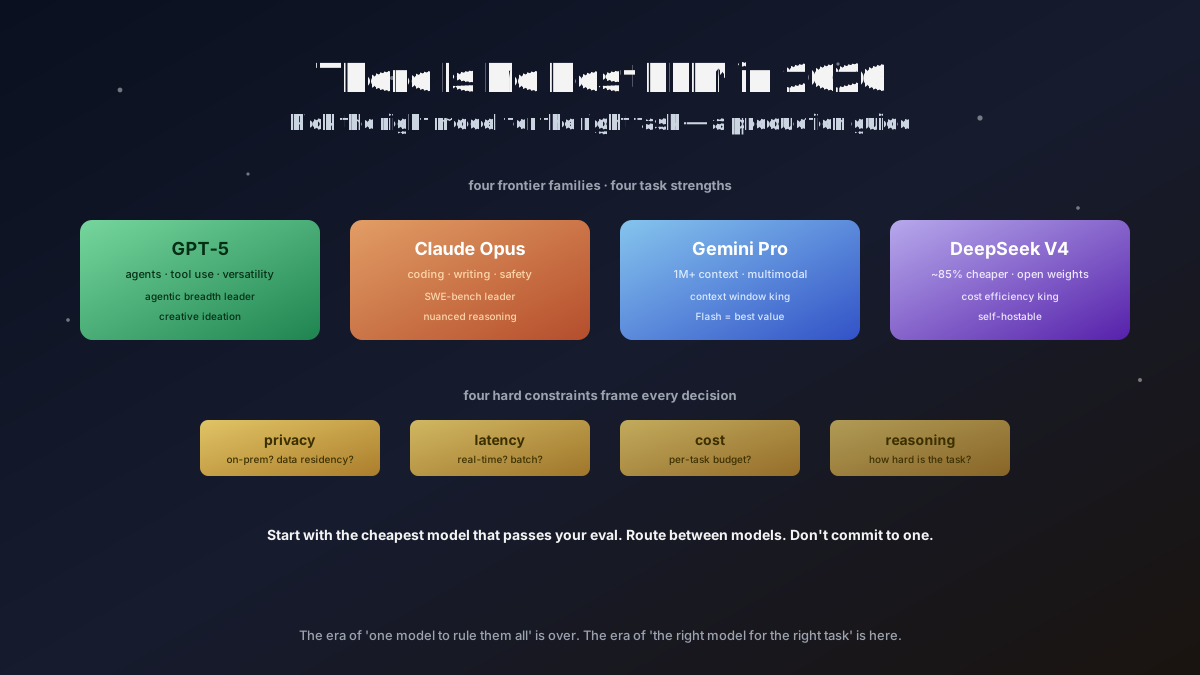
The question 'which LLM is best?' is the wrong question in 2026. There is no best model — there is the best model for your specific task, at your specific scale, under your specific constraints. Here is a source-checked guide to production LLM model selection: the four frontier families (GPT, Claude, Gemini, DeepSeek), which task each wins, the four hard constraints that frame every decision (privacy, latency, cost, reasoning depth), and why the dominant 2026 pattern is model routing — using multiple models in parallel, not picking one winner.
This piece opens a seventh topic cluster — LLM model selection — alongside our six existing clusters: LLM pricing, AI coding workflow, LLM evaluation, production RAG, prompt engineering, and agent architecture. Model selection is the upstream decision that shapes every other cluster: which model you choose determines your costs, your eval thresholds, your routing complexity, your RAG embedding quality, and your agent's ceiling.
My read, after going through the model-selection literature, is blunt: the 2026 frontier model landscape is not a leaderboard with a winner at the top. It is a portfolio. Each of the four frontier families excels at different things, and the teams that get model selection right are the ones who stopped asking 'which is best?' and started asking 'which is best for this task, at this scale, under these constraints?' — and then built routing to use multiple models in parallel rather than committing to one.
The four frontier families in 2026
GPT-5 / GPT-5.5 (OpenAI)
- Strengths: versatility, agentic workflows, tool use, creative ideation. GPT-5 leads on agentic breadth — function calling, multi-step tool orchestration, and browsing. If you are building an agent that chains many tool calls, GPT-5 is the default starting point.
- Weakness: not the cheapest, not the longest context, not the strongest on pure code quality.
- Best for: agents, tool-heavy workflows, brainstorming, all-rounder tasks where you need competence across many domains.
Claude Opus / Sonnet (Anthropic)
- Strengths: coding, long-context reasoning, nuanced writing, safety. Claude consistently leads on SWE-bench Verified (72.5%+ for Opus 4.x) and is praised for code comprehension and refactoring large codebases. It also follows formatting instructions better than most and produces the most natural prose.
- Weakness: comparatively weaker on vision/multimodal tasks; not the cheapest.
- Best for: code-heavy work, long-form writing, quality-critical analytical tasks where reliability matters.
Gemini 3.x Pro / Flash (Google)
- Strengths: massive context window (1M+ tokens), native multimodal, speed/value. Gemini is the context king and the multimodal leader. Flash variants offer the best price-to-performance among closed models for classification, summarization, and chat at scale.
- Weakness: retrieval quality at extreme context lengths can lag; not the strongest on pure reasoning benchmarks.
- Best for: processing huge documents, images and video, high-volume tasks where Flash pricing matters.
DeepSeek V3 / V4 (DeepSeek)
- Strengths: cost efficiency (~85-90% cheaper than GPT-5.5), strong technical reasoning, open weights for self-hosting. DeepSeek nearly matches frontier closed models on benchmarks like MMLU (88.5%+) at a fraction of the cost.
- Weakness: simpler code style (direct rather than sophisticated); smaller ecosystem of tools and integrations.
- Best for: budget-constrained, high-volume API calls; cost-sensitive routing; self-hosting when data privacy requires it.
The four hard constraints
Drawing on the iternal.ai selection guide, every model selection decision is framed by four hard constraints that trade off against each other:
-
Data privacy. Do you need on-premise deployment or data residency? If yes, open-weights models (DeepSeek, Llama, Qwen) or self-hosted variants become the only option, regardless of benchmark quality. Closed API models send your data to a third party.
-
Latency. How fast must the response be? For real-time user-facing features, Flash-tier models (Gemini Flash, Haiku-tier) win on speed. For batch processing where quality matters more than speed, frontier models are affordable.
-
Cost. What is your per-task budget? This connects directly to per-task cost observability. A model that is 5x cheaper per token but needs 3x more calls is not actually cheaper — measure on your real workload.
-
Required reasoning depth. How hard is the task? Simple classification does not need a frontier model. Complex multi-step reasoning, code generation across files, or nuanced analysis does. Match the model's capability ceiling to your task's difficulty ceiling.
The discipline: name your constraints before you name your model. A team that says 'we need Claude because it is the best coder' without measuring whether their coding task actually requires Opus-tier capability is overpaying for capability they may not need.
The decision framework I would use
For any new feature, run this ladder:
- Name your task type. Coding, writing, reasoning, classification, multimodal, agentic. Different models win at different task types.
- Name your hard constraints. Privacy, latency, cost, reasoning depth — in priority order. These eliminate candidates.
- Start with the cheapest model that clears your eval threshold. Measure on your golden set. If a mid-tier model passes, you do not need a frontier model.
- Escalate only when the eval fails. Move up the capability ladder until quality clears your threshold. Stop there.
- Consider routing from the start. Use the cheapest model for easy tasks, a stronger model for hard tasks, and route between them. This is the dominant 2026 production pattern.
The sharp edges that are not in the marketing copy
A few risks worth knowing:
- Benchmarks saturate and mislead. MMLU is largely saturated at the frontier level — most top models score within a few points of each other, which tells you little about production performance. SWE-bench (coding), agentic tool-use benchmarks, and context-handling reliability are more discriminating. Always benchmark on your own data.
- Model quality is not static. A model that was best-in-class in January may be overtaken by April. Re-run your evaluation when a major model update ships.
- The cheapest model per token is rarely the cheapest per task. A cheaper model that needs more retries, longer prompts, or more calls to reach acceptable quality can cost more per completed task than a more expensive model that gets it right the first time. This is why per-task cost observability is the metric that matters, not per-token price.
- Switching cost is real. Each model family has its own SDK, its own function-calling shape, its own prompt conventions. The deeper you integrate with one, the harder it is to switch. Build a routing abstraction from the start to keep switching costs low.
- Reliability in long agentic workflows decays differently per model. A model that produces excellent single-turn output may degrade over a 30-step agent run. Test the full trajectory, not just single-turn quality — this is the agent observability discipline.
How this connects to every other cluster
Model selection is the upstream decision that shapes everything else:
- It determines your pricing and routing strategy.
- It sets the ceiling on your evaluation thresholds.
- It drives your RAG embedding model choice and context handling.
- It shapes your prompt engineering — prompts do not transfer between models.
- It defines your agent architecture — agentic breadth varies by model.
My take
The 2026 story is that model selection matured from a 'pick the winner' question into a portfolio management discipline. The teams that get it right are not the ones who chose the single best model; they are the ones who mapped their task types, named their constraints, measured on their own data, and built routing to use multiple models where each excels. There is no best LLM in 2026. There is the best model for your task — and the discipline to know the difference.
If you take one thing from this piece: start with the cheapest model that passes your eval, escalate only when quality demands it, and route between models rather than committing to one. The era of 'one model to rule them all' is over; the era of 'the right model for the right task' is here.
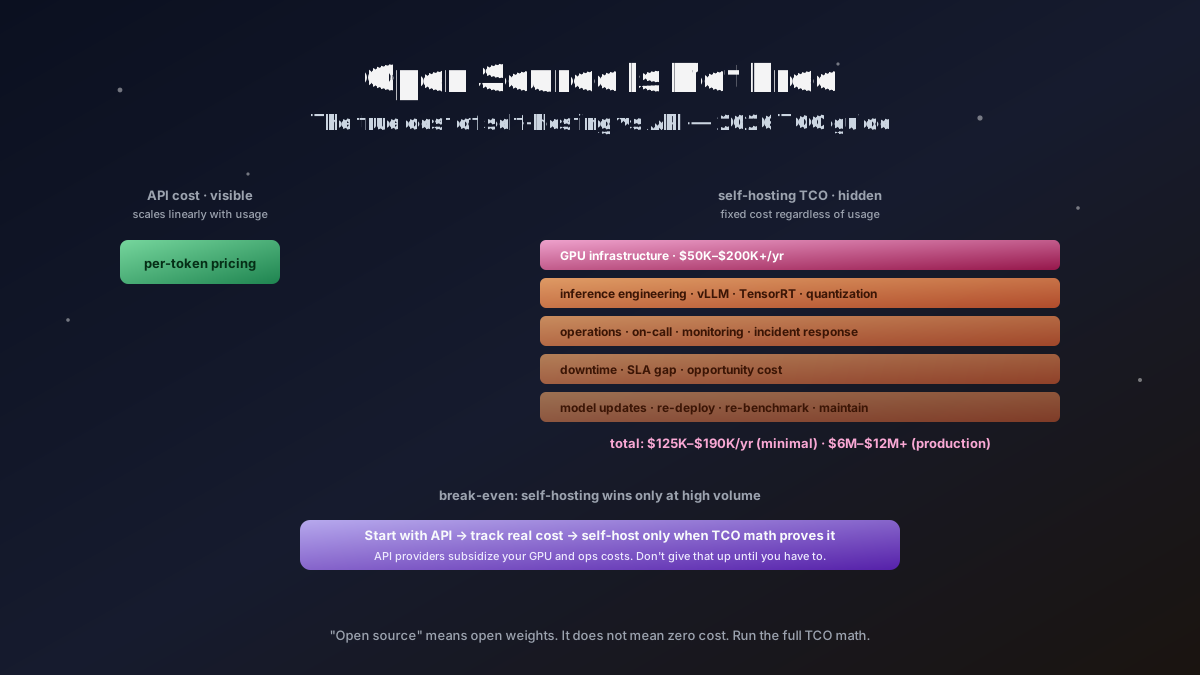
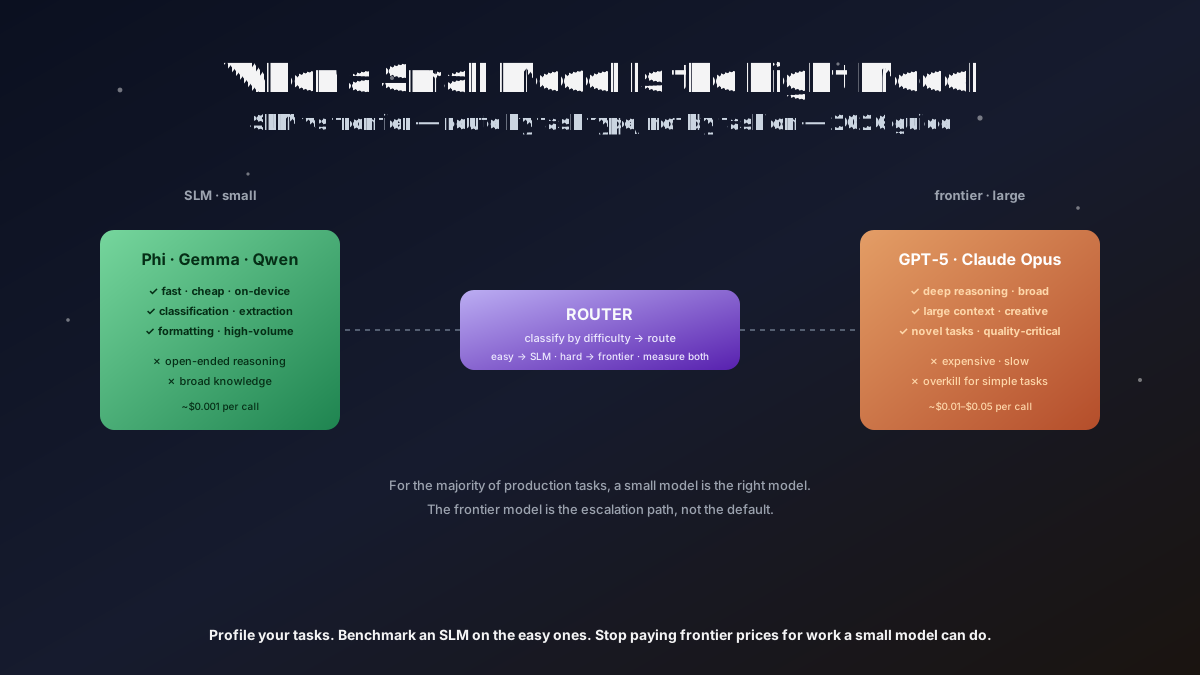
This is the first piece in the LLM model selection cluster. For the second piece — the TCO dimension of the open-source vs commercial decision, where 'open source' does not mean 'free' and self-hosting can cost $125K+/yr — see Open source is not free: a 2026 TCO guide to self-hosting vs API LLMs. For the third piece — the sizing dimension, where a small model is often the right model and the frontier model is the escalation path — see When a small model is the right model. For the cost and routing decisions your model choices unlock, see the LLM pricing cluster. For how to evaluate whether your chosen model is actually good enough, see the LLM evaluation cluster. For a maintained provider reference with current pricing, see our AI pricing data page.
Sources
- iternal.ai: Which LLM to choose in 2026? Selection guide + benchmarks
- FutureAGI: Best LLMs in May 2026 — what actually matters in production
- TeamAI: AI model benchmarks and provider comparison for 2026
- SitePoint: Open-source vs commercial LLMs — the complete guide (2026)
- Medium: How to choose an AI model in 2026 without getting it wrong
- Towards Data Science: How to choose between small and frontier models
- Creator Economy: ChatGPT vs Claude vs Gemini — best for each use case
- Our pricing cluster: 2026 LLM API price war
- Our pricing cluster: API routing and fallback
- Our pricing cluster: per-task cost observability
- Our eval cluster: Pass@1 is not quality
- Our RAG cluster: RAG did not solve hallucinations
- Our prompt-eng cluster: Stop cargo-culting prompt tricks
- Our agent cluster: An agent loop without guardrails is a runaway
- Our agent cluster: AI agent observability
Related
The pitch is seductive: self-host an open-source LLM and stop paying per-token API fees. The reality is that a minimal self-hosted deployment can cost $125K–$190K per year, and production-scale deployments can reach millions. Here is a source-checked 2026 guide to the true cost of ownership for open-source vs commercial LLMs: the hidden costs of self-hosting (GPU, ops, inference optimization, downtime), the break-even volume where self-hosting wins, and why most teams should start with API and move to self-hosting only when the math genuinely justifies it.
2026 data shows small language models now match or beat frontier LLMs on specific tasks — at a fraction of the cost and latency. Yet most teams default to the biggest model available, paying for capability they do not use. Here is a source-checked guide to the small-vs-frontier decision: what an SLM actually is (Phi, Gemma, Qwen), when it wins (classification, extraction, formatting, high-volume tasks), when it loses (open-ended reasoning, broad knowledge), and why the 2026 pattern is routing between both rather than choosing one.