Stop cargo-culting prompt tricks: a 2026 production guide to choosing the right prompting technique
Most prompt engineering advice in 2026 is still a list of techniques with no guidance on when to use which. The result is teams piling few-shot examples, chain-of-thought, and elaborate system prompts into every request, paying for latency and tokens they never needed to spend. Here is a source-checked guide to prompt engineering for production: when zero-shot wins, when few-shot earns its cost, when chain-of-thought actually helps (and when it is redundant), and why the most important prompt engineering decision is treating prompts as versioned, evaluated engineering artifacts rather than incantations.
This piece opens a fifth topic cluster — prompt engineering — alongside our LLM pricing, AI coding workflow, LLM evaluation, and production RAG clusters. It also closes a loop across the whole site: every prior cluster is downstream of prompt quality. The cheapest model routed perfectly, with a golden-set-backed eval and a well-chunked RAG pipeline, still produces garbage if the prompt is wrong.
My read, after going through the 2026 prompt engineering literature, is blunt: most teams do not have a prompting strategy. They have a prompting grab bag. They have heard that few-shot helps, that chain-of-thought helps, that system prompts are important, and they assemble all of it into every request — then wonder why latency is high, costs are up, and the output has not actually improved. The 2026 reality is that prompting techniques are tools with specific use cases, specific costs, and specific failure modes, and using the wrong one is worse than using none.
The core reframe: prompts are engineering artifacts, not incantations
The single most important shift in production prompt engineering is treating prompts the way you treat code: versioned, evaluated, reviewed, and changed deliberately. A prompt is not a creative writing exercise; it is an input to a system whose output quality and cost you measure. That means:
- Prompts live in version control, with a history of what changed and why.
- Every prompt change is evaluated against a golden set before it ships, the same way a code change is tested.
- Prompt cost is measured — few-shot examples and chain-of-thought reasoning both cost tokens, and that cost shows up in your per-task cost observability.
- Prompts are reviewed for security (prompt injection is a real attack surface), not just for quality.
The teams whose prompts work reliably in production are not the ones with the cleverest wording. They are the ones whose prompt process is disciplined: version, evaluate, measure, review. The wording is the easy part; the process is what makes it reliable.
The four techniques, and when each actually wins
Most 2026 prompt engineering guides list techniques (zero-shot, few-shot, chain-of-thought, system prompts) as if they were a ranked leaderboard. They are not ranked; they are matched to the task. Here is the honest decision guide.
1. Zero-shot with a strong system prompt (start here)
Give the model a clear system prompt that defines the role, the task, the output format, and the constraints, then ask for the answer directly. No examples, no reasoning steps.
- Use when: the task is simple or the model is already strong at it (common classifications, summarization, extraction, formatting). This is most tasks.
- Why it usually wins: it is the cheapest, fastest option, and for strong 2026 models on well-defined tasks, it is often all you need. Adding few-shot or CoT to a task the model already handles is pure cost with no benefit.
- When to move off it: when zero-shot is inconsistent, when the output format drifts, or when the task is specialized enough that the model needs calibration. Measure; do not assume.
2. Few-shot prompting (add when zero-shot is inconsistent)
Embed 3–5 high-quality, diverse examples directly in the prompt to show the model the pattern you want.
- Use when: the task is in a specialized domain where the model needs calibration, when you need to enforce a specific output format or style, or when zero-shot is producing inconsistent results.
- Why it works: it is in-context learning. The examples constrain the output distribution toward the pattern you want, without changing the model.
- The cost: every example costs tokens, every request. If you place examples in the system/static region, modern providers cache them, which mitigates cost — but the examples still add latency on the first request and complexity to the prompt.
- The discipline: examples must be clear, representative, diverse, and consistently formatted. Three good examples beat ten noisy ones. And match the example difficulty to the inputs you actually see.
3. Chain-of-thought (use sparingly, and not on reasoning models)
Ask the model to articulate its reasoning steps before the final answer. The canonical trigger is "think step by step," though production CoT is usually more structured.
- Use when: the task genuinely requires multi-step reasoning — math, logic, legal or medical reasoning, complex code analysis. CoT combined with self-consistency (sampling multiple reasoning paths and taking the majority answer) gives the biggest accuracy boost on hard reasoning tasks.
- The cost: CoT increases latency and token cost, often substantially. The reasoning trace also leaks intermediate reasoning, which can be a privacy or safety concern.
- The 2026 nuance: for frontier reasoning models (GPT-5/o-series, Claude with extended thinking), CoT is increasingly redundant because the model reasons internally. Explicitly asking these models to "think step by step" can even hurt. CoT is a technique for models that do not auto-reason; on models that do, let them.
4. System prompts (the production backbone)
A persistent prompt component that sets role, constraints, output format, and safety policy across a session or across all calls to a given feature.
- Use when: you need consistent behavior across many turns or API calls, when you want to enforce output schemas or refusal policies, or when one model serves multiple "modes."
- Why it matters in production: it is the single source of truth for the model's behavior, it is cacheable (which lowers cost and latency), and it is where you separate trusted system content from untrusted user content (the basis of prompt injection defense).
- The discipline: keep system prompts stable and version-controlled. Volatile content (user query, retrieved context) goes in the user message, not the system prompt, so the cache prefix stays valid.
The decision rule I would use
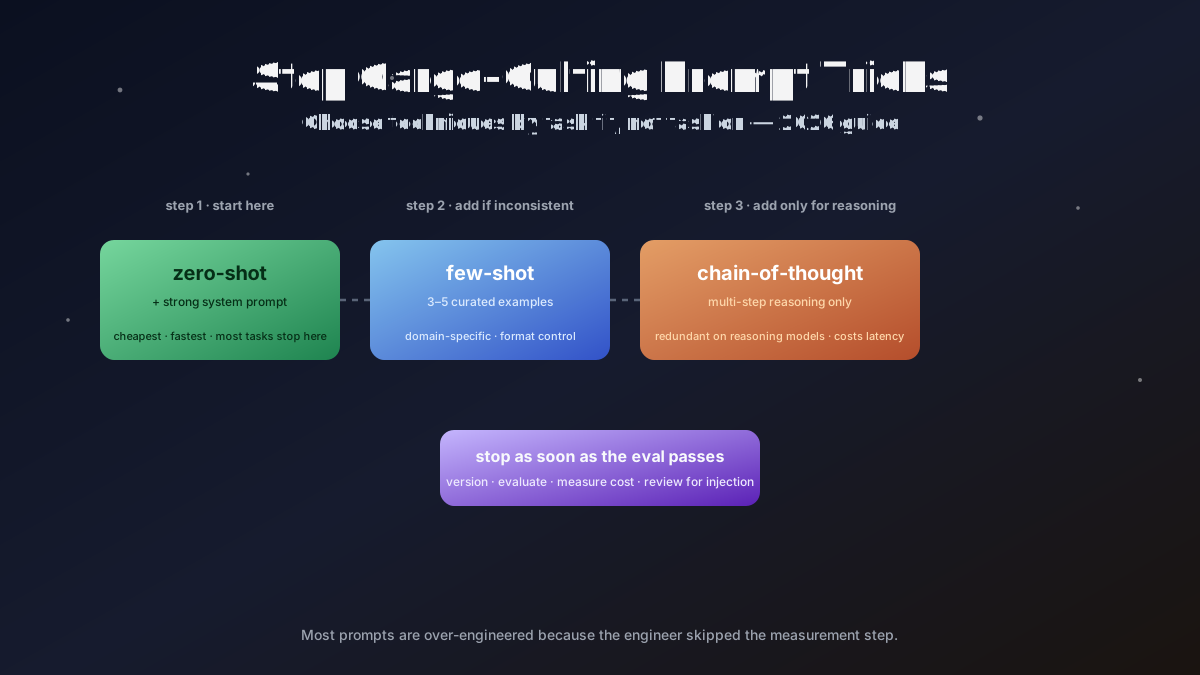
For any new feature, run the prompt ladder in order and stop as soon as the eval passes:
- Zero-shot + strong system prompt. Evaluate against your golden set. If quality clears your threshold, ship. This is where most tasks should stop.
- Add few-shot (3–5 examples). Only if zero-shot is inconsistent or the task is domain-specialized. Re-evaluate. If the lift justifies the token cost, ship.
- Add chain-of-thought. Only for genuinely multi-step reasoning tasks, and only on models that do not already reason internally. Re-evaluate. If the lift justifies the latency and cost, ship.
The mistake is starting at step 3 because someone read that CoT improves accuracy. CoT improves accuracy on hard reasoning tasks, at significant cost. For most production tasks, step 1 is sufficient, and the money you save by not adding unnecessary techniques is money you can spend on the tasks that actually need them.
The sharp edges that are not in the marketing copy
A few risks worth knowing:
- Prompt caching makes the cost of techniques less visible — which is dangerous. When few-shot examples are cached, the per-request cost looks low, but the complexity and maintenance cost are still there. Cached cost is not free cost; it is deferred cost.
- Few-shot examples can anchor the model to the wrong pattern. If your examples are biased, noisy, or out of date, the model learns the bias. Curate examples the way you would curate training data.
- CoT traces are a leakage surface. If the model reasons over sensitive context, that reasoning appears in the output. For production systems handling private data, this is a real risk.
- Prompt injection is a security problem, not just a quality problem. Untrusted user content must be separated from trusted system content, or a malicious input can override your instructions. The system prompt is your security boundary; treat it that way.
- Prompts do not transfer between models. A prompt tuned for one model family can perform worse on another. When you route between providers, re-evaluate the prompt for each — or maintain per-model prompt variants.
- Longer prompts are not better prompts. Prompt length adds cost and can dilute the signal. The best production prompts are often shorter than people expect, because they are precise.
How this connects to the rest of the stack
Prompt engineering is upstream of every other decision in the system, which is why this cluster connects to all four prior clusters:
- A bad prompt produces garbage that no amount of routing or cost optimization can fix.
- A bad prompt defeats your RAG pipeline — the retriever returns good context, but the prompt does not instruct the model to use it faithfully.
- A prompt change must be evaluated before it ships, against a golden set with a calibrated judge, or you are deploying unvalidated changes to production.
- Prompts define the instructions an AI coding agent follows, which is why prompt clarity matters for agent reliability.
My take
The 2026 story is that prompt engineering matured from a parlor trick into a discipline, and the discipline is not about clever wording — it is about treating prompts as versioned, evaluated, measured engineering artifacts and choosing techniques by task fit rather than by fashion. The teams whose prompts work in production start with the cheapest technique that passes the eval, add complexity only when measured quality justifies it, and treat the prompt as the load-bearing input to a system whose behavior and cost they are accountable for.
If you take one thing from this piece: start with zero-shot and a strong system prompt, evaluate, and only add few-shot or chain-of-thought when the eval proves you need them. Most prompts are over-engineered because the engineer skipped the measurement step.
This is the first piece in the prompt engineering cluster. For the second piece — the security dimension this piece only touches on, where prompt injection is OWASP's #1 LLM threat and requires defense-in-depth, not input sanitization — see Prompt injection is OWASP's #1 LLM threat: a 2026 defense-in-depth guide. For the third piece — the output-reliability dimension, where structured output is the bridge between LLM output and your application code — see Structured output is not reliable output. For how to evaluate whether your prompt is actually working, see the LLM evaluation cluster. For the cost dimensions of prompt choices like few-shot and CoT, see the per-task cost observability guide. For a maintained provider reference, see our AI pricing data page.
Sources
- OpenAI: Prompt engineering guide
- Prompting Guide: Chain-of-Thought (CoT) prompting
- Prompting Guide: Few-shot prompting
- Lakera: The ultimate guide to prompt engineering in 2026
- Thomas Wiegold: Prompt engineering best practices 2026
- Digital Applied: Prompt engineering — advanced techniques for 2026
- K2view: Prompt engineering techniques — top 6 for 2026
- IBM: What is chain-of-thought prompting?
- SurePrompts: Every prompt engineering technique explained
- PromptHub: The few-shot prompting guide
- Reintech: Prompt engineering best practices for production LLM apps
- Our pricing cluster: per-task cost observability
- Our pricing cluster: API routing and fallback
- Our eval cluster: golden set construction
- Our RAG cluster: RAG did not solve hallucinations
- Our coding cluster: AI coding agent evaluation
Related
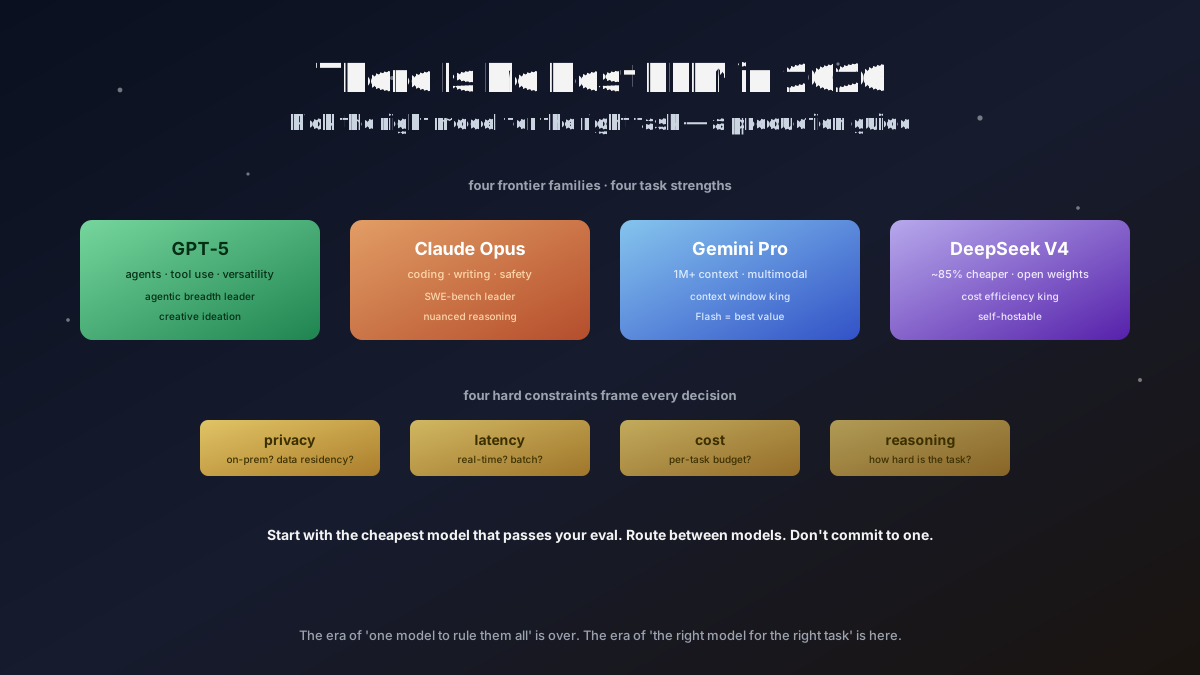
The question 'which LLM is best?' is the wrong question in 2026. There is no best model — there is the best model for your specific task, at your specific scale, under your specific constraints. Here is a source-checked guide to production LLM model selection: the four frontier families (GPT, Claude, Gemini, DeepSeek), which task each wins, the four hard constraints that frame every decision (privacy, latency, cost, reasoning depth), and why the dominant 2026 pattern is model routing — using multiple models in parallel, not picking one winner.
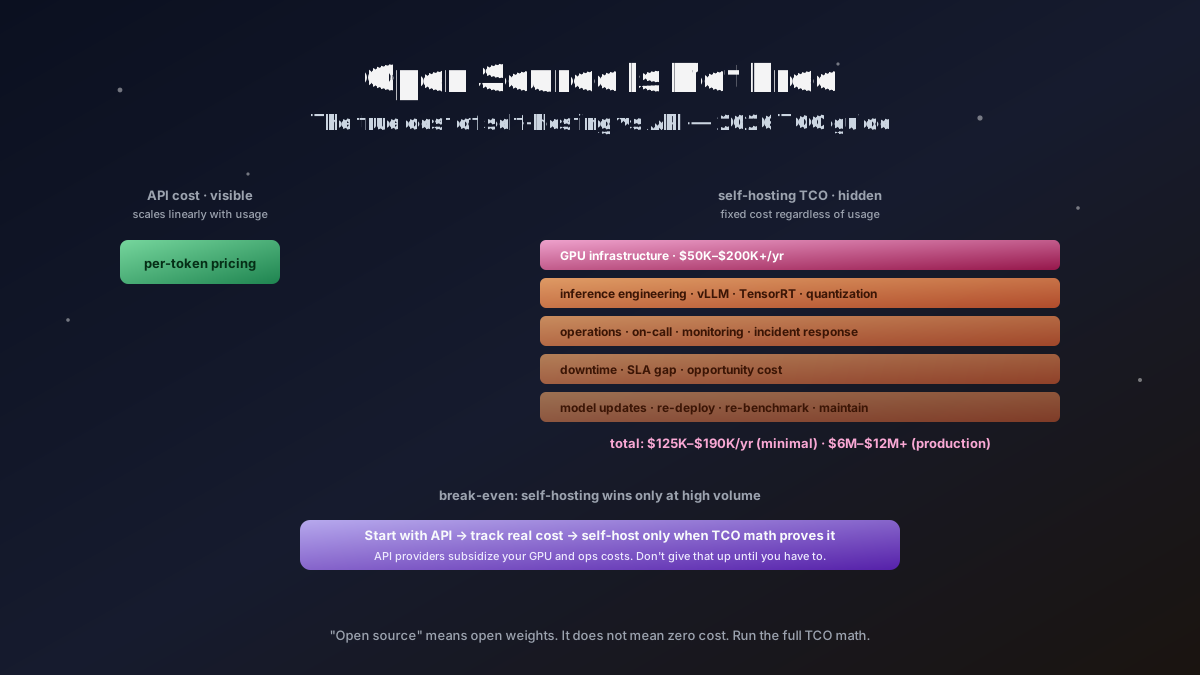
The pitch is seductive: self-host an open-source LLM and stop paying per-token API fees. The reality is that a minimal self-hosted deployment can cost $125K–$190K per year, and production-scale deployments can reach millions. Here is a source-checked 2026 guide to the true cost of ownership for open-source vs commercial LLMs: the hidden costs of self-hosting (GPU, ops, inference optimization, downtime), the break-even volume where self-hosting wins, and why most teams should start with API and move to self-hosting only when the math genuinely justifies it.