All posts
Read time 8 min

If you cannot trace your agent, you cannot trust your agent: a 2026 production guide to agent observability

An agent that runs twenty steps autonomously is a system you cannot debug by looking at the final output. You need to see every step, every tool call, every decision — the full trajectory. Here is a source-checked 2026 guide to production agent observability: the trace-level metrics that matter (span, trajectory, session), the tool landscape (Langfuse, LangSmith, Arize, Datadog), why most LLM observability tools miss the agentic decision flow, and why observability is not a nice-to-have — it is the precondition for trusting an autonomous system in production.

AI agent observability production 2026 cover

This is the third piece in the production AI agent architecture cluster, completing an architecture → memory → observability loop. An agent loop without guardrails is a runaway named observability as a non-negotiable production layer. The context window is RAM, not storage showed how memory engineering shapes what the agent knows. This piece is about what the agent does with what it knows — and how you see it, debug it, and prove it behaved correctly, after the fact.

My read, after going through the agent observability literature, is blunt: an agent without observability is an agent you cannot trust in production. The final output tells you what the agent decided; it does not tell you why, what it tried first, where it went wrong, or whether it followed the path you expected. The teams that ship production agents are the ones who instrumented every step from day one — not because they expected to debug, but because they knew that without traces, debugging an autonomous multi-step system after the fact is forensic archaeology, not engineering.

Why agent observability is different from LLM observability

A key insight from the 2026 literature, articulated by Latitude's platform analysis: most observability tools were built to monitor LLM completions, not agents. They track input and output — the prompt and the response — but they miss the agentic decision flow: which tools the agent chose, why it chose them, what arguments it passed, what the tool returned, how the agent reacted, and what it decided to do next. An agent is not a completion; it is a trajectory of completions, tool calls, and decisions, and observing it requires observing the trajectory, not just the endpoints.

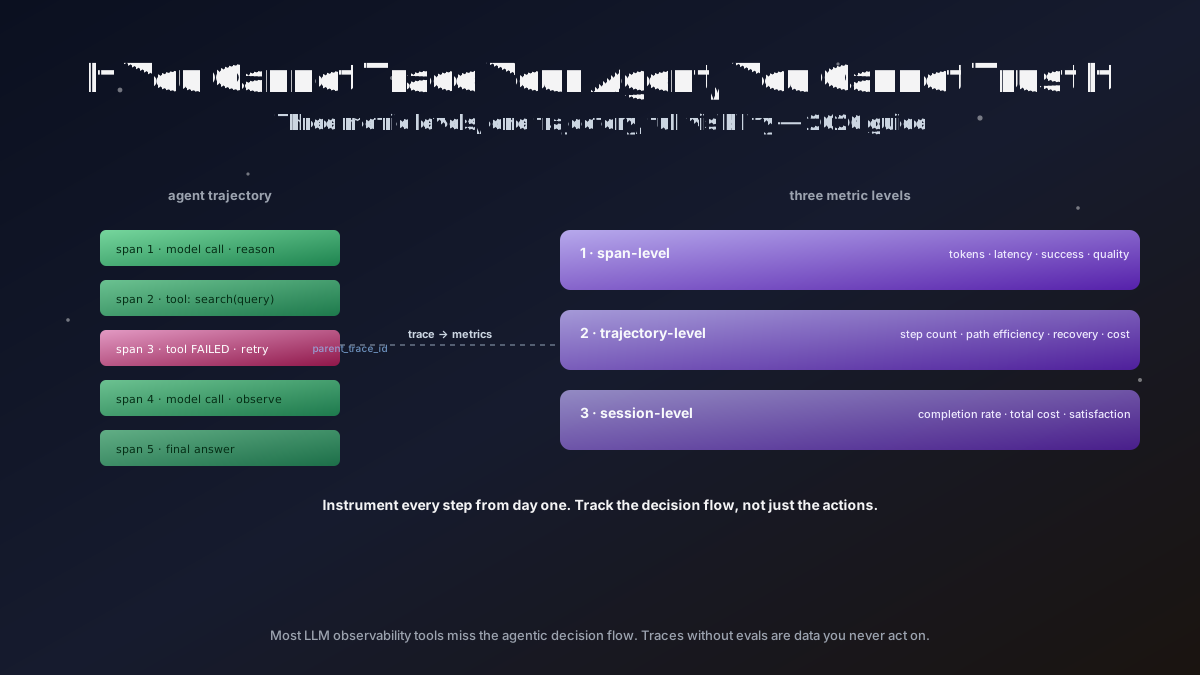
This is why agent observability is fundamentally trace-level, not request-level. You are not asking "was this API call fast and correct?" You are asking "did this twenty-step autonomous run follow a sensible path, make good decisions at each step, recover from failures, and reach the right outcome efficiently?" That question cannot be answered by logging inputs and outputs. It requires structured traces that capture every span — every model call, every tool invocation, every reasoning step — connected by a parent trace ID that lets you reconstruct the full execution DAG.

The three levels of metrics that matter

Drawing on the Augment Code and Braintrust guides, agent observability splits into three metric levels:

1. Span-level metrics (per step)

Each individual step — a model call, a tool invocation, a memory read — is a span. For each span, track:

  • Token usage. How many tokens did this step consume? Connects to per-task cost observability.
  • Latency. How long did this step take? Tool calls, especially external API calls, can dominate total latency.
  • Success/failure. Did the tool return successfully? Did the model produce valid output?
  • Semantic quality. Did this step produce a good result, not just a valid one? This is where a calibrated LLM judge can score individual steps.

2. Trajectory-level metrics (per run)

A trajectory is the full sequence of spans in one agent run. For each trajectory, track:

  • Step count. How many steps did the agent take? More is not better — it often means the agent is looping or struggling.
  • Path efficiency. Did the agent take a direct path to the answer, or did it meander through unnecessary steps?
  • Recovery rate. When a tool call failed or the model produced a bad result, did the agent recover, or did it compound the error?
  • Cost per trajectory. The sum of all span costs. This is the number that tells you whether the agent is cost-viable.

3. Session-level metrics (per user interaction)

For multi-turn agents, track across the full session:

  • Task completion rate. Did the agent actually solve the user's problem?
  • Total session cost. The sum of all trajectory costs in the session.
  • User satisfaction signal. Did the user ask the same question again (a failure signal), or move on (a success signal)?

The tool landscape (with honest caveats)

The 2026 agent observability tooling has matured significantly. From the Digital Applied, Braintrust, and MLflow comparisons:

ToolStrengthSweet spot
LangfuseOpen-source, self-hostable, strong tracing + evalTeams that need data residency or self-hosting; integrates evaluation into the observability loop
LangSmithDeep LangChain/LangGraph integration, minimal overheadTeams already on the LangChain stack; the tightest integration if you use LangGraph
ArizeProduction monitoring + ML observability heritageTeams that want AI observability alongside existing ML monitoring
DatadogEnterprise platform integrationTeams already on Datadog for APM that want agent traces in the same dashboard
MLflowOpen-source tracing + experiment trackingTeams that want tracing tied to model experiments and versioning

The honest caveat (consistent across clusters): most "best agent observability tool 2026" comparisons are vendor-affiliated. The architectural model (tracing depth, eval integration, deployment model) is verifiable on each tool's docs; the rankings should be read as marketing until you benchmark on your own agent's trajectory shape.

The deeper insight from the literature: the tool matters less than the discipline of turning tracing on from day one. A team with basic OpenTelemetry instrumentation and a willingness to read traces is ahead of a team with the most sophisticated platform that nobody looks at.

The sharp edges that are not in the marketing copy

A few risks worth knowing:

  • Tracing adds overhead. Every span you log costs latency and storage. For high-volume agents, this adds up. Sample (trace a percentage of runs, not all) if overhead is a concern, but never sample below the point where you cannot reconstruct a representative failure.
  • Most tools miss the decision flow. A tool that logs "model called search(query=X)" but not "model decided to search instead of answering directly because it was uncertain" is logging the action without the reasoning. The decision is what you need to debug; the action is just the symptom.
  • Trajectory monitoring is the guardrail that catches runaway agents. Monte Carlo's trajectory monitors let you define expected execution patterns and alert when the agent deviates — the agent that suddenly takes 50 steps instead of 5 is an agent that is looping, and a trajectory monitor catches that before the cost does.
  • Observability without evaluation is a trace graveyard. Logging every step is necessary but not sufficient. You also need to evaluate whether those steps were good — connecting traces to your golden set and evaluation pipeline, or your traces are data you never act on.
  • Multi-agent tracing is harder than single-agent. When agents hand off to each other, you need a parent trace ID that spans the full DAG, or you get fragments you cannot reassemble. Instrument this from the start; retrofitting it is painful.

How to actually build agent observability in 2026

The practical path:

  1. Turn on tracing from day one. Every model call, every tool invocation, every decision step logged with a parent trace ID. Do not wait until you need to debug; by then it is too late.
  2. Track the three metric levels. Span, trajectory, and session metrics — not just one. Each level tells you something different about where the agent is failing.
  3. Instrument the decision, not just the action. Log why the agent chose to do something, not just what it did. The reasoning is what you debug; the action is the symptom.
  4. Add trajectory monitors. Define expected execution patterns and alert on deviations. An agent that suddenly takes 10x more steps is an agent in trouble.
  5. Connect traces to evaluation. Your observability platform should feed your evaluation pipeline, and vice versa. Traces without evals are data you never act on; evals without traces are verdicts you cannot investigate.
  6. Track cost per trajectory. This is the number that tells you whether the agent is viable. Set per-run cost caps and alert on overruns.
  7. Sample if you must, but never below the failure-reconstruction threshold. You must always be able to reconstruct a representative failure from traces, or you cannot debug.
  8. Review traces regularly, not just on failure. The best teams review successful traces too — to understand what good looks like and to catch subtle degradations before they become failures.

My take

The 2026 story is that agent observability is the discipline that makes autonomous systems trustworthy. An agent that runs twenty steps without observation is a black box that produces outputs you must take on faith; an agent with full trajectory observability is a system whose behavior you can reconstruct, debug, evaluate, and improve. The teams that ship production agents are the ones who treated observability as the precondition for autonomy, not as a debugging tool they would add later. If you cannot trace your agent, you cannot trust your agent — and an agent you cannot trust does not belong in production.

If you take one thing from this piece: instrument every step from day one, track the decision flow not just the actions, and connect your traces to your evaluation pipeline. That is the minimum viable observability for an agent you are willing to put in front of users.

This is the third piece in the production AI agent architecture cluster. Start with An agent loop without guardrails is a runaway for the full architecture, then The context window is RAM, not storage for the memory layer, then this piece for the observability layer. For how trajectory-level evaluation fits into your broader eval pipeline, see the LLM evaluation cluster. For a maintained provider reference, see our AI pricing data page.

Sources

Related