The context window is RAM, not storage: a 2026 production guide to AI agent memory
Most agent failures trace back to one mistake: treating the model's context window as the memory system. The context window is RAM — scarce, expensive, and volatile — not a database. Here is a source-checked 2026 guide to production agent memory: the four memory types (working, episodic, semantic, procedural), the RAM-vs-storage principle that prevents most failures, the tool landscape (Mem0, Letta, Zep, Cognee), and why memory engineering — not prompt engineering — is the discipline that separates agents that scale from agents that bloat.
This is the second piece in the production AI agent architecture cluster, following An agent loop without guardrails is a runaway. That piece named memory as a production layer and said, sharply, "do not make the prompt the memory system." This piece is the full treatment: what agent memory actually is, why the context window is not storage, and how to design a memory architecture that lets your agent scale beyond a demo without bloating, contradicting itself, or pricing you out of production.
My read, after going through the agent memory literature, is blunt: the context window is the most expensive, most constrained, most volatile resource in your agent system, and most teams use it as if it were a database. Every step the agent takes, every tool result, every observation goes into the context window, which grows until it hits the token limit — at which point the agent either loses early context, pays escalating costs, or both. The teams whose agents scale to long-running, multi-session, personalized workflows are not the ones with the biggest context window. They are the ones who treated the context window as RAM and built a proper storage layer outside it.
The RAM-vs-storage principle
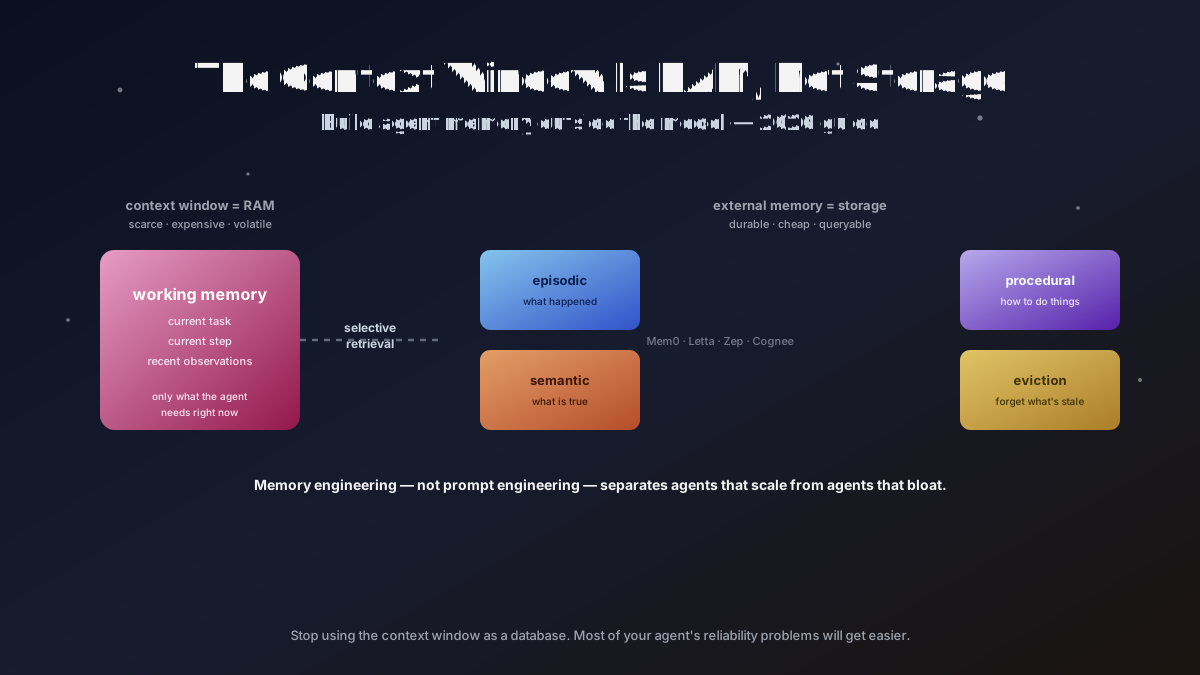
The single most important reframe in 2026 agent memory, articulated clearly by Mem0's state-of-memory analysis: the context window is RAM, not storage. RAM is scarce, expensive, and volatile — it is the active working area for the current step, not a place to persist data. Storage is durable, cheap, and queryable — it is where you keep things the agent will need later but does not need right now.
The mistake: dumping everything into the context window and hoping the model sorts it out. This works for a five-step demo and fails catastrophically for a hundred-step production agent. The context grows, the cost per step rises, the model's attention dilutes across irrelevant history, and eventually the window overflows and you lose the information that actually mattered. Treating RAM as storage is how you get an agent that worked yesterday and is broken today, on the same task, because the context got too big.
The production pattern: keep only what the current step needs in the context window (RAM), and push everything else to external memory layers (storage). Selectively retrieve from storage only the memories relevant to the current step, the same way your RAG system retrieves only the relevant chunks rather than dumping the entire corpus into the prompt. (This is the retrieval discipline from our RAG cluster, applied to memory instead of documents.)
The four memory types
Research in 2025–2026 — notably the arXiv survey "Memory in the Age of AI Agents" — converged on a taxonomy that goes beyond the simple short-term/long-term split. Four types matter for production:
-
Working memory (short-term). The current context window: the active task, the current step, the most recent observations. This is RAM. It should contain only what the agent needs right now, not its entire history.
-
Episodic memory. Logs of past events, actions, and outcomes — "what happened when." This is what makes an agent useful over time: it can recall that it tried approach A last session, it failed for reason B, and approach C worked. Implemented as structured, queryable event logs in external storage.
-
Semantic memory. Facts and general knowledge — "what is generally true." This includes user preferences, system facts, and learned generalizations. Distinct from episodic because it is about stable truths, not specific events.
-
Procedural memory. Learned skills and how-to knowledge — "how to do things." This is the agent's equivalent of muscle memory: workflows it has learned to execute, tool-use patterns that work, and approaches to avoid.
The discipline: know which type of memory you are writing to and reading from at each step. A common mistake is conflating episodic and semantic memory — logging every event as if it were a stable fact, which produces a memory store full of contradictions and stale context.
The tool landscape (with honest caveats)
The 2026 agent memory tooling has matured, but the space is still noisy. The frameworks worth knowing, from the Cognee and Vectorize comparisons:
| Tool | Model | Sweet spot |
|---|---|---|
| Mem0 | External extractive memory layer | Decouples memory from context window; treats context as RAM; extractive — pulls relevant memories on demand |
| Letta (formerly MemGPT) | Self-managed memory runtime | Agents manage their own memory via tools, paging memory in/out of context (OS/virtual-memory analogy) |
| Zep | Graph-based memory | Uses knowledge graphs for relational memory; strong for complex entity relationships |
| Cognee | Graph + vector hybrid | Combines graph and vector approaches; for use cases needing both relational and similarity retrieval |
The honest caveat (repeated across clusters): most "best agent memory tool 2026" comparisons are vendor-affiliated. The architectural model (extractive vs. self-managed vs. graph) is verifiable on each tool's docs; the rankings should be read as marketing until you benchmark on your own agent's workload.
The deeper insight from Letta's benchmarking work: a filesystem can be surprisingly competitive with sophisticated memory frameworks. An agent that can read and write files — managing its own notes, summaries, and state in a directory it controls — can achieve strong memory performance without a dedicated memory layer. The tool matters less than the discipline of keeping memory outside the context window.
The sharp edges that are not in the marketing copy
A few risks worth knowing:
- Memory bloat. Without eviction, your memory store grows until retrieval is slow and the relevant memories are drowned in noise. Every memory system needs a forgetting mechanism — a way to decay, archive, or delete memories that are no longer useful. A memory store that never forgets is a memory store that eventually remembers nothing useful.
- Memory contradictions. As the agent learns over time, new memories can contradict old ones. Without conflict resolution — a way to update or invalidate stale memories — your agent will retrieve contradictory context and act inconsistently.
- Retrieval quality is memory quality. An agent's memory is only as good as its retrieval. If the retriever returns irrelevant memories, the agent is better off with no memory at all. This is the retrieval quality problem from our RAG cluster, applied to memory retrieval.
- Memory is an injection vector. If an attacker can write to your agent's memory store (through indirect injection in retrieved documents, for example), they can persist malicious instructions that the agent will retrieve and act on later. Memory needs the same security boundaries as any other untrusted input.
- Memory adds cost. External memory means retrieval calls, storage costs, and potentially a second model for memory extraction and consolidation. This is a per-task cost that needs to be tracked, not assumed away.
How to actually build agent memory in 2026
The practical path:
- Treat the context window as RAM. Keep only the current step's active context in the prompt. Push everything else to external storage.
- Start with a simple external store. A database or file system the agent can read and write to, managed by your application code, is a strong starting point. You do not need a dedicated memory framework on day one.
- Separate episodic and semantic memory. Log events to episodic storage; extract stable facts to semantic storage. Do not conflate them.
- Add selective retrieval. When the agent needs memory, retrieve only what is relevant to the current step — by similarity, by recency, by entity match. Do not dump the entire memory store into context.
- Build in forgetting. Decay old memories, archive stale ones, and evict contradictions. A memory system that cannot forget is a memory system that cannot remember what matters.
- Evaluate memory quality. Does the agent retrieve the right memories? Does it act consistently with its past? This is a trajectory-level evaluation question, and it is harder than output evaluation because the space of memory states is enormous.
- Track memory cost. Retrieval, storage, extraction, and consolidation all cost money. Measure per-task memory cost the same way you measure model cost.
- Consider a memory framework when your simple store cannot keep up. Mem0, Letta, Zep, and Cognee earn their keep when the agent's memory needs exceed what a hand-rolled store can manage — complex retrieval, self-managed context, or relational memory. Start simple; adopt a framework when you have evidence you need one.
My take
The 2026 story is that memory engineering — not prompt engineering — is the discipline that separates agents that scale from agents that bloat. Prompt engineering decides what the model does with the context it has. Memory engineering decides what context the model has in the first place, and for long-running agents, that decision dominates. The teams whose agents stay fast, consistent, and affordable over hundreds of steps and multiple sessions are the ones who treated the context window as RAM, built a proper storage layer outside it, and engineered their memory with the same discipline they apply to any other production data system.
If you take one thing from this piece: the context window is RAM, not storage. Stop using it as a database, and most of your agent's reliability problems will get easier.
This is the second piece in the production AI agent architecture cluster. Start with An agent loop without guardrails is a runaway for the full architecture, then this piece for the memory layer, then If you cannot trace your agent, you cannot trust your agent for the observability layer. For the retrieval discipline that memory retrieval inherits, see the production RAG cluster. For how to evaluate whether your agent's memory is actually working, see the LLM evaluation cluster. For a maintained provider reference, see our AI pricing data page.
Sources
- arXiv 2512.13564: Memory in the age of AI agents (survey)
- IBM: What is AI agent memory?
- Mem0: The context window is RAM, not storage (2026)
- Mem0: State of AI agent memory 2026
- Letta: Benchmarking AI agent memory — is a filesystem all you need?
- Letta: Memory blocks — the key to agentic context management
- Cognee: Top AI memory layers for agents in 2026
- Vectorize: Best AI agent memory systems 2026
- Vectorize: Mem0 vs Letta compared
- Atlan: Agentic AI memory vs vector database (2026)
- Atlan: Episodic memory for AI agents
- Redis: Build smarter AI agents — manage short-term and long-term memory
- Medium: Memory engineering for AI agents (2026)
- Our cluster: An agent loop without guardrails is a runaway
- Our RAG cluster: RAG did not solve hallucinations
- Our eval cluster: Pass@1 is not quality
- Our prompt-eng cluster: prompt injection defense
- Our pricing cluster: per-task cost observability
Related
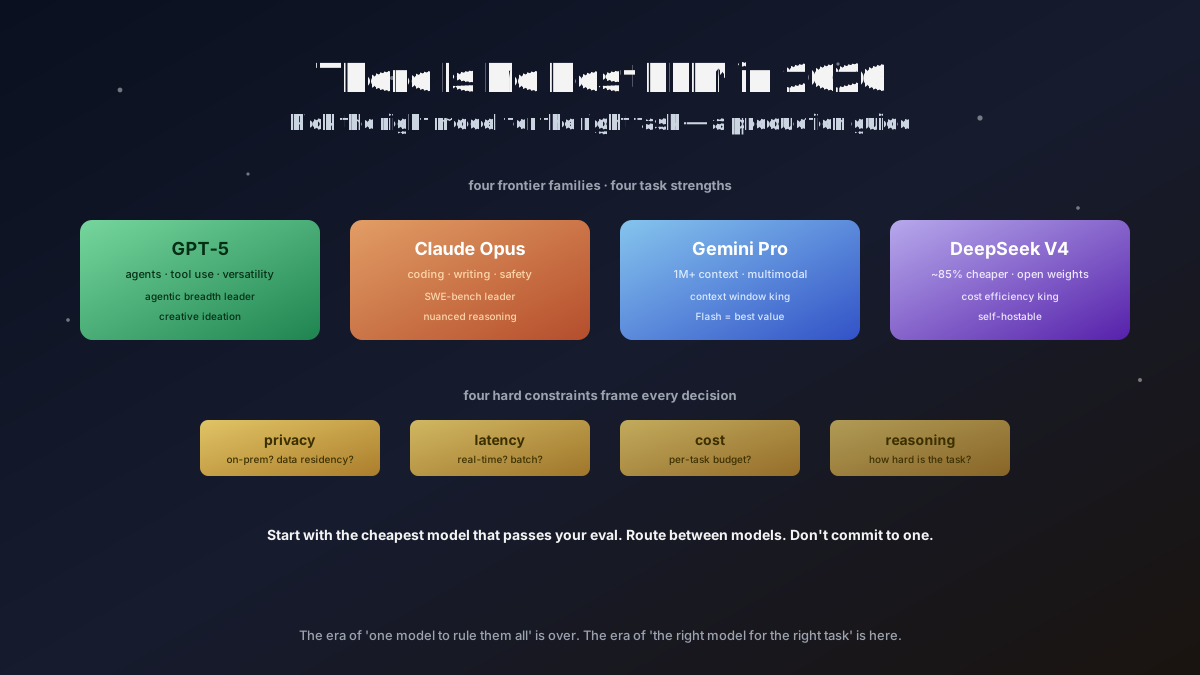
The question 'which LLM is best?' is the wrong question in 2026. There is no best model — there is the best model for your specific task, at your specific scale, under your specific constraints. Here is a source-checked guide to production LLM model selection: the four frontier families (GPT, Claude, Gemini, DeepSeek), which task each wins, the four hard constraints that frame every decision (privacy, latency, cost, reasoning depth), and why the dominant 2026 pattern is model routing — using multiple models in parallel, not picking one winner.
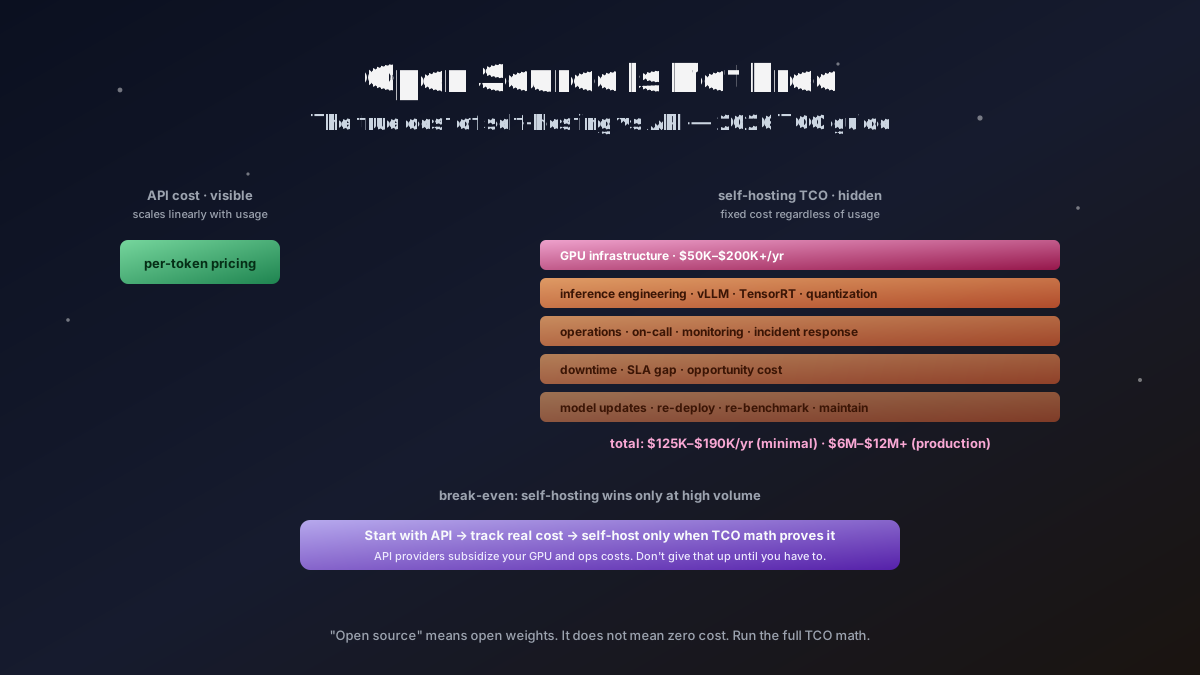
The pitch is seductive: self-host an open-source LLM and stop paying per-token API fees. The reality is that a minimal self-hosted deployment can cost $125K–$190K per year, and production-scale deployments can reach millions. Here is a source-checked 2026 guide to the true cost of ownership for open-source vs commercial LLMs: the hidden costs of self-hosting (GPU, ops, inference optimization, downtime), the break-even volume where self-hosting wins, and why most teams should start with API and move to self-hosting only when the math genuinely justifies it.