All posts
Read time 8 min

Stop trusting the SWE-bench leaderboard: how to actually evaluate an AI coding agent on your real codebase in 2026

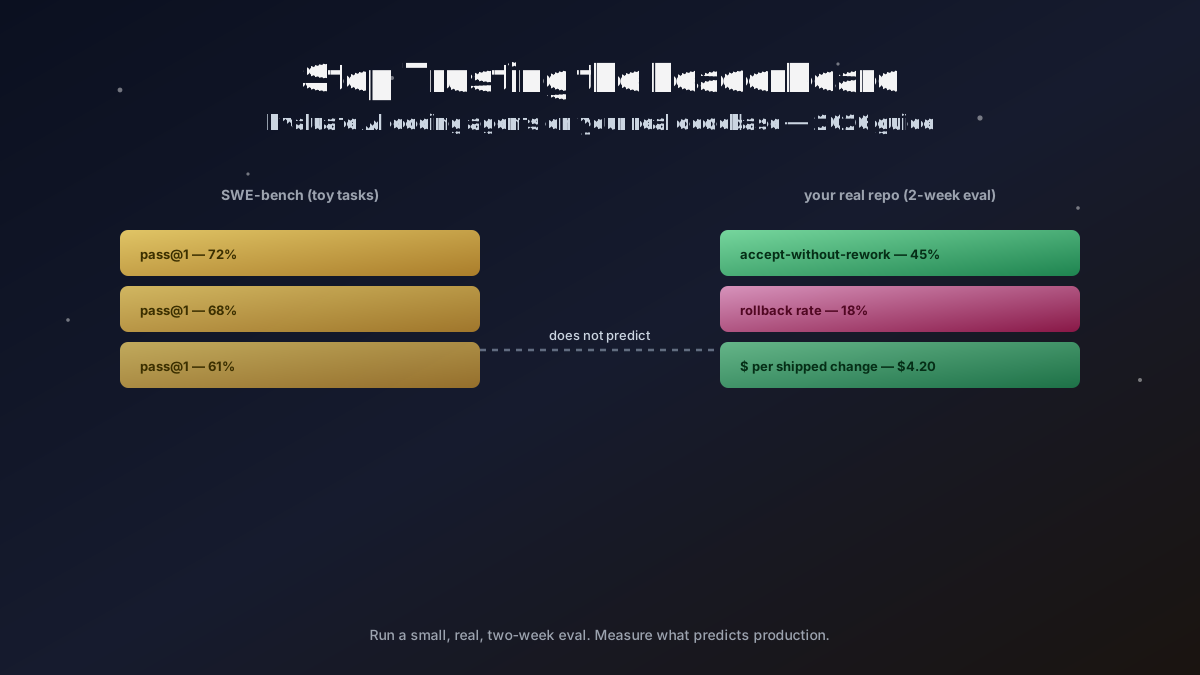
Public benchmarks rank AI coding agents on toy tasks, but your codebase is not a benchmark. Choosing Claude Code, Cursor, or Copilot by leaderboard is how teams end up with a tool that aced SWE-bench and failed on their repo. Here is a source-checked guide to running a real, two-week evaluation of an AI coding agent on your actual codebase — the metrics that matter beyond pass@1, the eval framework landscape, and the methodology that predicts production reality instead of marketing.

AI coding agent evaluation on real codebase cover

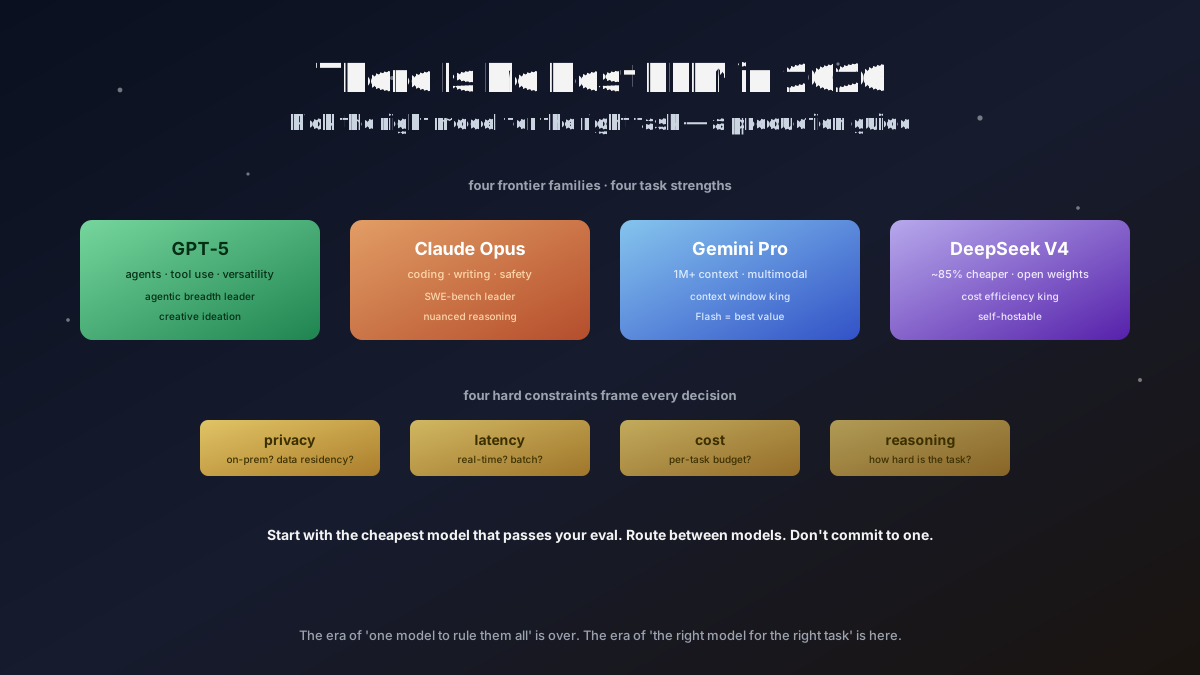
This piece opens a second topic cluster alongside our LLM pricing cluster. The first post in this AI-coding-workflow lane is a practical companion to our earlier Claude Code, Cursor, or Copilot in 2026 switchboard analysis — that piece was the strategic "how to choose between philosophies," and this one is the operational "how to actually evaluate one on your codebase before you commit."

My read, after going through the evaluation literature and the 2026 comparison sources, is blunt: the public leaderboards are necessary but not sufficient. They tell you which agent is technically capable in aggregate; they do not tell you which agent will work on your codebase, with your conventions, against your real bug reports and feature tickets. The gap between a SWE-bench score and production reality is exactly where teams waste a quarter on the wrong tool. Closing that gap means running your own evaluation, on your own repo, with metrics that go beyond "did the test pass."

Why public benchmarks mislead

SWE-bench and its descendants are real and useful. They measure whether an agent can take a GitHub issue and produce a patch that passes hidden tests on a set of open-source Python repositories. That is a genuine signal of capability. But it misleads in four specific ways:

  1. It is not your codebase. Your repo has your framework, your conventions, your test coverage gaps, and your legacy modules. An agent that excels on Flask utilities can still flail on your internal DSL.
  2. "Pass" hides everything about the diff. A patch that passes tests but rewrites 400 lines, breaks the style guide, and renames a public function is a production liability, not a win. Pass@1 measures outcome, not cost of review.
  3. It optimizes for the benchmark, not your work. Vendors tune for the leaderboard. The model that tops SWE-bench this month may be over-fit to the benchmark's style of tasks in ways that do not generalize to your tickets.
  4. It ignores the workflow you actually run. SWE-bench evaluates "issue → patch." Your day is "unclear ticket → clarification → explore → patch → review → rework → ship," and most of the value (and cost) lives in the clarification and rework loops the benchmark does not measure.

The honest version: use the leaderboard to shortlist two or three agents. Do not use it to pick a winner. The winner is decided on your repo, by your team, against your real work.

The metrics that actually predict production reality

Forget pass@1 as your north star. The metrics that correlate with whether an agent helps or hurts your team in production are:

  1. Accepted-without-rework rate. Of the patches or changes the agent produces, what fraction do you merge after only minor edits? This is the real "did it work" number. A 70% SWE-bench pass rate with a 20% accept-without-rework rate is worse than a 60% pass rate with a 45% accept rate.
  2. Review burden per change. How many minutes of human review does an average agent change require, compared to a human-authored change of the same scope? If reviewing the agent's output takes longer than writing it yourself, the agent is net-negative even when it "works."
  3. Rollback / revert rate. What fraction of agent-authored changes get reverted after merge? This catches the failure mode where a patch passed review but broke something downstream.
  4. Time-to-shipped, not time-to-first-patch. First patch is cheap; shipped, reviewed, merged is expensive. Measure the full loop, including the rework cycles the benchmark never sees.
  5. Token and dollar cost per shipped change. Not per attempt — per shipped change. An agent that costs $0.50 per attempt but needs 8 attempts to ship one change costs $4 per shipped change. This connects directly to the per-task cost observability discipline from the pricing cluster.
  6. Clarification burden. How often does the agent stop and ask you a question it should have been able to infer, or barrel ahead and produce a patch for the wrong interpretation of the ticket? Both are real costs.

Notice what is not first on this list: pass@1, SWE-bench score, or "did it write code that looks right." Those are inputs to the decision, not the decision.

The eval framework landscape (with honest caveats)

The tooling to actually run these evaluations has matured. The 2026 landscape splits into three tiers:

TierWhat it isExamplesSource
Benchmarks (fixed task sets)Standardized leaderboards; good for shortlisting, not for decidingSWE-bench, R2E, CommitPackMorph: AI Agent Evaluation
Frameworks (point at your agent)Tooling you run against your own agent/codebase to score itOpen-source eval frameworks, trajectory checking, CI gatingTop 7 AI agent eval frameworks 2026
Platforms (hosted eval + observability)Commercial platforms for simulation and production evaluationMaxim, Braintrust, and othersTop 5 AI agent evaluation platforms 2026

The methodological foundation — how to design an eval: give an agent an input, apply grading logic to its output, measure success — is documented authoritatively in Anthropic's engineering post on demystifying evals for AI agents. If you read one source before building your eval, read that one. An academic anchor for code-specific evaluation is the arXiv agent-based evaluation framework for complex code generation, validated on 363 samples across 37 coding scenarios and 23 languages.

The honest caveat: most "best AI agent eval framework 2026" listicles are vendor-affiliated. The Anthropic engineering post and the arXiv paper are neutral methodology sources; the framework rankings should be read as marketing until you have run them on your own repo.

A concrete two-week eval methodology

Here is the protocol I would actually run, adapted from the practitioner sources and the Anthropic methodology. It is deliberately small.

Week 1 — shortlist and seed tasks.

  1. Pick two, at most three agents from the public leaderboards and the switchboard analysis. Do not pick five; you will not finish.
  2. Pull 15–25 real, recently-closed tickets from your repo — a mix of bug fixes, small features, and refactors. These are your eval set. Choose tickets you already know the answer to, so you can grade the agent's output against a known-good resolution.
  3. For each ticket, write a one-paragraph prompt the way a teammate would actually write it — not a cleaned-up benchmark prompt. Realism is the point.

Week 2 — run, review, measure. 4. Run each agent against each ticket. Cap the agent's autonomy the same way you would in production (same review gates, same revert rights). 5. For each run, record the six metrics above: accept-without-rework, review minutes, rollback, time-to-shipped, dollar cost, clarification count. 6. At the end of the week, rank the agents by accept-without-rework rate and dollar cost per shipped change, not by pass rate.

Two rules that make or break this. First, grade blind where you can — review the agent's diff without knowing which agent produced it, to kill brand bias. Second, score on shipped, not on first patch — the rework loops are where the real cost lives, and they are exactly what benchmarks hide.

The sharp edges the marketing underplays

A few risks worth knowing before you commit a quarter to a tool:

  • Your eval set is small, and that is fine, but it biases. 15–25 tickets is enough to spot a disaster, not enough to be statistically rigorous. Treat the result as "good enough to commit for one quarter," not "proven forever." Re-run quarterly.
  • Agents improve fast, so your verdict expires. A tool that lost your eval in January may win it in April after a model update. Re-evaluate when a major version ships, not on a fixed calendar.
  • Workflow fit beats raw capability. An agent that integrates with your review process, your CI, and your conventions will outperform a "smarter" agent that fights your workflow. Weight integration heavily in the final call.
  • The cheapest agent per attempt is rarely the cheapest per shipped change. This is the same lesson as the LLM cost observability piece: per-attempt pricing lies; per-shipped-change cost tells the truth.
  • Confidentiality. Running a real eval means pointing an agent at your real codebase. Know your provider's data retention and training policy before you do. For some repos, that alone disqualifies certain providers.

How to actually decide

The decision rule I would use after the two-week eval:

  1. If one agent wins on both accept-without-rework rate and dollar cost per shipped change, pick it.
  2. If they are close on capability but one integrates far better with your workflow, pick the better-integrated one. Workflow fit compounds.
  3. If the eval is genuinely inconclusive, run a second week with a fresh batch of tickets rather than guessing. The cost of one more eval week is far smaller than the cost of standardizing on the wrong tool for a quarter.
  4. Whichever you pick, keep a second agent warm as a real option. The routing and fallback discipline from the pricing cluster applies here too: the market keeps inverting, and your workflow should survive the next inversion.

My take

The teams that pick the right AI coding agent in 2026 are not the ones who read the most leaderboard charts. They are the ones who run a small, real, two-week evaluation on their own codebase, measure the metrics that predict production reality, and treat the public benchmark as a shortlisting tool rather than a verdict. The benchmark tells you what is plausible. Your eval tells you what is true for you.

This is the first piece in an AI-coding-workflow topic cluster. For the strategic choice between the three philosophies — terminal-native agent, AI-native IDE, or GitHub-anchored assistant — start with the Claude Code vs Cursor vs Copilot switchboard analysis. For what to do after you have chosen an agent and need to ship its output safely, see the cluster's second piece: Autonomy without review is a liability: a 2026 discipline guide for shipping AI-generated code. For the cost dimensions that feed directly into your eval's dollar-cost-per-shipped-change metric, see the LLM pricing cluster: the price war analysis, the routing and fallback guide, and the per-task cost observability guide. For a maintained provider reference, see our AI pricing data page.

Sources

Related