Autonomy without review is a liability: a 2026 discipline guide for shipping AI-generated code
AI coding agents in 2026 can write production code faster than you can read it, and that is exactly the problem. Reports note that a large share of AI-assisted code ships without meaningful review, and even capable models produce correct-and-secure code only some of the time. Here is a source-checked discipline guide for shipping AI-generated code safely — the review tiers that matter, the failure modes to catch, and why treating every agent diff like a junior PR is the single highest-leverage habit your team can build.
This is the second piece in the AI coding workflow cluster, following how to actually evaluate an AI coding agent on your real codebase. That piece was about choosing an agent safely — running a real two-week eval before you commit. This piece is about what happens after you commit: the discipline required to ship that agent's output to production without eventually causing an incident. If the eval piece was "how to avoid picking the wrong tool," this one is "how to avoid the right tool hurting you anyway."
My read, after going through the practitioner sources, is blunt: the safety bottleneck in 2026 is no longer model capability. It is review discipline. The models are good enough to be dangerous, the agents are autonomous enough to act on that danger across many files at once, and the dominant failure mode is not "the AI wrote broken code" — it is "the AI wrote plausible-looking code that a human merged without reading carefully." The teams that ship AI-generated code to production safely are not the ones with the smartest model. They are the ones with the most disciplined review muscle.
Why 2026 makes this harder, not easier
Three shifts in 2026 raise the stakes on review discipline:
- Agents act across many files autonomously. A 2025 autocomplete suggested a line; a 2026 agent rewrites a module, runs the tests, fixes the failures, and opens a PR while you were reading email. The surface area of a single "change" is much larger, and so is the surface area you must review.
- Model output is fluent, not necessarily correct. The code looks right. It reads like a competent engineer wrote it. That fluency lowers your guard — a phenomenon practitioners increasingly call out when they warn against careless "vibe coding." Looking right and being right are different things, and the gap is exactly where production bugs live.
- Velocity pressure is real. When an agent can produce a 400-line diff in a minute, the social pressure to skim-and-merge is enormous. Review backlogs grow, diffs get larger, and the careful read becomes the first casualty.
The honest version of the 2026 capability story: the models are good enough that most of what they produce is fine. "Most" is a dangerous word in production. The discipline question is not "is the AI usually right" — it is "what is your process for the times it is not, and will that process catch it before users do."
The failure modes review must catch
Drawing on the practitioner literature, the failure modes that bite in production cluster into a few categories:
- Plausible-but-wrong logic. The code compiles, tests pass, and the core algorithm is subtly off — an off-by-one, a wrong default, a misread edge case. CI will not catch this because the tests were written by the same agent that wrote the bug.
- Security regressions. Hardcoded credentials, SQL injection re-introduced by a refactor, insecure deserialization, secrets committed to the repo. Reports indicate that even capable models produce correct-and-secure code only some of the time without explicit security prompting — which means without review, you are rolling the dice on every diff.
- Silent dependency and config changes. An agent "fixes" a test by changing a config value, bumping a dependency, or weakening an assertion. The diff is small, the test goes green, and the protection you actually needed is gone.
- Style and convention drift. The code works but violates your repo's conventions — naming, error handling, logging, layering. Each instance is minor; accumulated across hundreds of agent PRs, it erodes the consistency that makes a codebase maintainable.
- Tests that look comprehensive but aren't. The agent writes tests that pass and cover the happy path, but miss the boundary conditions that would have caught the real bug. High coverage, low actual safety.
- Confident self-review. If you ask an AI to review its own output, it tends to rate itself highly while missing real bugs — a documented pattern. Self-review gives you the feeling of review without the substance.
The three review tiers that actually work
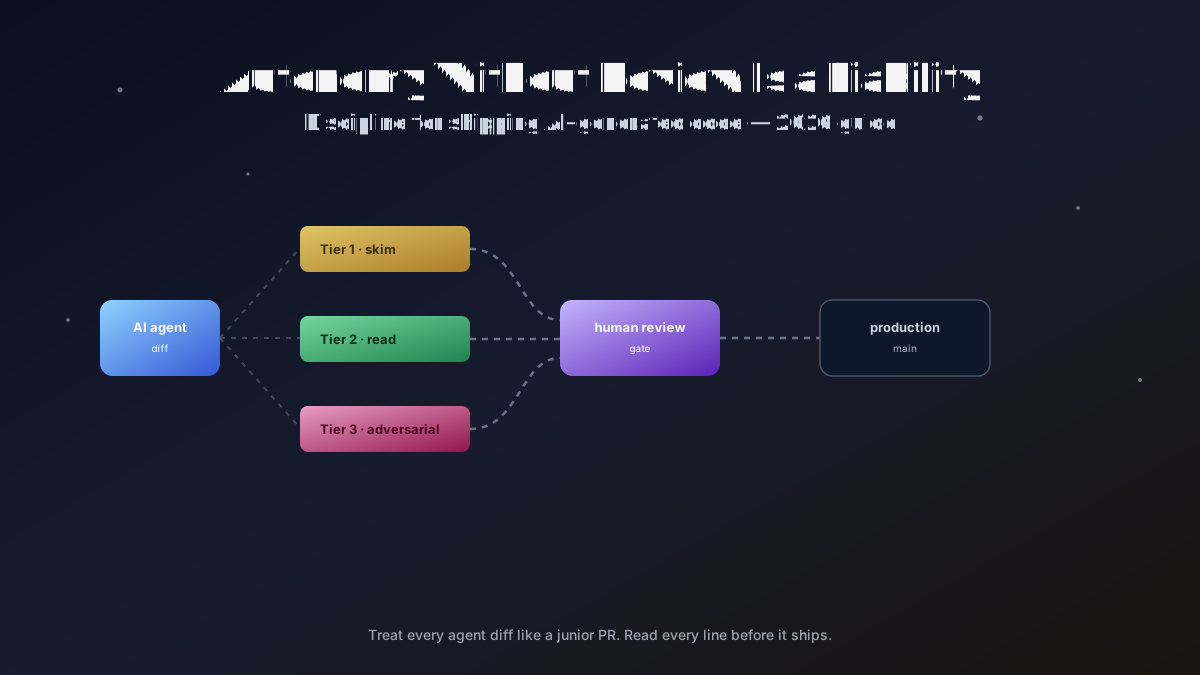
Not every change needs the same scrutiny. A practical discipline frames review in three tiers, sized to the risk of the change:
Tier 1 — Skim (low-risk, isolated changes). A one-line typo fix, a copy change, a localized refactor with strong test coverage. A focused skim for obvious issues is sufficient, provided CI is green and the diff is genuinely small. This is where you save time.
Tier 2 — Read (most changes). Anything touching business logic, a new function, a non-trivial refactor. Read the diff line by line. Ask: do I understand what this does, why it does it, and what breaks if it is wrong? Run it locally if you can. This is the default, and it is the tier teams under-apply under velocity pressure.
Tier 3 — Adversarial review (high-risk changes). Auth, payments, security boundaries, migrations, anything touching production data, anything a junior would not be allowed to ship alone. Review it as if a hostile actor wrote it: what is the worst this could do? What assumptions does it make? What invariant does it violate? This is where you prevent the incident.
The discipline is not "review everything at Tier 3." That is unsustainable and unnecessary. The discipline is classifying correctly and not letting a Tier-3 change disguise itself as Tier-1 because the diff is small or the agent sounded confident.
The single highest-leverage habit: treat every diff like a junior PR
If you build one habit, build this one: review every agent-generated diff the way you would review a junior developer's PR. That means:
- Read every line before you approve, even when it "looks fine."
- Require the change to explain itself — if you cannot tell what it does and why from the diff and the message, send it back.
- Watch for scope creep — an agent asked to fix one thing that also "improved" three others is a review hazard, not a bonus.
- Keep diffs small and focused. A 400-line agent diff is harder to review than four 100-line diffs; if your workflow lets the agent open one mega-PR, change the workflow.
- Trust your tests, but verify they test the right thing. Agent-written tests that pass are not proof of correctness; they are proof the tests pass.
- Never merge on confidence. "The AI is usually right" is not a review. "I read this and it is correct" is.
The reason this habit beats every other intervention: it works regardless of which model you use, how smart the agent gets, or how the market inverts. Models will keep improving. The teams that win are the ones whose review discipline keeps up with the model's output volume, not the ones who assume the next model will need less review.
The sharp edges that are not in the launch copy
A few risks worth naming before you standardize on an agent-driven workflow:
- Autonomy without review gates is a liability. The more a tool can do across many files, the more it can break across many files. Every autonomous capability must come with a review gate; otherwise you have given a junior the ability to ship to main without oversight.
- Review fatigue is a real attack surface. When agents generate high volumes of plausible diffs, reviewers start skimming. That fatigue is exactly what lets the Tier-3-posing-as-Tier-1 change through. Cap agent PR volume per reviewer, and protect deep-review time.
- "Tests passed" is not "it works." Agent-written tests frequently cover the happy path and miss the boundaries. Treat green CI as the start of review, not the end of it.
- Self-review is not review. No matter how convenient, asking the agent to grade its own output gives you a confident-sounding approval that missed the bug. Use a human, or use a different tool whose incentives are not aligned with the author.
- Confidentiality and IP. Pointing an agent at your real codebase, letting it read your secrets, and shipping its output all have data-handling implications. Know your provider's retention and training policy before autonomy scales.
How to actually build this discipline in 2026
The practical path I would give a team:
- Make review tier explicit on every PR. A one-line convention (Tier 1/2/3, or risk label) forces the author to classify the change and tells the reviewer how deep to go.
- Cap agent PR size and volume. Small, focused diffs review better than mega-PRs. Set a soft line count, and split work that crosses it.
- Run CI, then read the diff. CI is necessary but not sufficient. Green tests catch a subset of bugs; line-by-line reading catches the rest.
- Keep a human in the loop for Tier 3, always. Auth, payments, migrations, data-touching changes: a human reads them adversarially, no exceptions, no matter how confident the agent sounds.
- Re-review agent-written tests. Especially the ones that pass. Coverage without correctness is theater.
- Track incidents back to review tier. When something slips, ask which tier it should have been and why it was classified lower. Use that to recalibrate your classification, not to blame the model.
My take
The 2026 story is not that AI coding agents are unsafe. It is that they are safe only at the speed of your review discipline. A team that ships agent output faster than it can review it is not accelerating — it is borrowing incidents from the future, with interest. The teams that win are the ones who treat every agent diff like a junior PR, classify risk honestly, and never let a Tier-3 change sneak through disguised as a confident-looking Tier-1.
This is the second piece in the AI coding workflow cluster. For how to choose an agent in the first place — the two-week real-codebase eval that prevents you standardizing on the wrong tool — see how to actually evaluate an AI coding agent on your real codebase. For the strategic choice between the three philosophies — terminal-native agent, AI-native IDE, or GitHub-anchored assistant — start with Claude Code vs Cursor vs Copilot in 2026. For the cost dimensions that decide whether your review process is affordable to run at scale, see the LLM pricing cluster: the price war analysis, the routing and fallback guide, and the per-task cost observability guide. For a maintained provider reference, see our AI pricing data page.
Sources
- Addy Osmani: My LLM coding workflow going into 2026
- Addy Osmani: Vibe coding is not the same as AI-assisted engineering
- Manveer C.: How to manage AI coding agents like a junior developer
- The AI Corner: The AI code review checklist that prevents the next $1M production incident
- Verden: AI coding agents — autonomous development guide
- dev.to: I asked AI to review its own code — it gave itself 10/10
- Faros: Best AI coding agents for 2026 — a real-world developer view
- Coursiv: Best AI coding agents in 2026 — are they safe for production code
- Our cluster: how to evaluate an AI coding agent on your real codebase
- Our cluster: Claude Code vs Cursor vs Copilot in 2026
- Our pricing cluster: 2026 LLM API price war
- Our pricing cluster: API routing and fallback guide
- Our pricing cluster: per-task cost observability guide
Related
Your RAG demo worked on three PDFs and broke on the real corpus. That is not a mystery; it is the predictable cost of treating retrieval as a default instead of an engineering decision. Industry analysis in 2026 finds that when RAG fails, the failure point is retrieval roughly seven times in ten — not generation. Here is a source-checked diagnostic guide to production RAG in 2026: where it actually breaks (chunking, embedding, retrieval, staleness), the metrics that locate the break, and why RAG did not eliminate hallucinations so much as relocate them somewhere harder to see.
Chunking is the single highest-leverage and most under-treated decision in a RAG pipeline, and most teams leave it on the default. Here is a source-checked 2026 guide to the five chunking strategies that actually matter — fixed, recursive, semantic, late, and proposition-based — when to use each, the retrieval-quality tradeoffs, and why the right answer is never 'whatever the tutorial used.'