The 2026 LLM API price war: who is actually winning, and what developers should do
In mid-2026 the major LLM labs stopped competing only on benchmarks and started competing on price. OpenAI is reportedly preparing deep cuts to win Claude users, Google cut its consumer tier to $4.99, DeepSeek V4 claims GPT-5.5-class results at a fraction of the cost, and Chinese labs like Z.AI (GLM-5.2) are closing the gap. Here is what is verified, what is hype, and how developers should buy API capacity without betting on the wrong provider.
The story of 2026 is not that one lab pulled ahead on intelligence. It is that the market stopped treating price as a side variable and started treating it as the primary front. Within roughly a month, multiple major outlets reported that OpenAI is weighing significant API price cuts to compete with Anthropic; Google cut its consumer AI subscription from $7.99 to $4.99; DeepSeek V4 entered preview claiming GPT-5.5-class reasoning at far lower cost; and Chinese labs including Z.AI's GLM-5.2 kept closing the gap on U.S. incumbents. For developers who buy API capacity, this is the most important shift of the year — and also the easiest one to misread.
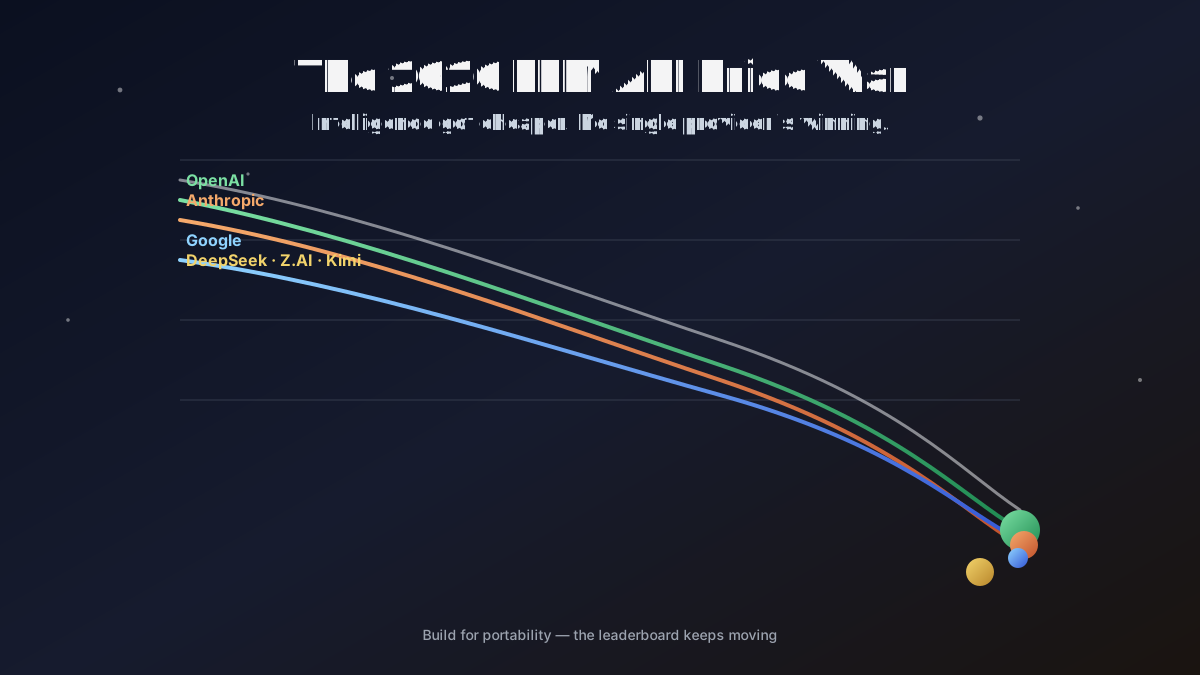
My read, after going through the available primary and secondary sources, is that the price war is real and structural, but the viral "X killed Y by 90%" framing is not. The honest take is simpler: equivalent intelligence got dramatically cheaper, no single provider is dominant on price, and the practical move is to build vendor-portable workflows instead of locking into whoever happens to be cheapest this week.
What is actually verified (mid-2026)
Let me separate what is reported by primary outlets from what is being reshared by content farms.
- OpenAI weighing price cuts. In June 2026, the Wall Street Journal, Bloomberg, and CNBC all reported that OpenAI is considering significant price cuts to compete with Anthropic and win Claude users. These are primary business outlets; the reporting is that cuts are being considered, not that a new published price sheet exists yet. Treat the exact percentages floating around social media as unverified until OpenAI updates its official pricing page.
- Google cut the consumer tier. Sherwood News and others reported Google dropping its entry-level AI Plus subscription from $7.99 to $4.99 per month. This is a consumer-subscription move, not a direct API price, but it signals that Google is willing to use price as a weapon across both surfaces.
- DeepSeek V4 in preview. Multiple outlets reported a DeepSeek V4 preview claiming a 91.3% MMLU score — edged ahead of an OpenAI flagship in that benchmark — at roughly 85% lower cost than GPT-5.5. The benchmark claim should be read as DeepSeek-reported until an independent eval confirms it, but the cost direction is consistent with DeepSeek's historical pattern.
- Chinese labs closing the gap. The New York Times reported that Z.AI's GLM-5.2 (released mid-June 2026) and other Chinese models are gaining ground, partly because U.S. businesses are actively looking for cost savings. This is a primary-source business story, not a viral chart.
The common thread: every credible signal points the same direction. Per-token prices for equivalent intelligence are falling fast, and the fight is now across U.S. incumbents (OpenAI, Anthropic, Google) and aggressive challengers (DeepSeek, Z.AI/GLM, Kimi, Qwen).
A snapshot of where prices sit (with caveats)
The numbers below come from public provider pages and secondary aggregators as of mid-2026. API pricing changes frequently, so verify against the official provider page before you buy. Treat aggregator numbers as indicative, not contractual.
| Provider | Representative model | Rough input / output per 1M tokens | Note |
|---|---|---|---|
| Gemini Flash-Lite | ~$0.075 / $0.30 | Cheapest tier; good for high-volume routing | |
| Z.AI | GLM-5.2 | ~$1.40 / $4 | Strong price-to-capability ratio; on our AI pricing page |
| Gemini 3.1 Pro | ~$2 / $12 | Mid-tier frontier | |
| OpenAI | GPT-5.4 | ~$2.50 / $10 | Mid-tier frontier |
| Anthropic | Claude Sonnet 4.6 | ~$3 / $15 | Premium mid-tier |
| Anthropic | Claude Opus 4.x | ~$15 and up | Premium tier |
Two honest caveats. First, "input/output per million tokens" is not the whole bill. You also pay for cached prompts, context length, vision, tool calls, batch discounts, and — for agents — multi-step runs that multiply token use by the number of steps. Second, the cheapest model is rarely the right default. A model that is 5x cheaper but needs 3x more tokens to finish a task is not actually cheaper.
What is overhyped
A few claims deserve skepticism:
- "Costs collapsed 90–97%." This is directionally plausible over a multi-year horizon, but the viral charts rarely show methodology or a fixed benchmark. The honest version is: for equivalent intelligence on a fixed task, real prices have fallen a lot — but the exact percentage depends entirely on which two models you compare.
- "Provider X is now the cheapest, so switch everything." Cheapest today is not cheapest next month. Labs are cutting prices in response to each other, which means the leaderboard moves. The win is not picking the current cheapest; the win is being able to move when the leaderboard moves.
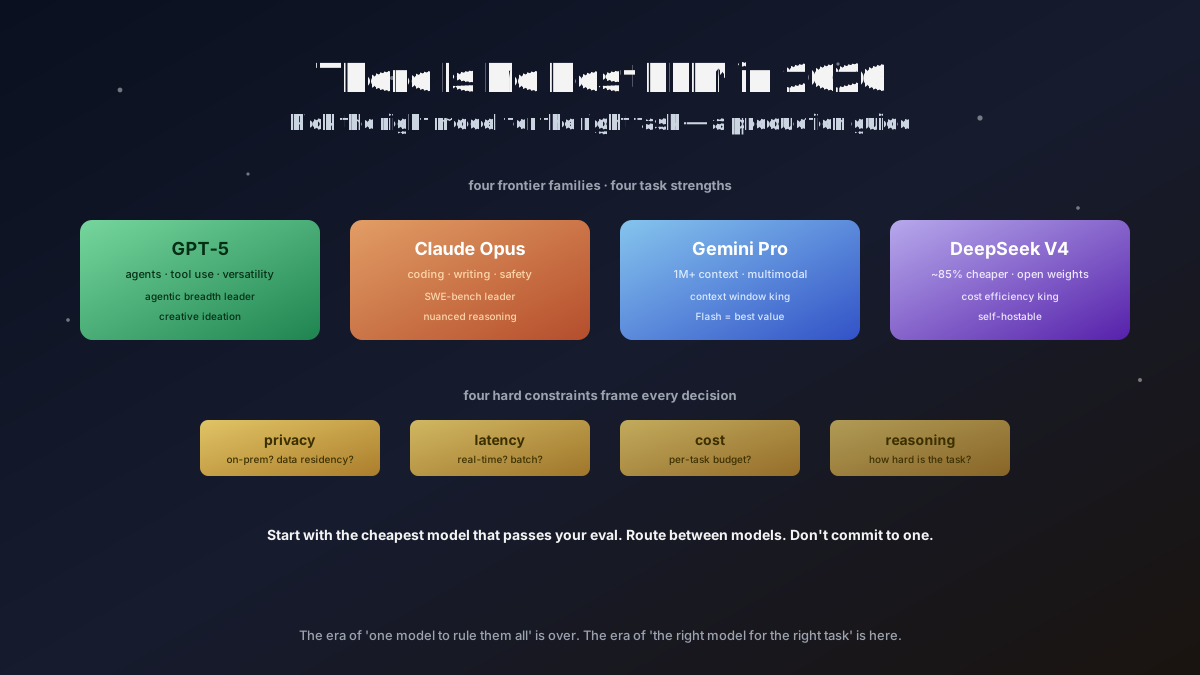
- "Benchmark X proves model Y beats Z." DeepSeek V4's reported MMLU number is impressive, but MMLU is one benchmark. A coding task, a long-context retrieval task, and a structured-output task can rank models very differently. Price wars are real; benchmark wars are noisier than they look.
The sharp edges that are not in the launch copy
Buying API capacity in 2026 means accepting some non-obvious risk:
- Price is a moving target, but your code is not. If you hard-code routing to one provider because it was cheapest last week, you eat the difference every time the leaderboard inverts. Model routing should be a config, not a refactor.
- Cheaper tokens can mean more tokens. Agentic workflows that loop, retry, and self-correct can spend more total tokens than a single stronger-model call would have. The unit price going down does not protect you if the unit count goes up.
- Region and account risk now affect price. If your provider is blocked or throttled in a region you depend on, your effective price can spike to whatever the next-best provider charges — or to infinity if you have no fallback. Diversity is a cost-control measure, not just a reliability measure.
- Vendor lock-in hides in the SDK. The deeper a provider's SDK, function-calling shape, or fine-tune pipeline gets into your code, the harder it is to switch for a 30% price difference. Portability has a real dollar value.
How to actually buy in a price war
The practical advice I would give a team buying API capacity in mid-2026:
- Decide what "good enough" means on your real tasks, not on a leaderboard. Run your actual workload — your prompts, your evals, your latency budget — and pick the cheapest model that clears your quality bar on those tasks.
- Treat routing as a first-class concern. Use a gateway, a router, or at minimum a thin abstraction so you can move traffic between providers when prices move. If switching providers is a multi-week refactor, you are losing the price war even if you are not in it.
- Track total cost, not unit cost. Log tokens in, tokens out, retries, tool calls, and cache hits per task. The provider with the cheapest input token often loses on a per-task basis once retries and long-context fills are counted.
- Keep at least two providers warm. One for the primary route, one as a fallback for both price spikes and outages. The cost of keeping a second integration alive is small; the cost of having no fallback in a price war is large.
- Read primary sources over aggregator charts. Provider pricing pages, official release notes, and primary business reporting (WSJ, Bloomberg, NYT) tell you more than reshared infographics.
My take
The 2026 LLM price war is genuinely good for developers, but only the ones who build for it. If you treat price as a one-time decision — "pick the cheapest provider and move on" — you will be repricing your stack every quarter and resenting it. If you treat provider choice as an ongoing, reversible decision — routing layer, multi-provider fallback, per-task cost tracking — then every price cut becomes a windfall instead of a migration project.
The deeper story underneath the price war is that intelligence is being commoditized faster than vendors can build moats around it. That is exactly why portability wins. The teams that come out ahead in 2026 are not the ones who bet on the right lab. They are the ones whose architecture survives the next three price inversions — because there will be at least three.
If you want a maintained reference table for the providers in this article, including the ones tracked on our site, see our AI pricing data page. It is seed-curated and admin-reviewed for corrections, not a real-time market feed, but it is a useful starting point for comparing providers side by side. For the practical "how to route between these providers without rewriting your code" companion piece, see Stop hard-coding one LLM provider: a 2026 guide to API routing and fallback. For the third piece in this cluster — how to actually measure what each task costs you across providers, retries, and tool calls — see Per-token billing is lying to you: a 2026 guide to measuring LLM cost per task.
Sources
- WSJ: OpenAI considers drastic price cuts anticipating war for users with Anthropic
- Sherwood News: Google cuts consumer AI Plus subscription to $4.99
- NYT: Chinese A.I. models gain ground as U.S. businesses seek cost savings
- CNN: China's AI upstart DeepSeek drops new model
- The Business Journal: China's DeepSeek rolls out a long-anticipated update
- Mashable: DeepSeek V4 preview comparison
- Anthropic: Claude platform pricing
- Google AI: Gemini API pricing
- OpenAI: API pricing
- Simon Willison: LLM pricing notes
Related
Your RAG demo worked on three PDFs and broke on the real corpus. That is not a mystery; it is the predictable cost of treating retrieval as a default instead of an engineering decision. Industry analysis in 2026 finds that when RAG fails, the failure point is retrieval roughly seven times in ten — not generation. Here is a source-checked diagnostic guide to production RAG in 2026: where it actually breaks (chunking, embedding, retrieval, staleness), the metrics that locate the break, and why RAG did not eliminate hallucinations so much as relocate them somewhere harder to see.
Chunking is the single highest-leverage and most under-treated decision in a RAG pipeline, and most teams leave it on the default. Here is a source-checked 2026 guide to the five chunking strategies that actually matter — fixed, recursive, semantic, late, and proposition-based — when to use each, the retrieval-quality tradeoffs, and why the right answer is never 'whatever the tutorial used.'