Claude Code, Cursor, or Copilot in 2026: a developer's honest switchboard
The AI coding tool market did not just add features in 2026 — it inverted. Claude Code reportedly overtook Cursor and GitHub Copilot in professional usage by Q1 2026, while Copilot split into three tools and Cursor rebuilt itself as an agent switchboard. Here is what actually changed, what is overhyped, and how to choose without betting your workflow on marketing.
The AI coding tool story for 2026 is not "one tool got better." It is that the entire shape of the market inverted in roughly eight months. A terminal-native agent from Anthropic reportedly overtook both the AI-native IDE favorite and Microsoft's incumbent. Cursor stopped being one thing and rebuilt itself as a switchboard. GitHub Copilot stopped being one thing and split into three. If you are a developer trying to pick a primary tool right now, the old "which IDE feels best" question is the wrong question. The real question is what kind of workflow you are actually betting on.
My read, after looking at the available 2026 sources, is blunt: there is no single winner, and the loudest claims deserve a footnote. But there is a real shift underneath the hype. Developers are no longer choosing a completion engine. They are choosing how much autonomy, vendor lock-in, and workflow risk they want to accept. That is a very different decision than picking an editor.
What reportedly changed: the inversion
Several 2026 comparison sources — mostly secondary AI-content blogs, so treat the exact numbers with caution — point to the same direction:
- Claude Code's professional usage share rose sharply through 2025 and into Q1 2026, with multiple sources calling it the fastest adoption reversal in developer tooling in recent memory.
- Cursor kept the AI-native IDE lead but growth is described as slowing, and Cursor 3.0 is now positioning itself as an "agent switchboard" that can orchestrate multiple models rather than just one editor experience.
- GitHub Copilot is under renewed pressure. Public coverage describes Microsoft working to deepen Copilot's agentic capabilities, and the product is now effectively three separate tools rather than one assistant.
The honest caveat: I could not find a primary survey (Stack Overflow Developer Survey, JetBrains Developer Ecosystem, or GitHub Octoverse) that independently confirms the most-cited percentages. The direction is consistent across many independent secondary sources, which is meaningful, but the specific numbers floating around should be read as reported, not as verified fact. What is verifiable is the structural shift: the market used to be "Copilot plus everyone else." It is now three different philosophies competing for the same developer.
Three philosophies, not three tools
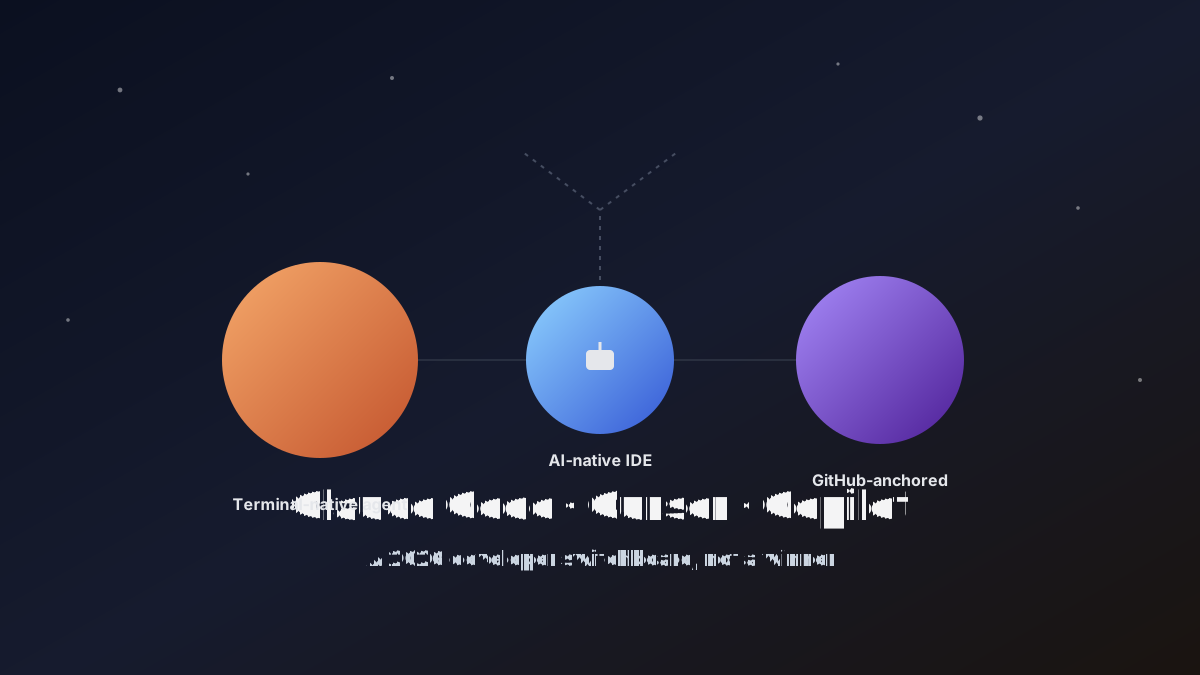
The practical decision in 2026 is not which tool is "best." It is which philosophy matches your work.
| Philosophy | Best fit | Watch out for |
|---|---|---|
| Terminal-native autonomous agent (Claude Code) | Long multi-file work, migrations, agentic runs that should happen while you do something else | Workflow state and code path can feel opaque; needs disciplined review gates |
| AI-native IDE (Cursor) | Frontend, side-by-side editing, fast inline iteration, multi-model flexibility | You are buying into one editor's UX and roadmap |
| GitHub-anchored assistant (Copilot) | Teams already standardized on GitHub, compliance-heavy shops | Agentic capabilities reportedly still catching up to the other two |
The reason this framing matters: developers who pick Claude Code for autonomy and then complain it is not a great inline-completion IDE, or who pick Cursor for inline speed and then complain it does not run a 40-file migration while they sleep, are not really evaluating the tools. They are mismatching philosophies.
What is actually overhyped
A few claims deserve skepticism:
- "X killed Y." No. Copilot is not dead; it is entrenched in GitHub-native organizations. Cursor is not dying; it still owns the inline-first IDE feel. Claude Code is not universal; many teams have not adopted any terminal-agent workflow at all.
- Precise market-share percentages without a primary source. Most viral charts trace back to AI-content blogs with unclear methodology. The direction is plausible; the exact numbers are marketing until a primary survey confirms them.
- "Just use the strongest model." Model quality matters, but the practical bottleneck in 2026 is workflow trust, account stability, and how well a tool handles refusals, retries, and human review. A stronger model behind an unpredictable account is not a productivity win.
The sharp edges that are not in the launch copy
Choosing a coding agent in 2026 means accepting some non-obvious risk:
- Account and region risk. If your tool is tied to one provider's account system, a suspension or a region-policy change can interrupt production workflows. Keep project docs, prompts, and source in your own repo, not trapped inside the agent's conversation history.
- Autonomy without review is a liability. The more a tool can do across many files, the more it can break across many files. Treat agent output like a junior PR: review every diff before it ships, even when it feels done.
- Vendor lock-in hides in the workflow. The deeper an agent integrates with your repo conventions, scripts, and review process, the harder it is to switch later. Portability is a feature, not a nice-to-have.
How to choose without betting on hype
The practical advice I would give a team choosing right now:
- Decide what work you actually want automated. If it is "long migrations and multi-file refactors while I review," lean toward Claude Code. If it is "fast inline help while I write frontend," lean toward Cursor. If it is "stay inside our GitHub-native compliance posture," lean toward Copilot.
- Run a real two-week trial on one project, not a toy benchmark. Measure tokens used, time saved, review burden, and number of rollbacks.
- Do not commit your durable workflow to one tool. Keep prompts, configs, and scripts portable so you can switch when the market inverts again — because it will.
- Read primary sources over viral charts. Anthropic's product page, GitHub's official changelog, and Cursor's release notes tell you more about capability than any "X killed Y" headline.
My take
The 2026 coding-agent market is genuinely more interesting than a year ago, but the loudest narrative — one tool won — is lazy. The truth is developers now have three coherent philosophies to choose between, and the right choice depends on the shape of your work, not on a market-share chart.
If I were standardizing a team today, I would pick a primary tool based on workflow fit, keep a second tool as a real option, and treat all three vendors as replaceable infrastructure rather than as a religion. Tools will keep inverting. The teams that win are the ones whose workflow survives the next inversion.
Sources
- Anthropic: Claude Code product page
- Anthropic: Enabling Claude Code to work more autonomously
- Claude Code Statistics 2026 — Gradually.ai (secondary; methodology not detailed)
- Claude Code vs Cursor vs Copilot: The 2026 Developer Comparison — SitePoint
- Claude Code vs Cursor vs GitHub Copilot in April 2026 — AI Plain English (secondary)
- 5 Best AI Coding Agents in 2026 — Fungies.io (secondary)
- Claude Code vs Cursor vs Copilot: 2026 Security Comparison — MintMCP
Related

Sonnet 5 is not just a friendly price cut. It is Anthropic's answer to developer cost anxiety, account-enforcement frustration, and the pressure to make agents run at scale. Claude is still powerful, but platform trust is becoming the real bottleneck.

A Chinese report says Alibaba has told employees to uninstall Claude and Claude Code. The internal ban itself is not publicly confirmed, but Anthropic's China restrictions, distillation accusations, Claude Code marker controversy, and the U.S. 1260H list all point to the same lesson: AI coding tools are now supply-chain risk, not just productivity software.