Structured output is not reliable output: a 2026 production guide to JSON, schemas, and the reliability stack you actually need
You switched on JSON mode and your LLM now returns valid JSON. The problem: valid JSON that conforms to a schema can still be semantically wrong, and production reliability is not a single feature you enable — it is a stack of layers you build. Here is a source-checked 2026 guide to structured output in production: JSON mode vs. schema-enforced structured output vs. function calling, when to use each, why Pydantic and Zod are not optional, and why 'the JSON parsed' is the beginning of reliability, not the end.
This is the third piece in the prompt engineering cluster, completing a techniques → security → reliability loop. Stop cargo-culting prompt tricks covered which prompting techniques to use when. Prompt injection is OWASP's #1 threat covered the security dimension. This piece covers the output dimension: when your LLM must produce machine-readable structured data, how do you make that reliable enough for production?
My read, after going through the structured-output literature, is blunt: most teams conflate "the JSON parsed" with "the output is correct," and those are very different things. JSON mode guarantees the former; it does nothing for the latter. A response can be perfectly valid JSON, conform to your schema, and still be semantically wrong — the wrong values, the wrong entities, the right shape filled with the wrong content. The teams that ship reliable structured-output features in 2026 are not the ones who turned on JSON mode and stopped. They are the ones who built a reliability stack — schema validation, retry logic, semantic checking, and output auditing — because they understand that structure is the floor of reliability, not the ceiling.
The three approaches, and what each actually guarantees
The 2026 structured-output landscape has three distinct mechanisms, each with a different guarantee level. The Vellum and Towards Data Science decision guides frame them cleanly.
1. JSON mode (the floor)
The provider guarantees the response is valid JSON — syntactically parseable, no trailing commas, balanced braces. That is all it guarantees. The JSON can have any keys, any values, any structure. JSON mode prevents "the model returned prose when I asked for JSON"; it does not prevent "the model returned JSON with the wrong fields."
- Use when: you need any valid JSON and your downstream code is tolerant of varying structure.
- Do not use when: you have a specific schema the output must conform to. Use structured output instead.
2. Structured output / schema enforcement (the middle)
The provider guarantees the response conforms to a specific JSON Schema you define — the right fields, the right types, the right constraints (enums, ranges, required vs. optional). OpenAI's structured outputs, Anthropic's tool-use schema, and Google's controlled generation all provide this. This is meaningfully stronger than JSON mode: it guarantees the shape is right.
- Use when: you have a defined schema and you want the provider to enforce it at generation time, not just at parse time.
- The limitation: it guarantees the shape, not the content. A schema-compliant
{"sentiment": "positive"}can still be wrong — the text was negative and the model misclassified it. Structure is not semantics.
3. Function calling / tool use (the full mechanism)
The model is given a set of tools (functions) with typed parameters, and it decides whether and which to call with what arguments. This is the most structured mechanism: the provider manages the schema enforcement and the routing, and the model's output is a structured function call rather than freeform JSON.
- Use when: your LLM needs to take actions (call APIs, query databases, trigger tools) with structured arguments, not just return data.
- The limitation: the same content-reliability gap applies. The model can call the right function with the wrong arguments — perfectly structured, semantically incorrect.
Why "structured" is not "reliable"
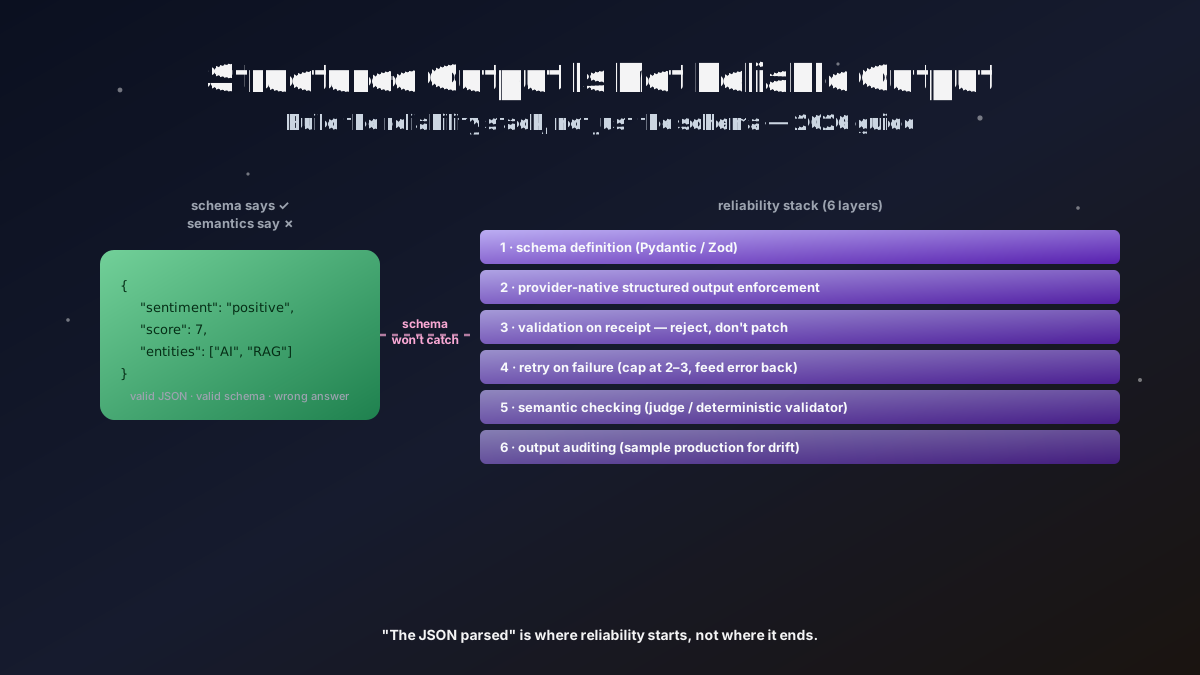
This is the most important point in the piece, and the one most teams miss. The Rotascale analysis names it sharply: structured output is not reliable output. Schema compliance covers one row of a multi-row reliability stack. A response that passes schema validation can still fail in any of these ways:
- Wrong values. The schema says
{"score": number}, the model returns{"score": 7}for an input whose correct score is 3. Valid JSON, valid schema, wrong answer. - Hallucinated content. The schema says
{"entities": string[]}, the model returns entities that do not appear in the source text. Structured hallucination is still hallucination. - Inconsistent typing intent. The schema says
{"date": string}, the model returns "last Tuesday" as a string. Valid against the schema, useless as a date. - Missing nuance. The schema has a category enum, the model picks a category that is technically valid but misses the nuance a human would have captured.
The discipline this implies: schema validation is one layer of the reliability stack, not the whole stack. You also need semantic checking (did the model actually answer the question, not just produce a valid object), retry logic (when the output fails validation or semantic checks, retry with the error fed back), and output auditing (sample and review production outputs for semantic correctness, because schema compliance will not catch semantic drift).
The production reliability stack
Drawing on the TECHSY Pydantic/Zod guide, the Collin Wilkins schema-validation article, and the Rotascale reliability framework, here is the stack I would build for any structured-output feature:
- Schema definition (Pydantic or Zod). Define your output schema as code, not as a comment in a prompt. Pydantic (Python) and Zod (TypeScript/JS) are the dominant libraries. The schema is your contract with the model and your validation layer for the output.
- Provider-native structured output. Use the provider's schema-enforcement feature (OpenAI structured outputs, Anthropic tool use, Google controlled generation) rather than asking for JSON in the prompt and hoping. Native enforcement is materially more reliable than prompt-based JSON requests.
- Validation on receipt. When the model returns, validate the output against the schema in your code. Reject outputs that do not conform; do not try to patch them. This catches the structural failures.
- Retry on failure. When validation fails, retry — ideally with the validation error fed back to the model so it can correct. Cap retries (two or three) to avoid cost spirals.
- Semantic checking. For high-stakes fields, add a semantic check beyond schema: did the model classify correctly, did it extract the right entities, is the score reasonable? This is where a calibrated LLM judge or a deterministic validator adds value.
- Output auditing. Sample production outputs periodically and review them for semantic correctness. Schema compliance will not tell you when the model starts returning subtly wrong values; auditing will.
The sharp edges that are not in the marketing copy
A few risks worth knowing:
- Complex nested schemas are less reliable. The deeper and more complex your schema, the more likely the model is to produce structural errors even with schema enforcement. Keep schemas as flat as you reasonably can.
- Structured output can constrain the model's reasoning. Forcing the model to produce a specific structure can sometimes lower answer quality, because the structure constrains how the model "thinks." For hard reasoning tasks, consider letting the model reason in freeform text first, then structure the final answer.
- Streaming + structured output is hard. If you stream partial outputs to the user, you cannot validate until the stream completes, which means partial outputs may be structurally invalid mid-stream. Design the UX for this.
- Function calling is not free of prompt-injection risk. A prompt injection can induce the model to call a function with malicious arguments. The function-calling mechanism structures the attack; it does not prevent it.
- Benchmarks for structured output are themselves unreliable. The Cleanlab critique of structured-output benchmarks is worth reading: many benchmarks measure the wrong thing, and a high benchmark score does not predict reliability on your specific schema and domain. Test on your own data.
How this connects to the rest of the stack
Structured output is the bridge between LLM output and the rest of your application, which is why it connects to every prior cluster:
- It consumes the prompting techniques — structured output is a prompting decision, and the system prompt is where you define the schema contract.
- It inherits the injection risk — a function call is an action, and actions need sandboxing.
- It feeds your evaluation pipeline — structured outputs can be evaluated deterministically (schema validation) and semantically (judge), making them some of the easiest outputs to eval well.
- It pairs with per-task cost observability — retry loops add cost, and you need to know whether your reliability stack is worth what it spends.
My take
The 2026 story is that structured output matured from "ask for JSON and pray" into a real engineering discipline, but most teams stopped at the first layer — turning on JSON mode — and treated it as the solution. It is the floor. The ceiling is a reliability stack: schema definition, native enforcement, validation, retry, semantic checking, and auditing. The teams whose structured-output features are reliable in production are the ones who built the full stack and accepted that "the JSON parsed" is where reliability starts, not where it ends.
If you take one thing from this piece: schema compliance guarantees structure, not correctness. Build the layers that check correctness, or your beautifully structured output will be beautifully wrong.
This is the third piece in the prompt engineering cluster. Start with Stop cargo-culting prompt tricks for the prompting foundation, then Prompt injection defense for security, then this piece for output reliability. For how to evaluate whether your structured outputs are semantically correct, see the LLM evaluation cluster. For a maintained provider reference, see our AI pricing data page.
Sources
- dev.to: LLM structured output in 2026 — stop parsing JSON with regex
- Vellum: When should I use function calling, structured outputs, or JSON mode?
- Towards Data Science: Structured outputs with LLMs — JSON mode, function calling, when to use each
- TECHSY: Reliable JSON from any LLM — Pydantic + Zod (2026)
- Agenta: The guide to structured outputs and function calling with LLMs
- Rotascale: Structured output isn't reliable output
- Collin Wilkins: LLM structured outputs — schema validation for real pipelines
- arXiv 2606.09395: Empirical study for structured output control in LLMs
- Cleanlab: LLM structured output benchmarks are riddled with flaws
- AWS Builder: How to get structured output from LLMs — a practical guide
- Our cluster: Stop cargo-culting prompt tricks
- Our cluster: Prompt injection defense
- Our eval cluster: LLM-as-judge calibration
- Our eval cluster: Pass@1 is not quality
- Our pricing cluster: per-task cost observability
Related
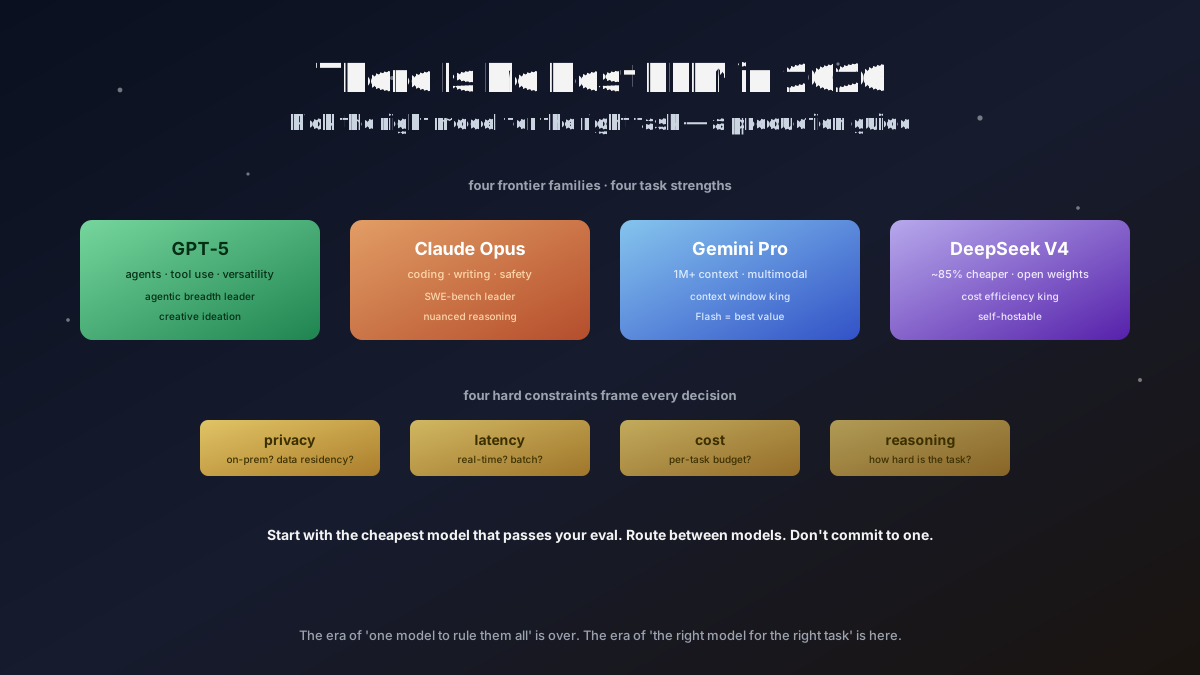
The question 'which LLM is best?' is the wrong question in 2026. There is no best model — there is the best model for your specific task, at your specific scale, under your specific constraints. Here is a source-checked guide to production LLM model selection: the four frontier families (GPT, Claude, Gemini, DeepSeek), which task each wins, the four hard constraints that frame every decision (privacy, latency, cost, reasoning depth), and why the dominant 2026 pattern is model routing — using multiple models in parallel, not picking one winner.
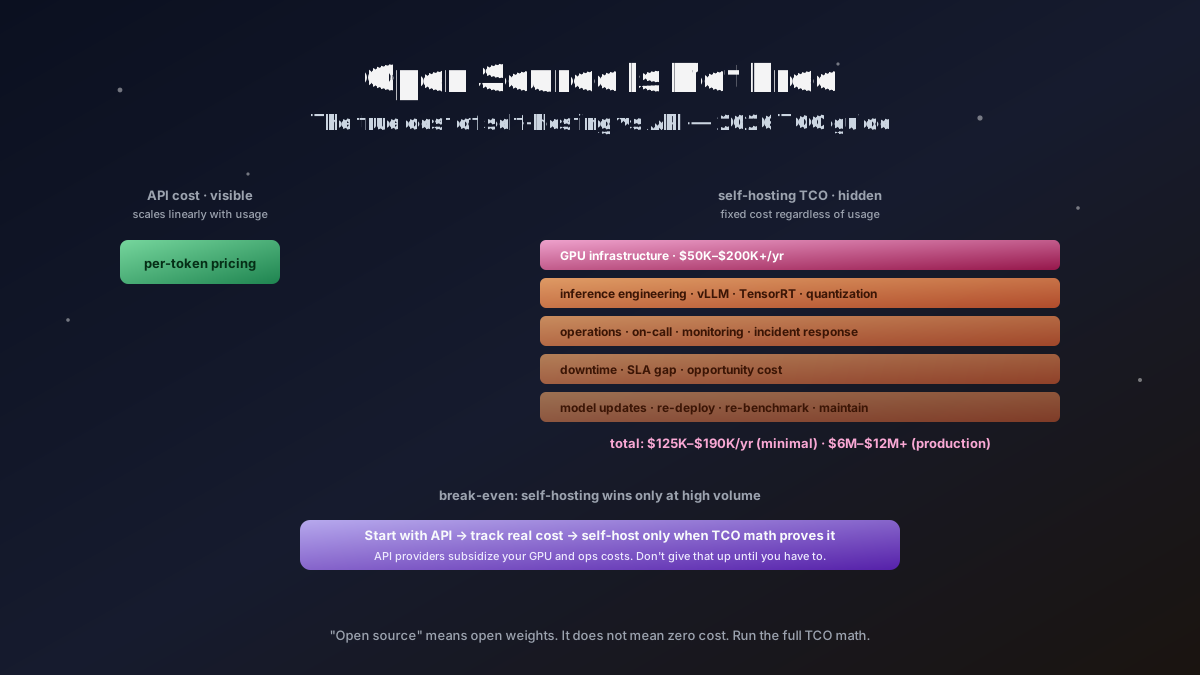
The pitch is seductive: self-host an open-source LLM and stop paying per-token API fees. The reality is that a minimal self-hosted deployment can cost $125K–$190K per year, and production-scale deployments can reach millions. Here is a source-checked 2026 guide to the true cost of ownership for open-source vs commercial LLMs: the hidden costs of self-hosting (GPU, ops, inference optimization, downtime), the break-even volume where self-hosting wins, and why most teams should start with API and move to self-hosting only when the math genuinely justifies it.