All posts
Read time 9 min

An agent loop without guardrails is a runaway: a 2026 production guide to AI agent architecture

Everyone is building AI agents in 2026. Very few are building them with the architecture they need to survive production. Here is a source-checked guide to production agent architecture: the core agent loop (reason, act, observe, repeat), the four patterns that matter (ReAct, Plan-and-Execute, tool-use, multi-agent), when single-agent beats multi-agent, why memory does not belong in the prompt, and the production layers — guardrails, observability, evaluation, cost control — that separate an agent demo from an agent you can ship.

AI agent architecture production 2026 cover

This piece opens a sixth topic cluster — production AI agent architecture — alongside our LLM pricing, AI coding workflow, LLM evaluation, production RAG, and prompt engineering clusters. It also pulls together every prior cluster into one place: an agent uses prompts, may use RAG, needs evaluation, incurs costs, and requires security — agent architecture is where all five prior disciplines converge.

My read, after going through the agent architecture literature, is blunt: the gap between an agent demo and a production agent is enormous, and it is almost entirely in the layers teams skip. The demo works because it runs three steps on a clean input in a controlled environment. Production breaks because the agent runs thirty steps on noisy inputs, hits tool failures, loops, drifts, and spends money you did not budget — all without a human watching. The teams that ship production agents are not the ones with the smartest model or the most tools. They are the ones who built the loop, the guardrails, the observability, and the cost controls around it.

The core: the agent loop

Every production agent, regardless of framework, is built on the same fundamental loop:

  1. Reason. The model receives a task and its current state (what it has done so far, what tools are available, what it has observed), and decides what to do next.
  2. Act. The model takes an action — typically calling a tool (search, code execution, API call, database query) or producing a final answer.
  3. Observe. The system feeds the action's result back to the model as new context.
  4. Repeat until the task is complete, the agent decides it cannot proceed, or a guardrail stops it.

This is the ReAct pattern (Reason, Act, Observe), and it is still the foundational loop for single-agent systems in 2026. Most agent frameworks — LangGraph, CrewAI, Microsoft Agent Framework — implement variations of it. The loop is simple; making it survive production is not.

The four patterns that matter

Drawing on the Towards AI design-patterns guide and the Redis architecture breakdown, here are the patterns worth knowing and when each wins.

1. ReAct (the default single-agent loop)

The model reasons about each step, calls a tool, observes the result, and loops. Best for tasks where each step depends on the previous one and the agent needs to adapt its plan as it learns.

  • Use when: the task is sequential and adaptive — research, multi-step retrieval, iterative code editing.
  • Risk: the loop can spiral. Without step limits and cost caps, a stuck agent will retry forever.

2. Plan-and-Execute

The agent first decomposes the task into a plan (a list of subtasks), then executes each subtask, possibly with a different agent or tool per subtask. Best when the task has a clear structure that benefits from upfront decomposition.

  • Use when: the task is decomposable and the subtasks are relatively independent — "research these five things, then synthesize."
  • Risk: the plan can be wrong. If step 1's result invalidates step 3's premise, a rigid plan-and-execute agent will execute a stale plan. Build in re-planning.

3. Tool-use orchestration

Not a separate loop, but a discipline applied to any loop: how the agent selects tools, validates inputs, handles tool failures, retries, and decides when a tool result is good enough. This is where most production agent failures live — not in the reasoning, but in the tool boundary.

  • The discipline: every tool call needs input validation, timeout, retry with backoff, and result validation. An agent that calls a tool that hangs, or trusts a tool result that is malformed, will fail in ways the reasoning layer cannot recover from.

4. Multi-agent collaboration

Multiple agents, each with a specialized role, communicate and coordinate to solve a task. Best when responsibilities are clearly separable — one agent researches, one writes, one reviews.

  • Use when: the task has clear role boundaries and the coordination overhead is worth it.
  • Risk: coordination overhead, message-passing failures, and the "telephone game" — information degrades as it passes between agents. Production multi-agent systems need circuit breakers on agent-to-agent calls and message trace logging, or they become impossible to debug.
  • When single-agent wins: if you are considering multi-agent for a task that one strong agent can handle with good tools, you are adding complexity without benefit. Start single-agent; go multi-agent only when the single agent demonstrably cannot handle the scope.

The production layers that separate a demo from a shipped agent

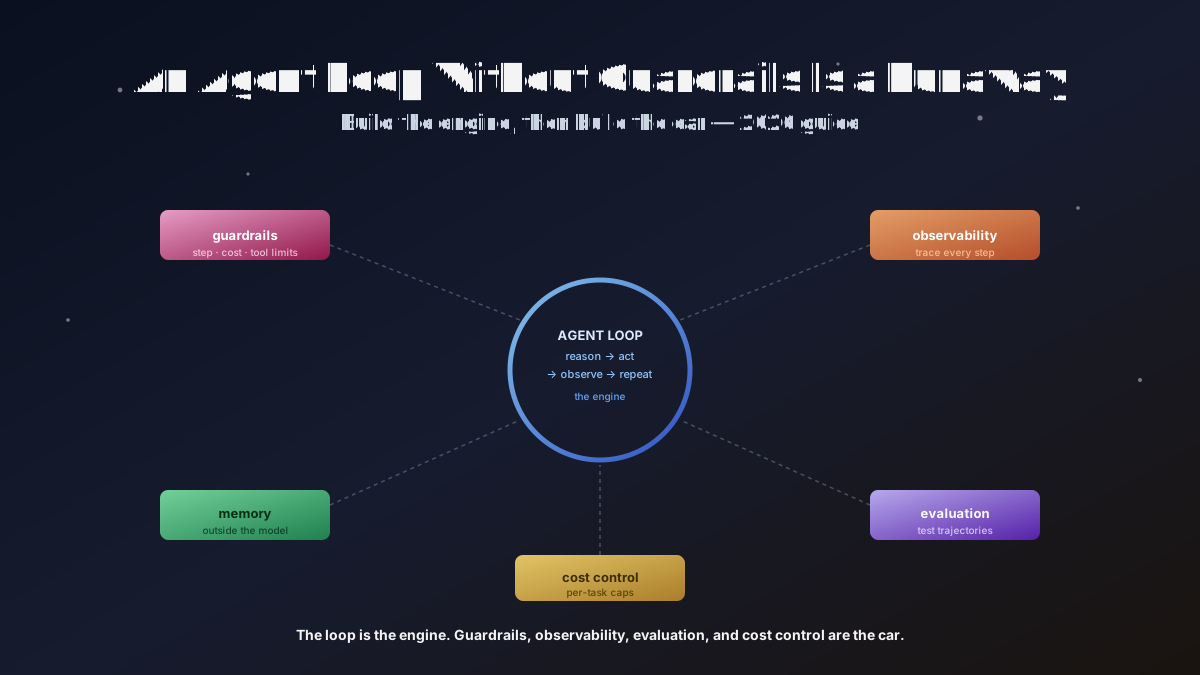
The agent loop is the engine. Production reliability is everything else. Here are the layers that matter, each connecting to a prior cluster:

Guardrails (stop the agent before it harms itself or you)

Every production agent needs hard limits: maximum steps, maximum cost, maximum runtime, tool allow-lists, and action approval gates for destructive operations. These are not optional. An agent without guardrails is one prompt injection or one infinite loop away from a budget-destroying or data-destroying incident.

This connects directly to the prompt injection defense and the code review discipline pieces: an autonomous agent needs the same trust-boundary discipline as any system that can take actions.

Memory (do not put it in the prompt)

A common mistake: using the model's context window as the memory system. As the agent runs more steps, the context grows, until it hits the token limit, at which point either the agent loses early context or you pay escalating costs for a bloated prompt.

The production pattern: store memory outside the model — in a database, a vector store, or a dedicated memory layer — and selectively inject only what is relevant to the current step. The Hugging Face discussion on long-running agent memory states the principle sharply: do not make the prompt the memory system.

Observability (you cannot debug what you cannot see)

Every agent step, tool call, and decision must be logged with enough detail to reconstruct what happened. This is trajectory-level observability — the same discipline our LLM evaluation cluster applies to evaluation, applied here to production runs. Tools like Langfuse, LangSmith, and Phoenix provide this; the discipline is turning it on and actually using the traces when something goes wrong.

Evaluation (test the agent, not just the model)

An agent is more than its model. You need to evaluate the full trajectory — did the agent pick the right tools, call them with the right arguments, recover from failures, and reach the right answer? This is the golden set discipline applied to agent trajectories, and it is harder than single-turn evaluation because the space of possible trajectories is enormous. Start small: a handful of representative tasks, scored on outcome and trajectory quality.

Cost control (agents spend money autonomously)

An agent that loops 20 times, calling a frontier model each step, can spend more in one task than a hundred single-call interactions. This is why per-task cost observability is not optional for agents — it is the only way to know whether your agent is cost-viable before it runs up a bill. Set per-task cost caps, track cost per trajectory, and alert when an agent run exceeds its budget.

The sharp edges that are not in the marketing copy

A few risks worth knowing:

  • More tools is not better. Every tool you give an agent increases the decision space and the failure surface. An agent with three well-chosen tools often outperforms an agent with fifteen, because it is less likely to pick the wrong one.
  • Autonomy without observability is negligence. If you cannot reconstruct what an agent did after the fact, you cannot debug it, cannot improve it, and cannot prove it behaved correctly. Observability is not a nice-to-have; it is the precondition for trusting an agent in production.
  • Multi-agent is harder than it looks. The coordination overhead, debugging complexity, and failure modes of multi-agent systems are substantially worse than single-agent. Do not go multi-agent because it sounds more sophisticated; go multi-agent when you have evidence that a single agent cannot handle the task.
  • Agents amplify every other failure mode. A prompt injection that would be a minor incident in a single-call system becomes a major incident when the agent acts on it across twenty steps. A RAG retrieval failure that would produce one bad answer produces a chain of bad decisions when the agent builds on it. The agent does not eliminate failure modes; it compounds them.
  • Framework lock-in is real. Agent frameworks (LangGraph, CrewAI, etc.) abstract the loop, but they also impose their architecture on you. Understand the loop before you adopt the framework, or you will be unable to debug what the framework does.

How to actually build a production agent in 2026

The practical path:

  1. Start with a single-agent ReAct loop. Build the reason-act-observe loop yourself, or with a minimal framework. Do not start with multi-agent.
  2. Add guardrails before you add tools. Step limits, cost caps, tool allow-lists, and approval gates for destructive actions. These are the seatbelts.
  3. Choose three to five tools, not fifteen. Cover the task's actual needs; add more only when the agent demonstrably cannot proceed.
  4. Store memory outside the model. Inject only relevant context per step. Do not let the prompt grow unbounded.
  5. Turn on trajectory observability from day one. Every step, every tool call, every decision logged. You will need it.
  6. Evaluate on agent trajectories, not just outputs. Build a small set of representative tasks; score on outcome and trajectory quality.
  7. Track cost per trajectory. Set a per-task cost cap and alert on overruns. Agents spend money; you need to know how much.
  8. Go multi-agent only when single-agent demonstrably fails. And when you do, add circuit breakers and message tracing before you add the second agent.

My take

The 2026 story is that agent architecture is where every other LLM discipline converges — and where skipping any of them compounds. An agent uses prompts (so prompt engineering matters), may use RAG (so retrieval quality matters), needs evaluation (so golden sets and judges matter), incurs costs (so observability matters), and can take actions (so security matters). The teams that ship production agents are the ones who built the loop, then built every layer around it, and accepted that the loop is the easy part.

If you take one thing from this piece: the agent loop is the engine, but guardrails, observability, evaluation, and cost control are the car. An engine without a car is dangerous. Build the car.

This is the first piece in the production AI agent architecture cluster. For the second piece — the memory layer this piece only touches on, where the context window is RAM and memory engineering is the discipline that separates agents that scale from agents that bloat — see The context window is RAM, not storage: a 2026 production guide to AI agent memory. For the third piece — the observability layer, where if you cannot trace your agent you cannot trust your agent — see If you cannot trace your agent, you cannot trust your agent. For every discipline an agent depends on, see the five prior clusters: LLM pricing (cost), AI coding workflow (tools), LLM evaluation (quality), production RAG (retrieval), and prompt engineering (instructions). For a maintained provider reference, see our AI pricing data page.

Sources

Related