RAG did not solve hallucinations — it moved them: a 2026 guide to diagnosing why your retrieval-augmented generation fails in production
Your RAG demo worked on three PDFs and broke on the real corpus. That is not a mystery; it is the predictable cost of treating retrieval as a default instead of an engineering decision. Industry analysis in 2026 finds that when RAG fails, the failure point is retrieval roughly seven times in ten — not generation. Here is a source-checked diagnostic guide to production RAG in 2026: where it actually breaks (chunking, embedding, retrieval, staleness), the metrics that locate the break, and why RAG did not eliminate hallucinations so much as relocate them somewhere harder to see.
This piece opens a fourth topic cluster — production RAG and retrieval — alongside our LLM pricing cluster, our AI coding workflow cluster, and our LLM evaluation cluster. It also closes a conceptual loop: the evaluation cluster tells you how to measure output quality, and this cluster is about one of the most common things that goes wrong with output quality in production systems that cite external sources.
My read, after going through the practitioner literature, is blunt: the "Hello World" of RAG — chunk some PDFs, dump them in a vector database, retrieve the top-k, and hand them to a model — is dead as a production strategy. It works on a toy corpus because a toy corpus cannot surface the failure modes that real scale exposes. In production, the failure is almost never the model confidently making things up out of nothing. The failure is the model confidently making things up on top of retrieved context that was wrong, incomplete, stale, or irrelevant — and that failure is invisible unless you instrument the retrieval layer separately from the generation layer.
The core reframe: retrieval is the bottleneck, not generation
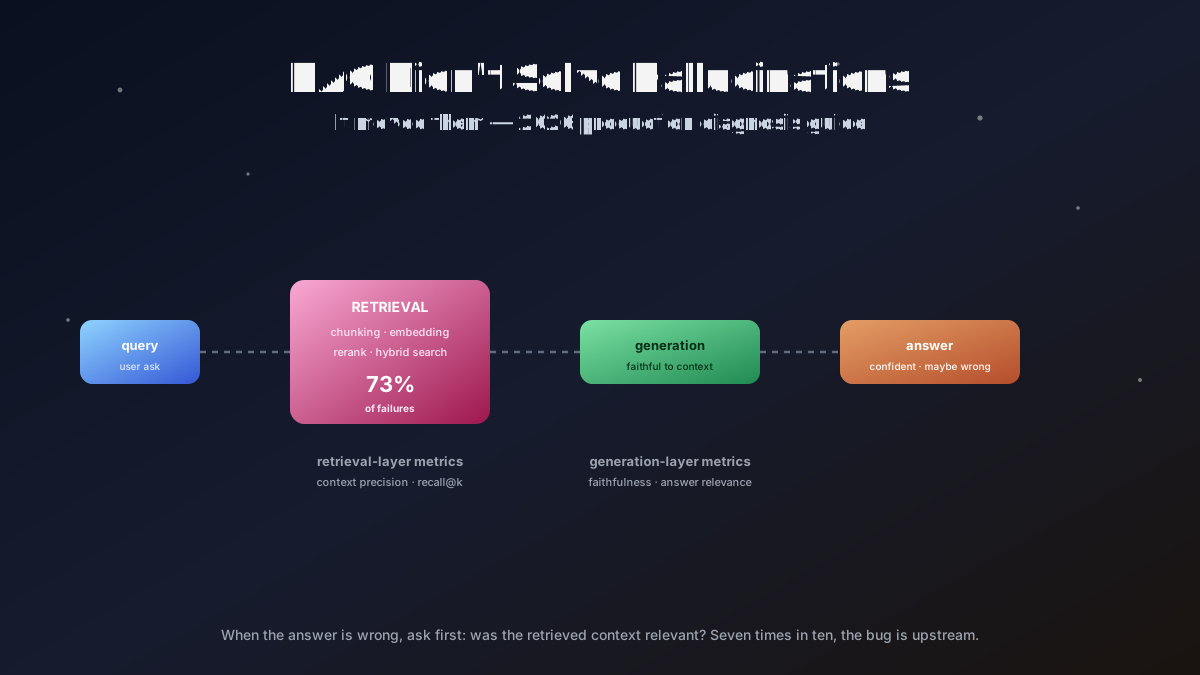
Start with the single most useful data point in the 2026 RAG literature. Industry analysis consistently finds that when RAG fails in production, the failure point is retrieval roughly 73% of the time — not generation. (Cited across multiple practitioner sources; the exact percentage varies by study, but the direction — retrieval dominates — is universal.)
This reframes the whole problem. If you are debugging a RAG system by staring at the model's output and asking "why did the model say this," you are debugging the wrong layer. The model said it because you fed it context that made saying it reasonable. The bug is upstream: in the chunking that split a coherent document into incoherent fragments, in the embedding that mapped those fragments into a space where semantic similarity did not match relevance, in the retrieval that returned the wrong fragments, or in the index that was stale relative to the source of truth.
The diagnostic discipline this implies: instrument retrieval and generation separately. Measure whether the retrieved context was relevant (a retrieval metric) and whether the answer was faithful to that context (a generation metric). If you only measure the final answer, you cannot tell whether a bad answer came from bad retrieval or bad generation — and the fix for each is completely different.
Where RAG actually breaks, layer by layer
Drawing on the practitioner sources, here is where production RAG fails, in rough order of frequency:
1. Chunking destroys semantic coherence (the silent killer)
The default in every RAG tutorial is fixed-size chunking: split the document every N tokens, with some overlap. This is an engineering default, not an engineering decision — and it is the single most common cause of bad retrieval. A fixed chunk boundary can split a coherent argument across two chunks, so neither chunk contains the full context needed to answer the question. The retriever then returns a fragment that is semantically near the query but substantively useless.
The 2026 best practice, per the Digital Applied chunking playbook and the Towards AI production guide, is to treat chunking as a deliberate strategy: semantic chunking (boundaries at meaning shifts), hierarchical chunking (parent-child relationships so the model can pull in broader context), or late chunking (embed the full document first, then chunk the embeddings). Which strategy fits depends on your document type and query patterns; the point is that "every 512 tokens" is a starting baseline to beat, not a final decision.
2. Embedding choice mismatches the domain
Embeddings map text into a vector space where "similar" means "nearby." If the embedding model was trained on generic web text and your corpus is domain-specific (legal, medical, internal code), the notion of "similar" in that space may not match the notion of "relevant" for your queries. The result: the retriever confidently returns chunks that are semantically near but topically wrong.
Diagnosis: evaluate embedding quality on your domain data, not on a generic benchmark. A common production pattern is hybrid search — combining dense (embedding) retrieval with sparse (BM25/keyword) retrieval — so that lexical matches catch what pure semantic similarity misses.
3. Retrieval returns irrelevant or incomplete context
Even with good chunking and good embeddings, top-k retrieval can fail when the right answer is at position k+1, or when the query is ambiguous and the retriever cannot tell which sense of the query matters. Two 2026 fixes consistently recommended:
- Reranking. Retrieve a larger candidate set with fast embedding search, then re-score the top candidates with a cross-encoder reranker (Cohere and others). This is repeatedly cited as the highest-leverage single optimization for retrieval quality.
- Adaptive RAG / query routing. A query classifier routes each query to the appropriate pipeline based on complexity — simple lookup, multi-hop synthesis, or conversational follow-up — instead of forcing every query through one fixed pipeline.
4. Stale context is a silent hallucination driver
This is the failure mode the Towards AI "RAG didn't solve hallucinations" piece highlights most sharply. A RAG system that retrieves from an out-of-date index will confidently produce answers that were correct when the source was written and are wrong now. The model is not hallucinating in the classical sense — it is faithfully reporting what its context says. The context is just stale.
The fix is operational, not algorithmic: pipeline observability and freshness checks. Know when your index was last refreshed, flag sources with known update cadences, and treat "the source changed" as a first-class event your pipeline reacts to.
5. The retrieval layer has no evaluation of its own
The deepest failure is meta: most teams have no evaluation for the retrieval layer at all. They measure the final answer (was it right?) and treat retrieval as a black box. But "the answer was wrong" tells you nothing about whether to fix chunking, embeddings, retrieval, reranking, or the prompt. Each of those requires a different intervention, and you cannot choose the right intervention without per-layer metrics.
The metrics that locate the break
This is where RAG evaluation connects directly to our LLM evaluation cluster. The metrics that diagnose RAG failures split across the retrieval and generation layers:
Retrieval-layer metrics (did we fetch the right context?):
- Context precision. Of the chunks retrieved, how many were actually relevant?
- Context recall. Of the relevant chunks that existed in the corpus, how many did retrieval find?
- Recall@k. Of the relevant chunks, how many appeared in the top-k returned?
Generation-layer metrics (did the model use the context correctly?):
- Faithfulness. Is the answer supported by the retrieved context, or did the model go beyond it?
- Answer relevance. Does the answer actually address the question?
- Hallucination rate. How often does the model assert things not grounded in the context?
This separation is exactly what the Ragas framework (from our eval cluster) is built for: faithfulness and answer relevance score the generation; context precision/recall score the retrieval. Maxim AI's RAG evaluation guide treats the same split as foundational. The discipline: measure both layers, separately, every time. If faithfulness drops but context precision holds, the model got worse. If faithfulness drops and context precision also dropped, retrieval got worse and the model is faithfully reporting bad context. The fixes are different; the diagnosis must be too.
The sharp edges that are not in the marketing copy
A few risks worth knowing before you standardize on a RAG architecture:
- "Semantic" retrieval is not semantic understanding. Embeddings capture distributional similarity, not comprehension. Two chunks can be "semantically similar" to a query in vector space while being substantively about different things. Treat embedding similarity as a hypothesis about relevance, not a proof of it.
- A bigger index is not a better index. Adding more documents to a RAG corpus without improving retrieval precision makes the system worse, not better, because the retriever has more chances to return a plausible-but-wrong chunk. Quality over quantity, at the index level.
- Reranking costs latency and money. A cross-encoder reranker materially improves retrieval quality and materially adds latency and per-query cost. Whether the quality lift is worth the cost depends on your use case — and this is exactly the kind of tradeoff our per-task cost observability discipline is for.
- Agentic RAG is powerful and hard to evaluate. The 2026 trend toward agentic RAG — where the model decides when to retrieve, what to retrieve, and when to retrieve again — moves the failure surface into the agent's reasoning, which is harder to evaluate than fixed retrieval. The trajectory-level evaluation point from our eval cluster applies in full force.
- RAG does not replace grounding; it relocates it. A non-RAG model hallucinates from its weights. A RAG model "hallucinates" from its retrieved context. The failure mode moved; it did not disappear. The discipline that catches it — faithfulness scoring, retrieval-layer eval, freshness checks — is the price of admission for production RAG.
How to actually diagnose your RAG system in 2026
The practical diagnostic path I would give a team:
- Instrument retrieval and generation separately. If you only measure the final answer, you cannot diagnose. Split the metrics across the two layers.
- Start with retrieval, because it fails first. Given the ~73% retrieval-failure rate, the first diagnostic question for any bad RAG answer is "was the retrieved context relevant?" If no, fix retrieval before touching the model or prompt.
- Evaluate chunking as a strategy, not a default. Try at least two chunking strategies on a held-out query set and measure retrieval recall. If semantic or hierarchical chunking beats fixed-size, switch.
- Add reranking if retrieval precision is the bottleneck. Retrieve more candidates, rerank with a cross-encoder, measure the lift. This is the single most-cited high-impact optimization.
- Measure faithfulness on every bad answer. When the answer is wrong, ask: was it wrong because the context was wrong (retrieval bug) or because the model went beyond the context (generation bug)? The fix differs.
- Add freshness checks to the pipeline. Know when each source was last indexed, and treat staleness as a first-class failure mode.
- Evaluate with the same discipline as any LLM system. Build a golden set of query-context-answer triples, calibrate your judge, and track retrieval and generation metrics over time.
My take
The 2026 story is that RAG is not a feature you bolt on; it is a retrieval system you operate. The teams whose RAG works in production are not the ones with the smartest model or the biggest vector database. They are the ones who instrumented retrieval separately from generation, measured per-layer metrics, treated chunking as an engineering decision, and accepted that RAG did not eliminate hallucinations — it relocated them somewhere that requires its own evaluation to see.
If you take one thing from this piece: when a RAG answer is wrong, the first question is "was the retrieved context relevant," not "why did the model say this." Seven times in ten, the bug is upstream of the model. Fix retrieval first.
This is the first piece in the production RAG cluster. For the second piece — how to choose a chunking strategy once you have identified chunking as your failure mode — see Every 512 tokens is not a chunking strategy. For the third piece — the evaluation discipline that tells you whether any of these fixes actually worked — see A RAG system without evaluation is a guess. For how to evaluate the outputs your RAG system produces — the metrics that tell you whether retrieval or generation is to blame — see the LLM evaluation cluster: Pass@1 is not quality, Your eval is only as good as your golden set, and An uncalibrated judge is decorative. For the cost tradeoffs of retrieval strategies like reranking, see the per-task cost observability guide and the routing and fallback guide. For a maintained provider reference, see our AI pricing data page.
Sources
- Lush Binary: RAG production guide 2026 — retrieval fails ~73% of the time
- mudassirkhan.me: Production RAG — why retrieval fails and how to fix it
- Towards AI: RAG didn't solve hallucinations — it just moved the problem somewhere harder to see
- DigitalOcean: Why RAG systems fail in production
- Unstructured.io: Common challenges in RAG and how to solve them in production
- Label Studio: Seven ways your RAG system could be failing and how to fix them
- Stack AI: RAG best practices — chunking, embeddings, reranking, hybrid search
- Maxim AI: Best practices in RAG evaluation — a comprehensive guide
- Digital Applied: RAG chunking strategies — a 2026 retrieval quality playbook
- Towards AI: Production RAG — the chunking, retrieval, and evaluation strategies that actually work
- Starmorph: RAG techniques compared — adaptive RAG and query routing
- Kapa.ai: How to build a RAG pipeline from scratch in 2026
- Redgate: How to stop AI hallucinations in enterprise RAG systems
- Our eval cluster: Pass@1 is not quality
- Our eval cluster: golden set construction
- Our eval cluster: LLM-as-judge calibration
- Our pricing cluster: per-task cost observability
- Our pricing cluster: API routing and fallback
Related
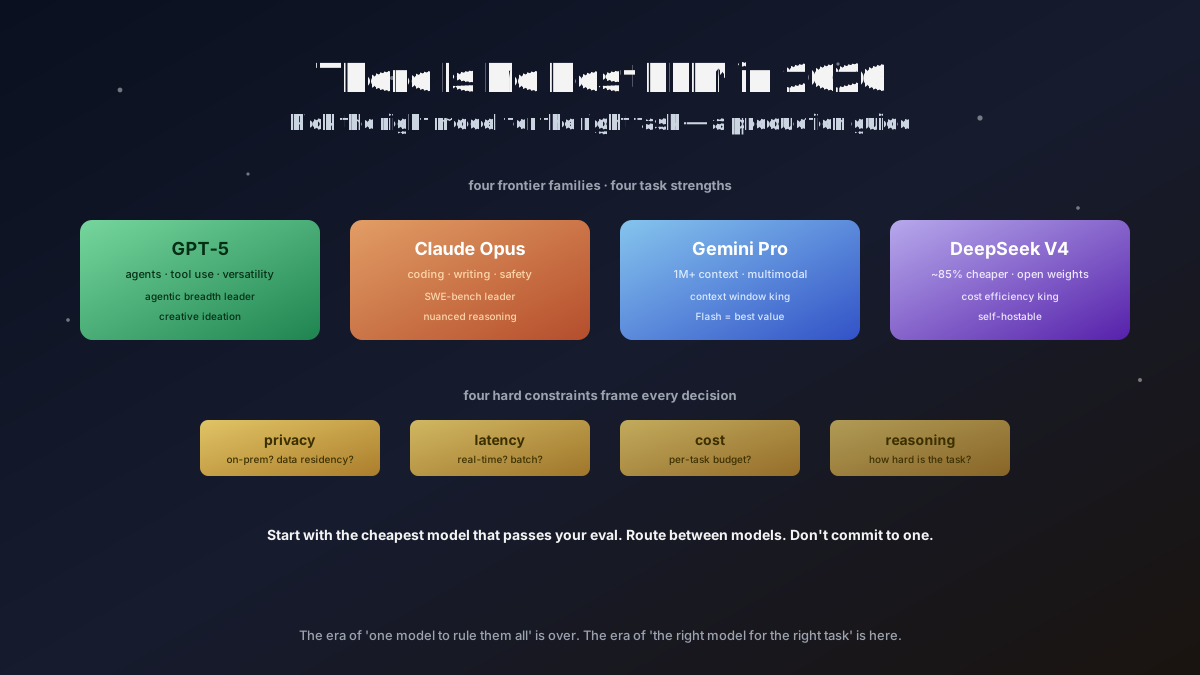
The question 'which LLM is best?' is the wrong question in 2026. There is no best model — there is the best model for your specific task, at your specific scale, under your specific constraints. Here is a source-checked guide to production LLM model selection: the four frontier families (GPT, Claude, Gemini, DeepSeek), which task each wins, the four hard constraints that frame every decision (privacy, latency, cost, reasoning depth), and why the dominant 2026 pattern is model routing — using multiple models in parallel, not picking one winner.
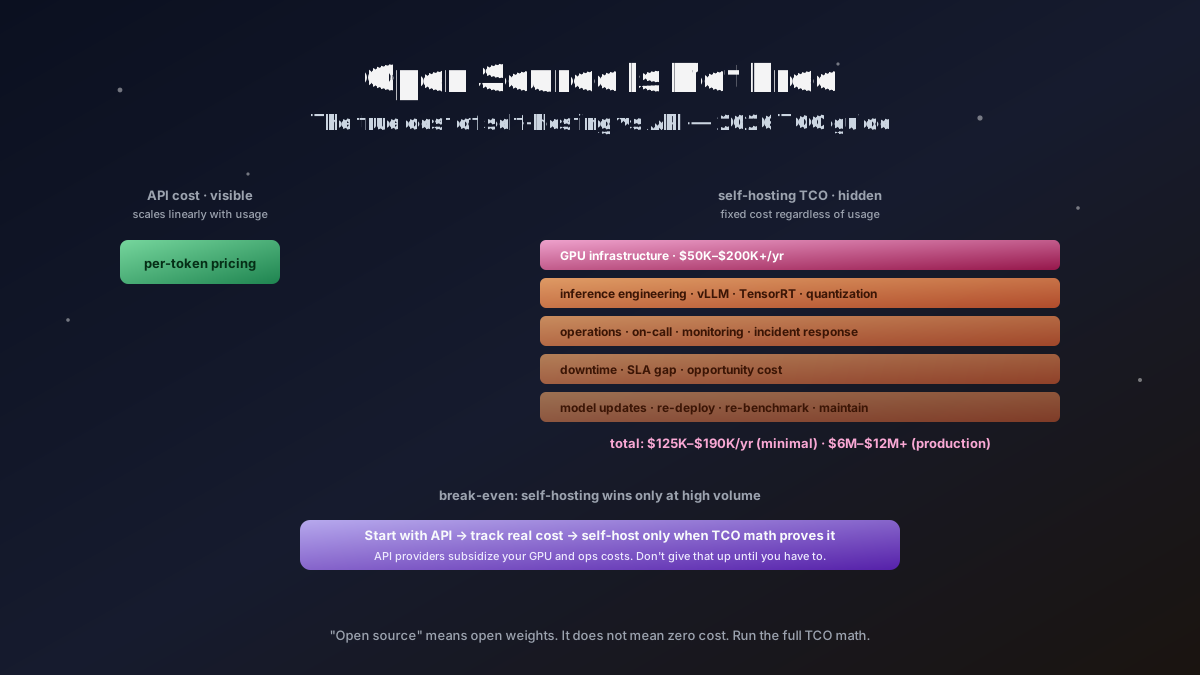
The pitch is seductive: self-host an open-source LLM and stop paying per-token API fees. The reality is that a minimal self-hosted deployment can cost $125K–$190K per year, and production-scale deployments can reach millions. Here is a source-checked 2026 guide to the true cost of ownership for open-source vs commercial LLMs: the hidden costs of self-hosting (GPU, ops, inference optimization, downtime), the break-even volume where self-hosting wins, and why most teams should start with API and move to self-hosting only when the math genuinely justifies it.