All posts
Read time 8 min

An uncalibrated LLM judge is decorative: a 2026 guide to making your judge actually agree with humans

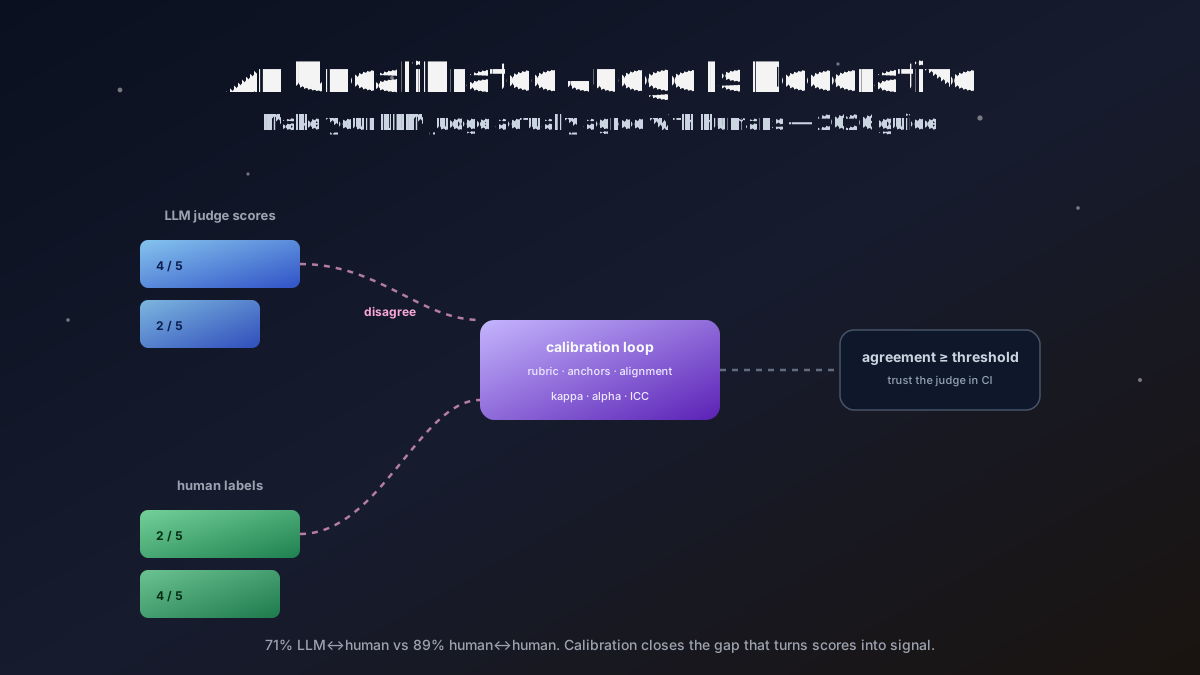
You set up an LLM-as-a-judge, it confidently returns scores, and your dashboards light up green. The only problem: those scores may not correlate with what your humans actually think. Practitioner reports put LLM-vs-human agreement around 71%, while human-vs-human sits near 89% — a gap that turns confident scores into decorative numbers unless you calibrate. Here is a source-checked guide to calibrating an LLM judge in 2026: the agreement metrics that matter, the alignment-loop workflow, and why a judge you have not validated against human labels is a metric you cannot trust.

LLM-as-judge calibration cover

This is the third piece in the LLM evaluation and quality cluster, completing a why → what → how loop. Pass@1 is not quality made the case for multi-dimensional evaluation and introduced LLM-as-a-judge. Your eval is only as good as your golden set built the labeled dataset a judge must be validated against. This piece closes the loop: how to take a judge and a golden set and calibrate the judge until it actually agrees with humans — the step that separates an evaluation you can trust from one that just looks like one.

My read, after going through the calibration literature, is blunt: an uncalibrated LLM judge is decorative. It produces numbers. The numbers fill dashboards. The dashboards feel like measurement. But unless you have measured the judge's agreement with human labels, you do not have an evaluation system — you have a confidence theater. The practitioner data is sobering: community reports put LLM-vs-human agreement around 71%, while inter-human agreement sits near 89%. That gap is the entire point of calibration. Closing it is what turns a judge from decoration into signal.

Why calibration is the step everyone skips

The failure pattern is consistent across teams. You read that LLM-as-a-judge is the 2026 default for open-ended evaluation. You pick a strong model, write a rubric, point it at some outputs, and it returns scores that look reasonable. You wire those scores into CI. Dashboards go green. Shipping resumes.

What you did not do is answer the one question that matters: does this judge agree with the humans whose judgment it is supposed to approximate? Without that answer, every score the judge produces is ungrounded. A score of "4 out of 5 for factual accuracy" from an uncalibrated judge is not a measurement of factual accuracy — it is a measurement of what that model tends to say when shown that prompt. Those are different things, and the gap between them is where production incidents hide.

Calibration is the discipline that closes that gap. It is the step that asks: when a human says this output is a 2, does the judge also say 2? When a human flags this output as a hallucination, does the judge catch it? If not, why not — and what do we change in the rubric, the model, or the prompt to make the judge agree?

The agreement metrics that actually matter

Calibration is quantified through agreement metrics. The ones worth knowing:

  • Pearson / Spearman correlation. How linearly (Pearson) or monotonically (Spearman) the judge's scores track human scores across the golden set. A high correlation means the judge ranks outputs the way humans would, even if its absolute scores are shifted.
  • Cohen's kappa. Agreement between the judge and a human annotator, corrected for the agreement you would expect by chance. This is the workhorse metric for categorical labels (e.g., "safe / unsafe").
  • Krippendorff's alpha. A generalization of kappa that handles multiple annotators, missing data, and different label types. This is the right metric when you have more than two humans labeling each example (which you should).
  • ICC (intraclass correlation). Useful for continuous scores on a scale; the arXiv paper on human-LLM alignment uses ICC to compare grading scales.

The metric you pick matters less than the discipline of picking one and tracking it. A team that measures judge-vs-human agreement with a single metric, sets a threshold, and refuses to ship below it is ahead of a team with five metrics it never acts on.

One practitioner data point worth carrying: reports of inter-human agreement around 89% and LLM-vs-human agreement around 71%. That tells you two things. First, even humans disagree 11% of the time, so 100% judge-vs-human agreement is not a realistic target. Second, a judge at 71% is missing roughly a fifth of the human signal — usable, but only if you know that is what you are getting. Calibration is how you find out what you are actually getting.

The alignment-loop workflow

Calibration is not a one-time check; it is a loop. Drawing on the LangChain alignment-loop work and the Galileo step-by-step guide, here is the protocol:

  1. Start with your golden set. This is the human-labeled dataset from the previous piece. If you do not have one, go build one first; calibrating against nothing is not calibration.
  2. Run the judge on the golden set. Take your current judge (model + rubric + prompt) and score every example the humans already labeled. You now have two scores per example: human and judge.
  3. Measure agreement. Compute your chosen metric(s) across the set. If agreement is above your threshold, the judge is calibrated enough to use in CI. If it is below, proceed to step 4.
  4. Find the disagreements and fix them. Look at the examples where judge and human diverge. Two root causes: (a) the rubric is ambiguous and the judge interpreted it differently — fix the rubric; (b) the judge has a bias (verbosity, position, self-preference — see the pass@1 piece) — mitigate the bias explicitly.
  5. Use anchor examples. Galileo's guidance highlights anchor examples — representative cases with known-good human scores that you include in every calibration run to detect drift. If the judge starts disagreeing with its anchors over time, the judge has drifted and needs recalibration.
  6. Re-run and track over time. Re-run the loop when you change the judge model, the rubric, or the prompt — and on a cadence otherwise, because production traffic drifts and judges can drift with it.

The output of this loop is not a one-time "the judge works" stamp. It is an ongoing measurement: judge-vs-human agreement, tracked over time, with a threshold below which you do not trust the judge and a process for getting back above it.

The sharp edges that are not in the marketing copy

A few risks worth knowing before you standardize on a calibrated judge:

  • A judge calibrated on one task type does not transfer. A judge that agrees with humans on summarization may disagree with them on code review. Calibrate per task type, and do not assume transfer.
  • Calibration decays. A judge calibrated today will drift as production traffic changes, as you add new failure modes to the golden set, and as the underlying model gets updated. Build a refresh cadence into the process, or your calibration is a snapshot that ages into a lie.
  • Your human labels are themselves noisy. Calibration measures judge-vs-human agreement, but if the human labels are inconsistent (low inter-annotator agreement), you are calibrating against noise. Measure human-vs-human agreement first; if it is low, fix the annotation guidelines before blaming the judge.
  • A judge that agrees with humans on average can still be wrong on the cases that matter. Aggregate agreement hides distributional failures — the judge may agree on easy cases and disagree systematically on the edge cases that cause incidents. Slice the agreement by category and difficulty, not just in aggregate.
  • Self-preference is sticky. A judge tends to prefer outputs from its own model family, and this bias survives naive calibration. Use a different model family as judge, or validate specifically for self-preference and mitigate it.
  • Fine-tuning is a bigger commitment than prompting. You can fine-tune a judge to improve agreement, but a fine-tuned judge is harder to maintain, harder to reason about, and harder to update than a prompted one. Exhaust prompt and rubric iteration first.

How this closes the evaluation loop

This piece completes the LLM evaluation cluster and connects it to the rest of the production stack:

My take

The 2026 story is that LLM-as-a-judge is easy to set up and easy to trust for the wrong reasons. The dashboards look like measurement; the scores feel like signal. They become signal only when you have measured the judge against human labels and confirmed the two agree. Calibration is unglamorous, incremental work — write the rubric, run the loop, find the disagreement, fix it, repeat — but it is the work that separates a team whose evaluation predicts production from a team whose evaluation predicts nothing.

If you take one thing from this cluster: an evaluation system is a chain, and every link must be validated. A great golden set validates the judge. A calibrated judge validates the model. A validated model, paired with honest cost observability, validates your routing decisions. Skip a link and the whole chain is decorative.

This is the third and final piece in the LLM evaluation and quality cluster. Start with Pass@1 is not quality for the foundational case, then Your eval is only as good as your golden set for the dataset, then this piece for calibration. For the cost dimensions your calibrated judge unlocks, see the LLM pricing cluster. For the coding-agent application, see the AI coding workflow cluster. For a maintained provider reference, see our AI pricing data page.

Sources

Related