All posts
Read time 9 min

Pass@1 is not quality: a 2026 guide to evaluating LLM output beyond a single score

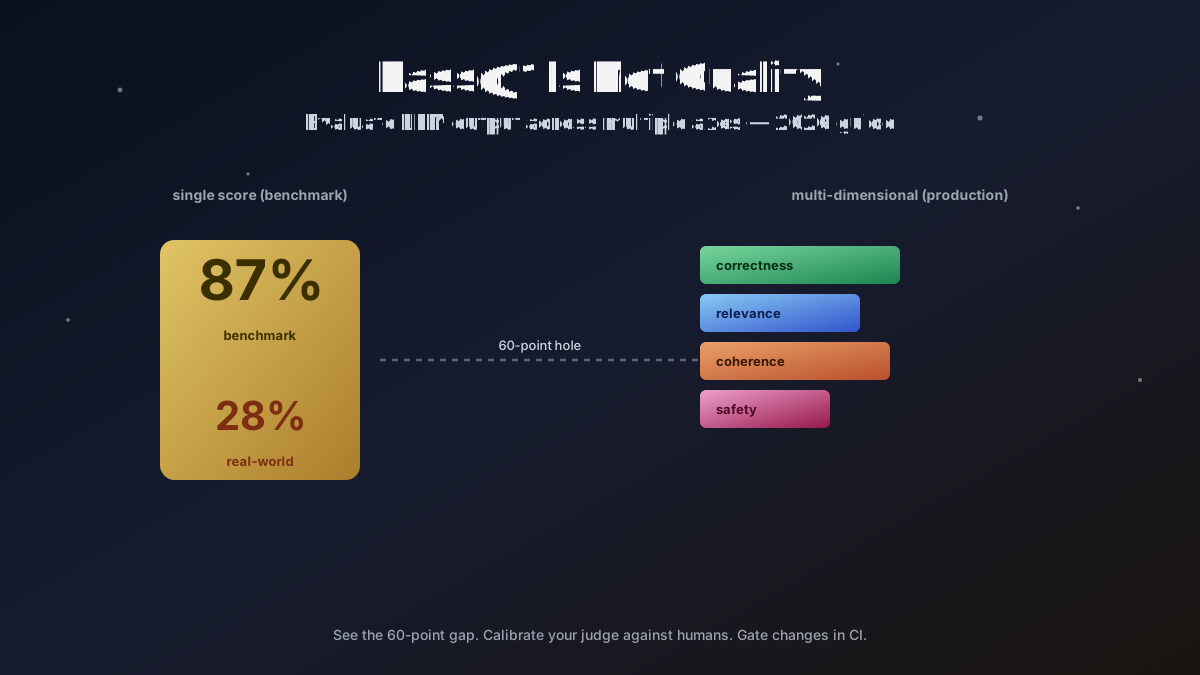
Your LLM hits 85% on the benchmark and ships answers that fail in production. That gap is not a mystery; it is the cost of measuring LLM quality with a single scalar. Research shows models can score 84–89% on synthetic benchmarks but only 25–34% on real-world tasks — a 60-point hole that pass@1-style metrics systematically hide. Here is a source-checked guide to production LLM output evaluation in 2026: the multi-dimensional metrics that matter, how LLM-as-a-judge actually works (and where it fails), the Ragas / DeepEval / Promptfoo landscape, and the eval stack that catches what benchmarks miss.

LLM output quality evaluation beyond pass@1 cover

This piece opens a third topic cluster — LLM evaluation and quality — alongside our LLM pricing cluster and our AI coding workflow cluster. It also closes a conceptual loop across the site: the pricing cluster is about what each task costs, the coding cluster is about how to choose and ship tools safely, and this cluster is about whether the output those tools produce is actually good enough to ship at all.

My read, after going through the evaluation literature, is blunt: most teams measure LLM quality with the wrong instrument. They track a single benchmark score, or a single "did the test pass," and treat that as if it captures quality. It does not. Quality is multi-dimensional — correctness, relevance, coherence, safety, factuality — and a single scalar cannot represent five independent axes. The teams that ship reliable LLM features in 2026 are not the ones with the highest benchmark number. They are the ones whose evaluation can see the 60-point hole between benchmark and reality.

The benchmark-reality gap is real and large

Start with the single most important data point in the 2026 evaluation literature. A study of LLM performance on real-world class-level code generation (arXiv 2510.26130) found models scored 84–89% on established synthetic benchmarks but only 25–34% on real-world tasks. That is roughly a 60-point gap. The benchmark said "this model is excellent"; reality said "this model fails two-thirds of the time on our actual work."

This is not a one-off. It reflects a structural problem: benchmarks are synthetic, clean, and self-contained; production tasks are messy, contextual, and entangled with your specific codebase, data, and users. A metric that measures performance on the former tells you very little about performance on the latter. And yet most teams still treat the benchmark score as if it were the quality signal.

The honest version: pass@1 (or any single benchmark score) is necessary but not sufficient. It tells you the model is capable in principle. It does not tell you the model will produce good outputs on your tasks, for your users, under your real conditions. That gap is exactly what production evaluation must close.

Why a single score cannot represent quality

Practitioners increasingly frame LLM output quality along at least four independent axes:

  1. Correctness. Is the answer factually and logically right?
  2. Relevance. Does it actually address what was asked, or does it drift?
  3. Coherence. Is it well-structured, readable, internally consistent?
  4. Safety. Is it free of toxicity, leakage of sensitive data, and instruction-following failures?

A single score collapses these four axes into one number, which means two outputs with identical scores can be wildly different in quality. Output A can be correct but incoherent; Output B can be fluent but wrong. A scalar metric treats them as equal. They are not.

This is why the 2026 consensus has moved toward multi-dimensional rubric scoring: evaluate the same output against multiple criteria, each scored independently, so you can see where the model is failing instead of just that it failed. The RACE benchmark proposal (OpenReview, "Beyond Correctness") applies this idea to code generation, scoring four-plus quality axes simultaneously rather than binary pass/fail — and the principle generalizes to any LLM output.

LLM-as-a-judge: the new default, with sharp edges

For open-ended outputs (where there is no unit test to run), the 2026 default evaluation method is LLM-as-a-judge: use a strong LLM to score another model's output against a rubric. Techniques like G-Eval (chain-of-thought rubric scoring) have largely displaced older lexical metrics like BLEU and ROUGE for quality assessment, because BLEU/ROUGE measure surface similarity, not semantic quality.

How it works, in outline: you define a rubric (e.g., "score 1–5 on factual accuracy, with these criteria..."), give the judge LLM the input, the output, and the rubric, and ask it to score with chain-of-thought reasoning. The judge returns a score and an explanation. Done at scale across a golden set of test cases, this gives you a multi-dimensional quality signal that no single benchmark can.

But LLM-as-a-judge has documented failure modes you must know before relying on it:

  • Position bias. In pairwise comparisons, judges prefer the first or second option based on order, not quality. Mitigation: randomize order and average.
  • Verbosity bias. Judges prefer longer answers, even when a shorter one is better. Mitigation: penalize length explicitly in the rubric.
  • Self-preference. Judges tend to prefer outputs from their own family of models. Mitigation: use a different model family as judge, or validate against human baselines.
  • Confident-but-wrong. A judge can produce a fluent, confident-sounding score that is itself wrong. Mitigation: calibrate the judge against human-labeled examples and track agreement.

The non-negotiable discipline: validate your judge against human baselines before trusting it. Collect a small set of human-scored examples, run your judge on the same set, and measure agreement. If agreement is low, your judge is the problem, not the model you are evaluating. Hamel Husain's practitioner write-up is the canonical reference for evaluating the LLM judge itself — a step most teams skip and should not.

The 2026 evaluation tool landscape

The tooling splits along scope lines. The three frameworks worth knowing, with honest sweet spots:

FrameworkSweet spotStrengthsLimitations
RagasRAG pipelinesResearch-backed retrieval + generation scoring (faithfulness, answer relevance, context precision/recall)Narrow — essentially RAG-only; minimal coverage for agents, chatbots, or adversarial testing
DeepEvalBroad metric coverage, test-driven LLMOps14+ metrics (G-Eval, hallucination, faithfulness, toxicity), pytest-style integration, CI/CD hooks, covers RAG + agents + chatbots + safetyHeavier setup; metric quality depends on the judge LLM; can be overkill for small prompt loops
PromptfooCLI-first iteration + red-teamingFastest prompt-comparison loop, YAML/JSON config, strong automated red-teaming (prompt injection, jailbreaks)Less depth on RAG-specific retrieval metrics; not a full metric library

Sources for these characterizations: the DeepEval alternatives comparison (Braintrust, 2026), the DeepEval vs Ragas breakdown, and practitioner comparisons on aiml.qa.

The honest caveat (repeated from our other pieces): most "best LLM eval framework 2026" listicles are vendor-affiliated. The scope claims above are verifiable on each framework's own docs; the ranking orders in listicles should be read as marketing until you have run them on your own data.

The key insight the listicles underplay: these tools are complementary, not substitutable. A common 2026 production pattern is Ragas (for the RAG slice) + Promptfoo (for adversarial/red-team testing) + DeepEval or a platform (Opik, Langfuse, Braintrust) for end-to-end CI/CD scoring and observability. Picking "the one eval framework" is usually the wrong question; the right question is which combination covers your surface area.

The sharp edges that are not in the launch copy

A few risks worth knowing before you standardize on an eval stack:

  • Your golden set is the whole game. Every automated metric, judge, and framework is only as good as the labeled examples you validate against. Teams obsess over framework choice and underinvest in the golden set; the golden set is what actually determines whether your eval predicts reality.
  • Trajectories beat outputs for agents. If you are evaluating an agent (not a single completion), scoring only the final answer misses most of the failure surface. LangChain's 2026 framework argues you must score every tool call, reasoning step, and conversation turn — not just the final output. This connects directly to our AI coding agent evaluation guide.
  • Static eval sets rot. Your production traffic drifts; your eval set must drift with it, or it will stop predicting reality. Refresh the golden set from real production examples on a cadence.
  • Cost and quality are coupled. A cheaper model that scores lower on your eval may still be the right choice if the quality gap is acceptable for the price — but only if you are measuring quality rigorously in the first place. This is why eval connects directly to per-task cost observability: without both, you are guessing on both.
  • Human review is still the gold standard. Automated judges are scalable but imperfect; human review is accurate but does not scale. The production pattern is humans on a sample (especially edge cases), automated judges at scale, and a calibration loop between them.

How to actually build this in 2026

The practical path I would give a team:

  1. Define quality multi-dimensionally for your task. Name the 3–5 axes that matter for your specific output (correctness, relevance, safety, tone, ...). Do not collapse them into one score.
  2. Build a golden set of human-labeled examples. Start small (50–200 examples). This is the asset everything else depends on.
  3. Choose a judge and calibrate it. Pick a strong LLM as judge, run it on your golden set, measure agreement with human labels. Iterate on the rubric until agreement is acceptable.
  4. Run the eval in CI, not just offline. Quality regressions caught in review are expensive; caught in CI are cheap. Gate prompt and model changes on eval scores, the same way you gate on tests.
  5. Add adversarial coverage. Use Promptfoo-style red-teaming for prompt injection, jailbreaks, and toxicity. Production users will probe these surfaces; your eval should too.
  6. Refresh the golden set from production. Sample real traffic, label edge cases, add them to the set. An eval set that does not evolve stops predicting reality.
  7. Pair eval with cost observability. Quality without cost context is half a decision. Quality + per-task cost tells you which model to route which task to.

My take

The 2026 story is not that LLMs are unreliable. It is that they are reliable only at the resolution of your evaluation. A team measuring quality with a single benchmark score is flying blind on a 60-point gap it cannot see. A team measuring quality with a calibrated, multi-dimensional, golden-set-backed eval stack can see exactly where the model fails, fix it, and prove the fix worked — before users do.

If you build one piece of LLM infrastructure in 2026 beyond routing and observability, make it a real evaluation stack. It is the prerequisite for everything else: without it, model choice is a guess, routing is a guess, and "is this good enough to ship" is a guess. With it, all three become decisions.

This is the first piece in the LLM evaluation and quality cluster. For the second piece — how to build the golden set of labeled examples that every metric and judge in this article depends on — see Your eval is only as good as your golden set: a 2026 guide to building the dataset that decides everything. For the cost dimensions that decide which model your eval should approve, see the LLM pricing cluster: the price war analysis, the routing and fallback guide, and the per-task cost observability guide. For how to evaluate AI coding agents specifically — where trajectory-level evaluation matters most — see the AI coding agent evaluation guide and the code review discipline guide. For a maintained provider reference, see our AI pricing data page.

Sources

Related