Your eval is only as good as your golden set: a 2026 guide to building the dataset that decides everything
Every LLM evaluation framework, judge, and metric you use is only as reliable as the labeled examples you validate against — and most teams invest heavily in tooling while underinvesting in the one asset that actually determines whether their eval predicts reality. Here is a source-checked guide to building an LLM evaluation golden set in 2026: what belongs in it, the three sources that produce a representative set, the annotation discipline that makes labels trustworthy, and the maintenance habits that stop a golden set from rotting into uselessness.
This is the second piece in the LLM evaluation and quality cluster, following Pass@1 is not quality: evaluating LLM output beyond a single score. That piece argued the what — multi-dimensional evaluation, LLM-as-a-judge, the tool landscape. This piece is about the prerequisite that makes any of that work: the golden set of labeled examples you validate everything against. If the first piece said "your scalar metric is lying to you," this one says "the dataset behind your real metric is where you win or lose."
My read, after going through the practitioner literature, is blunt: the golden set is the whole game, and most teams treat it as an afterthought. They spend weeks choosing between DeepEval and Promptfoo and Ragas, then label fifty examples in an afternoon and wonder why their eval does not predict production. The framework is the instrument; the golden set is the signal. A great framework on a bad golden set produces confidently wrong numbers. A mediocre framework on a great golden set still catches the regressions that matter. Invest accordingly.
What a golden set actually is
A golden set is a curated, versioned collection of inputs, contexts, expected outputs (or rubrics), and metadata that serves as ground truth for evaluating your LLM system. The key words there are curated, versioned, and ground truth.
- Curated. It is not a random dump of production traffic. It is deliberately constructed to cover the cases that matter — the common path, the edge cases, the failure modes you have seen before and want to catch again.
- Versioned. It changes over time, and every change is tracked. A golden set that silently drifts is one that breaks reproducibility: you cannot tell whether a score changed because the model changed or because the set changed.
- Ground truth. Each example has an expected output or, for open-ended tasks, a rubric a human (and later a judge) can score against. Without this, you have a dataset; you do not have an evaluation.
DeepEval's docs frame this cleanly: the "goldens" in your dataset are converted to test cases at evaluation time. The golden set is the precursor to every test that runs. If the goldens are wrong, every test built on them is wrong.
The three sources that produce a representative set
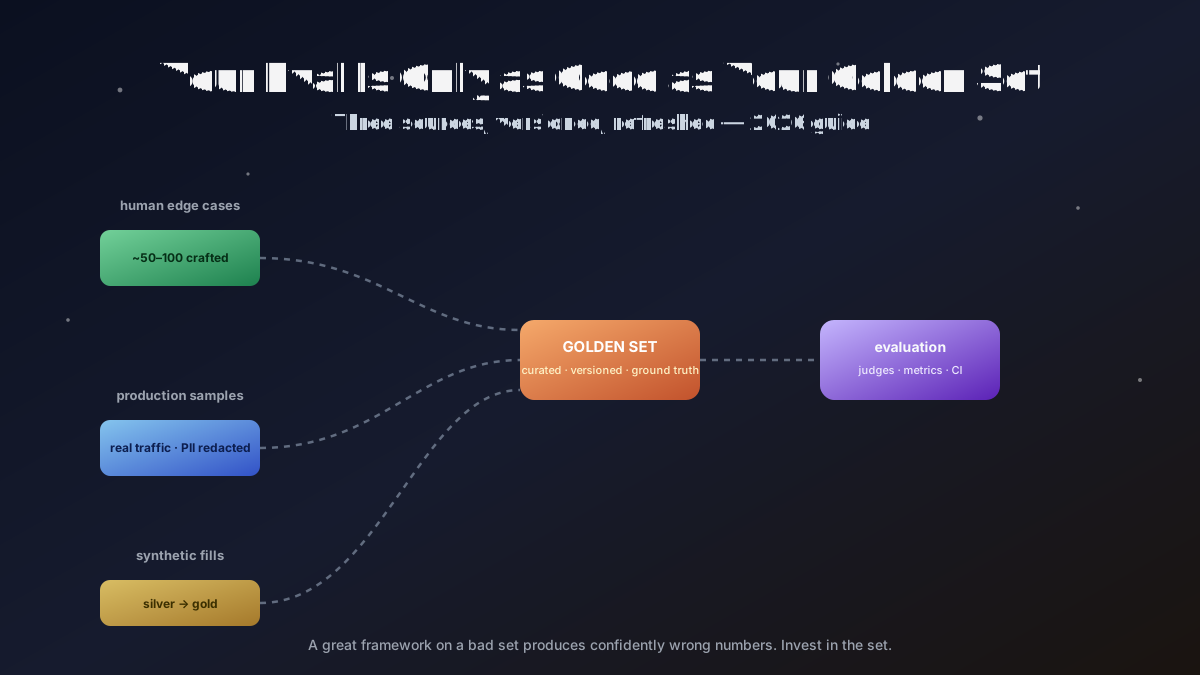
The strongest practitioner guidance — summarized well in the Galtea 2026 evaluation guide — is that an effective golden set combines three sources, not one:
- Human-crafted examples covering known edge cases. These are the inputs you know are hard: the ambiguous query, the adversarial prompt, the out-of-distribution input, the case that broke production last quarter. You write them deliberately, because production traffic alone will under-represent them.
- Real production samples, with PII redacted. These anchor the set in reality. Sample from actual user traffic so the distribution of inputs matches what your system sees in production, not what you imagine it sees. Redact personally identifiable information before storing anything.
- Synthetic examples filling coverage gaps. Where you have blind spots — a class of input you have not seen much but expect to grow — generate synthetic examples to fill the gap. Treat these as "silver" until a human reviews and promotes them to "gold."
The mistake teams make is relying on only one source. A set built only from human-crafted examples misses real distribution. A set built only from production traffic misses the rare edge cases that cause incidents. A set built only from synthetic data misses both. The representative set is a blend.
How to actually build it, step by step
Drawing on the Maxim AI step-by-step guide and related practitioner sources, here is the protocol I would run:
Step 1 — Define scope, goals, and metrics first. Before labeling a single example, decide what you are evaluating (which feature, which task type), what "good" means (your quality axes from the pass@1 piece), and which metrics you will run. A golden set built without a defined scope becomes a junk drawer.
Step 2 — Source from the three channels above. Pull a few hundred examples: ~50–100 human-crafted edge cases, a stratified sample of real production traffic, and synthetic fill for known blind spots. The Weights & Biases wandbot case study is a useful reference point — they sampled a few hundred gold-standard queries from 800+ real user questions. That scale (hundreds, not thousands) is where most teams should start.
Step 3 — Write annotation guidelines before labeling. This is the step most teams skip and should not. Write down, in writing, what each label means, how to handle ambiguous cases, and what a "3 out of 5" looks like versus a "5 out of 5." The dev.to guide on building evaluation datasets has a good treatment of rubric design. Without written guidelines, every annotator applies their own implicit rubric and your labels are noise.
Step 4 — Label, then measure annotator agreement. Have at least two people label a subset, and measure inter-annotator agreement. If two humans disagree on the right label, your judge will too — and the disagreement is a signal that your rubric needs sharpening, not that your annotators are bad.
Step 5 — Convert goldens to test cases and run your eval. This is where the framework (DeepEval, Promptfoo, your own) consumes the set. Run your current model and any candidate models against the set, score them, and look at where they disagree with ground truth — not just the aggregate score.
Step 6 — Iterate on the set itself. The golden set is not done when you ship it. Every production incident, every user-reported bad output, every new failure mode becomes a candidate example. Add it, label it, version the set. A golden set that does not grow stops predicting reality.
The sharp edges that are not in the marketing copy
A few risks worth knowing before you invest in a golden set:
- A golden set rots if you do not refresh it. Production traffic drifts; user behavior shifts; new failure modes emerge. A set frozen at launch will, within months, stop representing what your system actually faces. Build a refresh cadence into the process — monthly or quarterly, depending on traffic volume.
- Label noise is real and accumulates. Even with written guidelines and agreement checks, some labels will be wrong. Periodically re-review a sample of old labels; the labels that were "obvious" six months ago are sometimes the ones quietly misleading your eval today.
- Edge cases are over-represented by design — remember that when reading scores. Your golden set has more hard cases than production does, by construction. A 70% score on a golden set with heavy edge-case coverage may correspond to a 95% success rate in production. Do not compare golden-set scores to production success rates as if they were the same metric.
- PII and confidentiality. Real production samples often contain sensitive data. Redact before storing, and apply the same data-handling discipline your production system follows. A golden set that leaks PII is a liability, not an asset.
- Synthetic data can bake in your blind spots. If you generate synthetic examples from a model, the model's assumptions become your dataset's assumptions. Treat synthetic examples as provisional until a human reviews them.
- A golden set without a calibration loop is half-built. Once you have a set, you can calibrate an LLM-as-judge against it — which is the bridge to scaling evaluation beyond what humans can review by hand. That calibration piece (a natural third post in this cluster) is what turns a golden set from a static benchmark into a live evaluation system.
How this connects to the rest of the stack
The golden set is not an isolated artifact. It is the foundation that makes the rest of your evaluation and production discipline work:
- It validates your LLM-as-a-judge: without a human-labeled set to calibrate against, you cannot tell whether your judge is reliable.
- It gates routing and fallback decisions: when you ask "is model A better than model B for this task," the golden set is what gives you a defensible answer instead of a vibe.
- It pairs with per-task cost observability: quality (from the golden set) + cost (from observability) is the full decision matrix for which model to route which task to.
- It sharpens AI coding agent evaluation: the same principles — representative coverage, written rubrics, agreement checks, refresh — apply to the codebase-eval set you build there.
My take
The 2026 story is that evaluation quality is bottlenecked on data quality, not on tooling. The teams whose eval actually predicts production are the ones who invested in a curated, versioned, multi-source golden set with written annotation guidelines and a refresh cadence — not the ones who picked the "best" framework. Frameworks are replaceable; a great golden set compounds in value over time, because every incident that becomes a labeled example makes every future evaluation more honest.
If you build one evaluation asset in 2026, build the golden set. It is the prerequisite for every metric, every judge, and every model-selection decision that follows. Everything else is downstream of it.
This is the second piece in the LLM evaluation and quality cluster. For the foundational case for multi-dimensional evaluation beyond a single score, see Pass@1 is not quality. For the third piece — how to take a golden set and calibrate your LLM judge until it actually agrees with humans — see An uncalibrated LLM judge is decorative. For the cost and routing decisions your golden-set-backed eval unlocks, see the LLM pricing cluster: the price war analysis, the routing and fallback guide, and the per-task cost observability guide. For the coding-agent-specific application of these principles, see the AI coding agent evaluation guide. For a maintained provider reference, see our AI pricing data page.
Sources
- Maxim AI: Building a "Golden Dataset" for AI evaluation — a step-by-step guide
- Galtea: The complete guide for LLM evaluations in 2026
- Arize: Pre-production LLM evaluation (golden datasets as ground truth)
- Arize: Golden dataset — role in custom LLM evals
- DeepEval: Evaluation datasets (goldens → test cases)
- dev.to: 7 ways to create high-quality evaluation datasets for LLMs
- Twine: Building a golden dataset for model evaluation
- Weights & Biases: Building an evaluation dataset for our LLM system (wandbot case study)
- Relari AI: How important is a golden dataset for LLM evaluation
- Caylent: A comprehensive guide to LLM evaluations
- Confident AI: The ultimate LLM evaluation playbook
- arXiv 2406.15527: Data-efficient evaluation of LLMs (sampling techniques)
- Kili Technology: How to build LLM evaluation datasets for domain-specific use cases
- Our cluster: Pass@1 is not quality — evaluating LLM output beyond a single score
- Our pricing cluster: API routing and fallback guide
- Our pricing cluster: per-task cost observability guide
- Our coding cluster: AI coding agent evaluation guide
Related
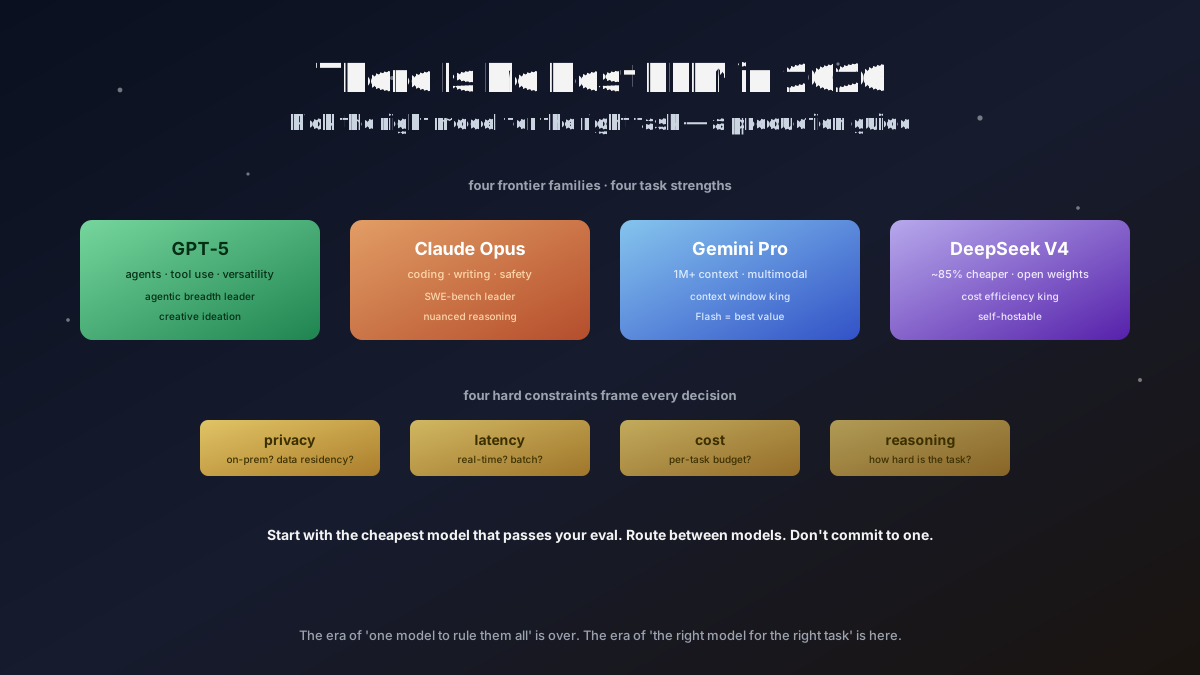
The question 'which LLM is best?' is the wrong question in 2026. There is no best model — there is the best model for your specific task, at your specific scale, under your specific constraints. Here is a source-checked guide to production LLM model selection: the four frontier families (GPT, Claude, Gemini, DeepSeek), which task each wins, the four hard constraints that frame every decision (privacy, latency, cost, reasoning depth), and why the dominant 2026 pattern is model routing — using multiple models in parallel, not picking one winner.
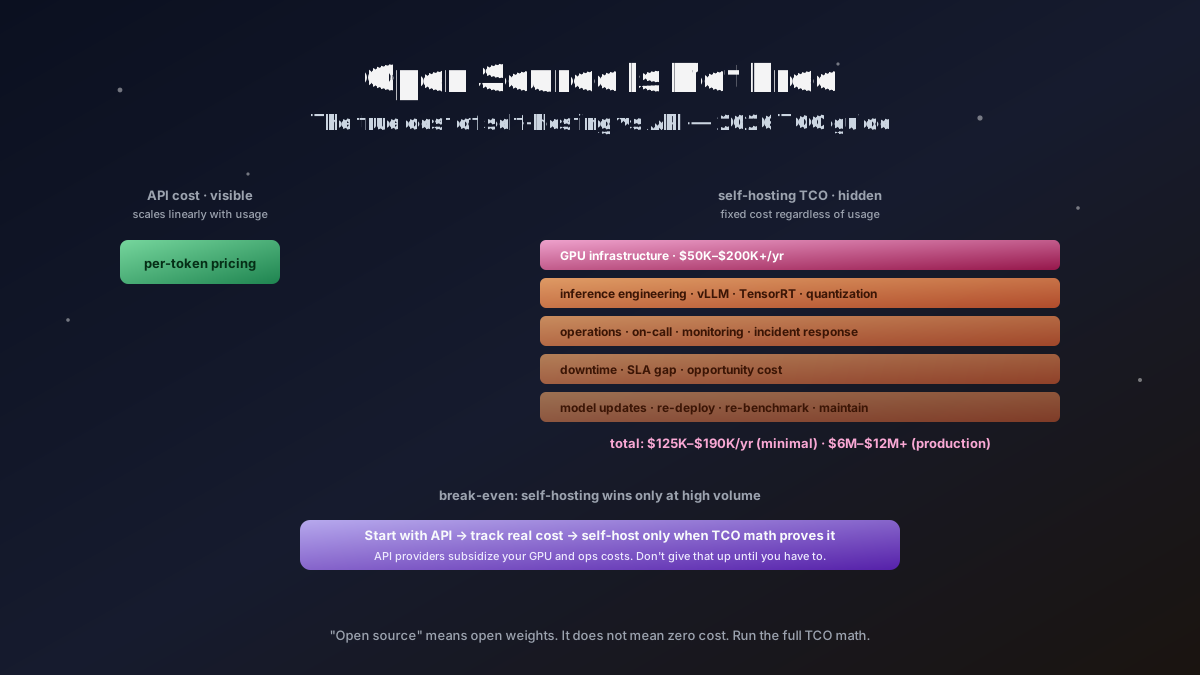
The pitch is seductive: self-host an open-source LLM and stop paying per-token API fees. The reality is that a minimal self-hosted deployment can cost $125K–$190K per year, and production-scale deployments can reach millions. Here is a source-checked 2026 guide to the true cost of ownership for open-source vs commercial LLMs: the hidden costs of self-hosting (GPU, ops, inference optimization, downtime), the break-even volume where self-hosting wins, and why most teams should start with API and move to self-hosting only when the math genuinely justifies it.